

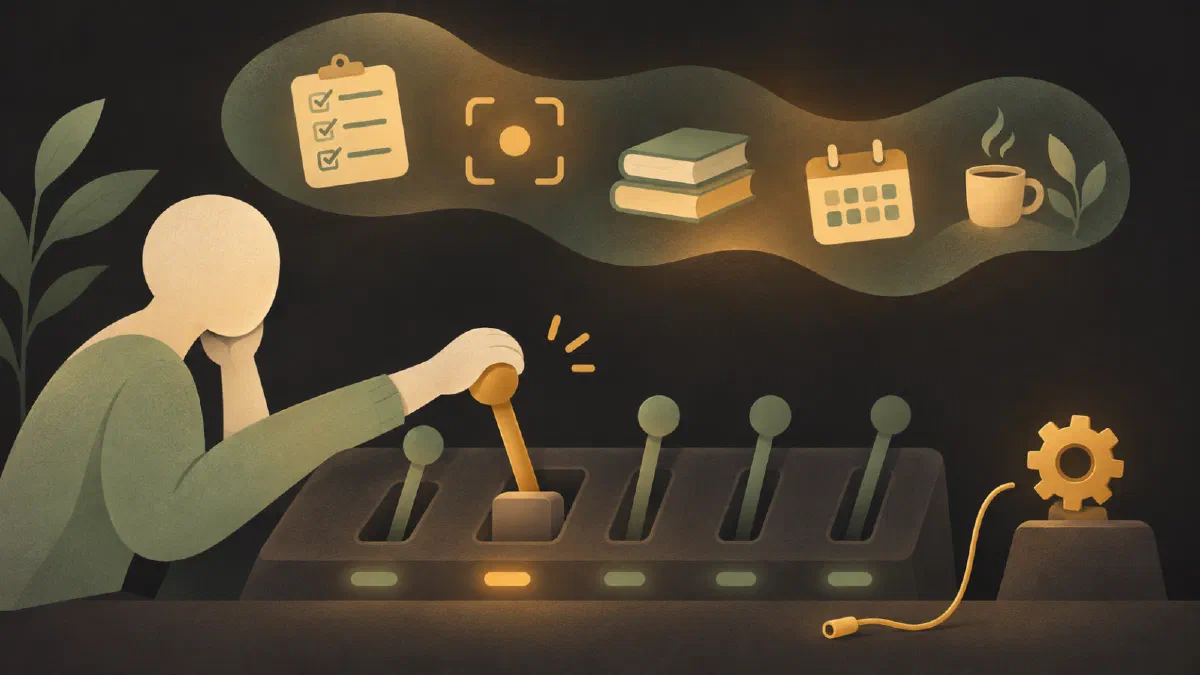
You finish a meeting, and for the next hour your mind replays one sentence you said. Or it is 11 pm and your brain is drafting tomorrow’s difficult email for the tenth time. If you have ADHD, this kind of looping thought can feel constant. This guide explains what is going on, what research does and does not say, and how to step out of a loop during a normal working day.
Is overthinking a symptom of ADHD?
Not officially. “Overthinking” is an everyday word, not a diagnostic criterion, and you will not find it in the ADHD symptom lists. But two well-studied features of adult ADHD help explain why so many people with ADHD describe it.
A mind that wanders on its own. A review in Neuroscience and Biobehavioral Reviews proposed that excessive spontaneous mind wandering contributes to ADHD symptoms, and noted that in one study spontaneous (unplanned) mind wandering, but not deliberate mind wandering, was linked to ADHD symptom severity. The authors stress that their brain-network explanation is still a hypothesis that has not been formally tested. A validation study of a mind-wandering questionnaire found that adults with ADHD reported higher levels of excessive mind wandering than controls, and that it added to everyday impairment beyond the core ADHD symptoms. A literature review of nine studies reached a similar conclusion: spontaneous mind wandering is common in ADHD and linked to greater impairment, though research is still limited.
Strong, fast emotions. A meta-analysis of 13 studies with 2,535 participants found that adults with ADHD showed markedly higher emotion dysregulation than controls, with emotional lability (quick, intense mood shifts) showing the largest difference. A review in the American Journal of Psychiatry summarised clinic-based studies that found emotion dysregulation in roughly 30 to 70% of adults with ADHD, and noted that population-based studies are still needed. For the wider picture, see our guide to ADHD and emotional dysregulation.
Put together, a mind that drifts easily plus emotions that hit harder is a plausible recipe for getting stuck on negative thoughts. To be clear, though, these studies measured mind wandering and emotional regulation, not overthinking itself. Rumination in ADHD specifically has been studied far less. Anxiety also often travels with ADHD: the NHS notes that people with ADHD may often have other conditions too, such as depression or anxiety. If anxiety is the bigger theme for you, read ADHD and anxiety.
Rumination, worry and intrusive thoughts: what is the difference?
These three words get used interchangeably, but they describe different loops, and each responds to slightly different tools.
| Type | What it sounds like | Time focus | A first step to try |
|---|---|---|---|
| Rumination | “Why did I say that? Why am I always like this?” | The past | Switch from “why” to “how”, then act |
| Worry | “What if the client hates it? What if I miss the deadline?” | The future | One concrete step, or park it in a worry window |
| Intrusive thought | An unwanted image or thought that pops in, often out of character | Any | Recognise it as an unwanted thought; seek help if it keeps returning and affects daily life |
A major review of rumination research describes how rumination worsens depression, increases negative thinking and impairs problem solving, and links it to anxiety as well as depression. The same authors distinguish rumination from healthy self-reflection, which looks at a problem in order to learn from it.
Worry is part of normal life. It becomes a concern when it no longer matches the situation and is hard to control: NIMH describes generalized anxiety disorder as trouble controlling worry on most days for at least six months, alongside symptoms such as restlessness, poor concentration or sleep problems.
Intrusive thoughts are different again. The NHS describes an obsession as an unwanted and unpleasant thought, image or urge that repeatedly enters your mind. If such thoughts keep coming back and affect your daily life, the NHS advises speaking to your GP rather than managing alone.
One more distinction: getting stuck replaying the same thought is not quite the same as getting stuck on the same activity. If you struggle to stop doing one thing and switch to the next, see ADHD perseveration.
Why “why” questions keep the loop going
A useful finding from research on repetitive thought: it is not only what you think about, but how you think about it. A review in Psychological Bulletin concluded that repetitive thinking can be helpful or harmful, and that the level of abstraction is one of the key differences. Abstract, evaluative thinking (“Why did this happen? What does it say about me?”) was linked with unhelpful outcomes, while concrete thinking about how something happened and how to proceed was linked with better problem solving. The review adds that the unhelpful effects of abstract thinking showed up mainly in people who were already low or anxious.
In practice, “why” questions have no finish line. “Why am I so bad at emails?” can be answered a hundred ways, none of which produce an email. “How do I write the first two lines?” has an answer you can act on in five minutes.

Practical loop-breakers
These steps work best in order, but any single one can help. None of them is a treatment; they are everyday strategies.
- Name the loop. Say or write: “I’m ruminating about the meeting” or “I’m worrying about Friday.” Labelling the type tells you which tool to reach for (see the table above).
- Ask a “how” question instead of a “why” question. Turn “Why did I mess up the report?” into “How do I fix section 2?” This applies the abstract-versus-concrete finding directly.
- Find one next action under ten minutes. Draft one line, open the file, write one question to ask your manager. If you freeze at this point, our guide to ADHD and decision making covers getting unstuck between options.
- Do it inside a short, defined block. A timed session of 10 to 25 minutes gives your attention one concrete place to land. A common strategy is to keep a notepad next to you and jot down any loop thought that returns, then go back to the task.
- Park the rest in a worry window. In a small randomised study of 53 adults who worried a lot, limiting worry to a daily 30-minute period at a set time and place reduced worry, anxiety and insomnia more than the comparison condition after two weeks. The authors call the results preliminary, but the idea is easy to try: when a worry shows up, write it down and tell yourself “4:30 pm.”
- Switch to something absorbing. The rumination review notes that, in experiments, positive distraction relieves depressed mood, even though correlational studies of everyday life are less consistent. A common suggestion is to choose a walk, a conversation or a hands-on task rather than trying to “stop thinking.”
- Settle your body. The NHS suggests calming breathing exercises and regular exercise such as walking for anxiety, and advises against dwelling on things you cannot change. For more ways to settle down fast, see how to calm down with ADHD.
Mindfulness is often recommended too. The evidence specific to ADHD is early: a small pilot trial in which 22 adults were randomised found that an eight-week mindfulness programme improved self-reported emotion dysregulation compared with a waitlist, and the authors say larger trials are needed.
A worked example from a workday
Here is how this can look in practice. This is an illustrative example, not a real person.
10:40. Maya, a project coordinator, gets a one-line reply from her manager: “Let’s discuss the timeline tomorrow.” By 11:15 she has reread it six times. Her mind runs: “Why did I commit to that date? They think I can’t plan. Why do I always do this?”
11:15 – Name it. She writes on a sticky note: “Rumination (past) + worry (tomorrow).”
11:17 – Swap why for how. “How do I go into tomorrow’s chat prepared?” Answer: list the three tasks behind the delay and one realistic new date.
11:20 – One block. She sets a 20-minute session and writes the list. Twice, the thought “they’re annoyed” comes back; she writes “4:30” next to it on the notepad and returns to the list.
11:40 – Done. She has a short summary to bring to the meeting. The worry is not gone, but it has shrunk to something with a plan attached.
16:30 – Worry window. She looks at the two notes. One no longer matters. The other becomes a single question to ask tomorrow.
Nothing here required her to “stop thinking.” She gave the loop a concrete outlet and a later time slot.
A fill-in loop-breaker card
Copy this into your notes app or onto an index card and use it the next time a thought starts circling.
- The loop is about: ____________________
- Type: rumination (past) / worry (future) / intrusive thought
- My “why” question: ____________________
- Rewritten as a “how” question: ____________________
- One next action under 10 minutes: ____________________
- Session length: 10 / 15 / 20 / 25 minutes
- Parked until (worry window time): ____________________
- Afterwards, the loop feels: louder / same / quieter
Over a week or two, the last line shows you which tools actually help you. If you like writing things down, an ADHD journal can hold these cards in one place.
When to talk to a professional
Self-help strategies have limits. Talk to a GP or doctor if:
- worry is hard to control on most days and has gone on for months, especially with restlessness, poor sleep or trouble concentrating (the pattern NIMH describes for generalized anxiety disorder);
- unwanted thoughts or images keep returning and affect your daily life, as the NHS advises for possible OCD;
- low mood, hopelessness or exhaustion are part of the loop.
Talking therapies can help. The NHS describes cognitive behavioural therapy (CBT) as therapy where a therapist helps you change how you think and act, and lists anxiety among the problems it can treat. If you ever feel unsafe or have thoughts of harming yourself, contact your local emergency number or a crisis line in your country straight away.
Summary
- Overthinking is not an ADHD criterion, but excessive spontaneous mind wandering and emotion dysregulation, both linked to adult ADHD, may make thought loops more likely.
- Rumination replays the past, worry rehearses the future, and intrusive thoughts arrive uninvited; each needs a slightly different response.
- Abstract “why” thinking tends to feed loops; concrete “how” thinking and one small action are practical ways to interrupt them.
- A daily worry window, an absorbing activity and calming your body are practical, low-effort tools.
Next step: the next time a loop starts at work, write down one “how” question and one next action, then give that action a single short session. You can use the free Cyklio Focus Timer in your browser, or Cyklio, our focus app, to set a session between 10 and 60 minutes and rate afterwards whether you had full focus, some distractions, or “not today.”