


Yoga often comes up as a calm, low-cost way to manage a restless ADHD brain. This article sums up what research actually shows, how strong that evidence is, and how to try a short, safe beginner routine without expecting it to do more than it can.
This article is educational and does not replace advice from a doctor.
What does research say about yoga and ADHD?
The short answer: some small studies look encouraging, but the evidence is too limited to call yoga an ADHD treatment. Here is what the main reviews and trials found.
- The Cochrane review could not decide. A Cochrane review of meditation therapies for ADHD found only four trials with 83 participants in total; two tested mantra meditation and two tested yoga. Only one trial gave usable data, the studies had a high risk of bias, and the authors said they could not draw any conclusions about effectiveness.
- Reviews in children are positive but cautious. A 2018 meta-analysis of yoga, mindfulness and meditation in young people with ADHD reported benefits but warned that, given the methodological limits, these approaches should not be considered first-line interventions. A summary in CHADD’s Attention magazine notes that most of the studies simply compared children before and after the programme, without a control group, and that the authors saw these practices as an addition to better-supported treatments.
- A controlled study in children. In a 2017 study of 49 children aged 8 to 12 with ADHD, those who did 40 minutes of yoga twice a week for eight weeks improved more on attention tests than children who kept their normal routine. The groups were formed by school district rather than at random, and the control group simply kept their normal routine. The authors list the non-randomised design as a limitation and say they could not rule out that the effect came from the extra attention the yoga group received.
- Not a replacement for medication. A 2023 systematic review of yoga and meditation in children with ADHD concluded that yoga could improve some symptoms, but that the small number of studies and participants means it cannot be said to replace medication.
So most of the research is in children, most studies are small, and very few compare yoga with a fair control activity. That does not mean yoga does nothing. It means nobody can yet say how much it helps, or for whom.
What about adults with ADHD?
Adult research is even thinner. The one randomised trial we found is a 2022 pilot study of 32 women aged 18 to 24 who screened positive for ADHD on a questionnaire (they did not necessarily have a clinical diagnosis). Half did heated (Bikram) yoga, two 90-minute classes a week for six weeks; the other half went on a waiting list.
The results are worth knowing because they are honest:
- There was no improvement in inhibitory control, cognitive flexibility, working memory or mood compared with the waiting-list group.
- About a third of the yoga group dropped out (5 of 16), while those who stayed attended most classes.
- After single sessions, participants reported small increases in energy and small drops in tension, although fatigue also tended to rise after classes. No injuries or adverse events were reported.
The authors concluded that this dose of yoga was potentially feasible for women with ADHD symptoms but produced no cognitive or mood benefit. They suggested that longer or more frequent practice, and help with sticking to it, should be tested next. In other words: the adult question is still open.
Why some people still find yoga useful
Research on ADHD specifically is limited, but yoga’s general effects are better studied. According to the US National Center for Complementary and Integrative Health, yoga may help improve general wellness by relieving stress, supporting good health habits and improving mental and emotional health. The same page notes there is little evidence of a benefit for people with anxiety disorders, so it should not be oversold there either.
Yoga also counts as movement. The NHS advice for adults with ADHD is to make time for physical activities you enjoy, because exercise has many health benefits and can be a good focus for your energy. If yoga is the kind of movement you will actually do, that alone is a fair reason to try it. For other forms of activity, see exercise and ADHD.
What the evidence does not support: yoga as a cure, yoga instead of medication or therapy, or any promise of a specific improvement in focus. The NIMH lists medication and psychosocial interventions such as cognitive behavioural therapy as standard ADHD treatments, and the NHS says ADHD medicines must be started and monitored by an ADHD specialist. If you are treated for ADHD, keep yoga next to that plan, and do not change any medication on your own. The wider picture is covered in ADHD treatment options for adults.
Is yoga safe for beginners?
For most people, yes, with sensible precautions. The NCCIH states that yoga is generally considered a safe form of physical activity for healthy people when done properly under a qualified instructor. Its key safety points:
- The most common injuries are sprains and strains, most often in the knee or lower leg.
- Pregnant women, older adults and people with health conditions should talk with their health care providers and the yoga instructor about their individual needs.
- Beginners should avoid extreme practices such as headstands, shoulder stands, the lotus position and forceful breathing.
- Hot yoga carries special risks related to overheating and dehydration. The adult ADHD pilot used heated yoga, and about a third of its yoga group dropped out, for reasons such as illness or lack of time rather than heat. Given the overheating risk, a gentle, unheated class is the more cautious first choice.
- Do not use yoga to postpone seeing a health care provider about a medical problem.
Choosing a first class
Style names vary between studios, so ask the teacher what a class involves rather than relying on the label.
| If this sounds like you | Look for | Be careful with |
|---|---|---|
| Sitting still feels impossible | A slow flow or beginners’ class that keeps you moving | Long silent holds in the first weeks |
| You get bored by repetition | A class with a teacher who talks you through each step | Self-taught videos with long pauses |
| You have a joint, back or blood pressure problem | A gentle class, after talking with your doctor | Advanced or fast-paced classes |
| You like intensity | A beginners’ class first, then progress | Hot yoga, inversions, forceful breathing |
| Classes are hard to fit in | A short home routine (below) on most days | Promising yourself 90 minutes you will not have |
A safe 15-minute beginner routine
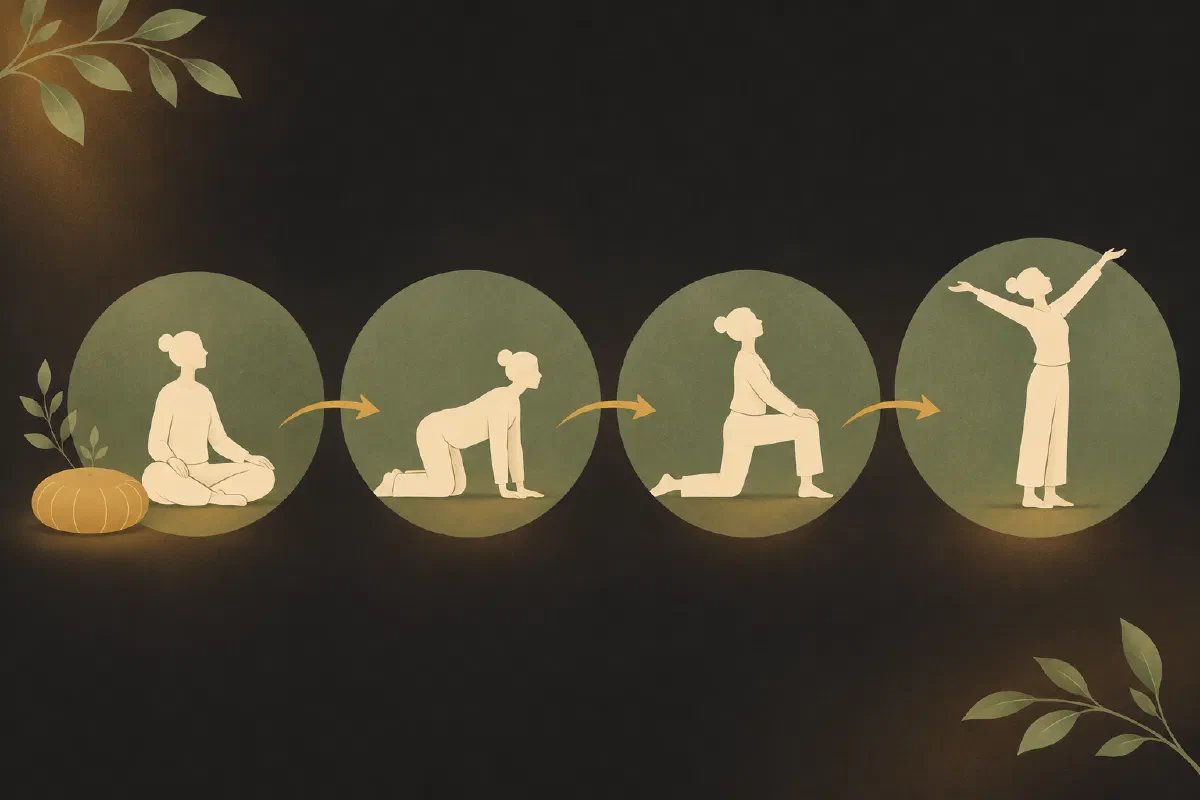
This is a common, gentle sequence suitable for healthy adults. It is a practical starting point, not a treatment. Move slowly, stay well within comfort, and stop if anything hurts. Breathe normally through your nose; you do not need special breathing techniques.
- Settle (2 minutes). Sit on a cushion or chair with your feet grounded. Notice your breath without changing it. If your mind wanders, that is normal; simply come back to the breath.
- Cat and cow (2 minutes). On hands and knees, slowly round your back, then let your belly drop and lift your chest. Move with your breath.
- Child’s pose (1 minute). Sit back towards your heels with your arms forward or by your sides. Use a cushion under your hips if your knees complain.
- Mountain pose with arm raises (2 minutes). Stand tall, feet hip-width apart. Raise your arms as you breathe in, lower them as you breathe out.
- Gentle standing side bend (2 minutes). Reach one arm up and lean slightly to the side, then switch. Keep it small.
- Supported forward fold (2 minutes). With soft knees, fold forward and rest your hands on your thighs, a chair or blocks. Come up slowly.
- Lying twist (2 minutes). On your back, knees bent, let both knees drop to one side, then the other.
- Rest (2 minutes). Lie on your back with a cushion under your knees. Let the body be heavy before you get up slowly.
Using a timer for the whole block, rather than checking the clock between poses, can make it easier to stay with the routine. If seated stillness is the hardest part for you, meditation for focus and why deep breathing works offer shorter starting points.
A four-week trial log
Because the evidence cannot tell you whether yoga will help you, the most useful thing is a simple personal test. Try the routine, or a class, on a fixed number of days for four weeks and note what you see. This is an observation log, not a medical assessment.
| Week | Days I practised | Minutes in total | How restless I felt before / after (low, medium, high) | Focus at work that day (full, distracted, not today) | Anything that hurt or felt wrong |
|---|---|---|---|---|---|
| 1 | |||||
| 2 | |||||
| 3 | |||||
| 4 |
At the end, ask three questions: Did I keep doing it? Did I feel different straight after? Do practice days look any different from the others? If something hurt, stop that pose and get advice from a teacher or doctor.
An example from a working week
Here is an illustrative example, not a real case. Tom, a project coordinator with ADHD, finds his afternoons scattered. He keeps his treatment as it is and adds the 15-minute routine before work on three weekdays. In week one he skips twice because the plan relies on remembering; in week two he lays the mat out the night before and practises all three days. His log shows he feels calmer for about an hour afterwards, but his afternoon focus ratings look much the same on practice and non-practice days. He decides to keep yoga because he enjoys it, and mentions the log at his next ADHD review rather than expecting yoga to fix the afternoons.
Limits worth keeping in mind
- Evidence: studies are few and small, and most are in children. A positive feeling after a session is real, but it is not proof of a lasting effect on ADHD.
- Not a replacement: yoga is an add-on to treatment, not a substitute for medication, therapy or specialist review.
- Stress and mood: if stress is the main problem, see ADHD and stress or how to calm down when ADHD overwhelm spikes. If low mood or anxiety is getting worse, talk to a doctor.
- Crisis: if you are having thoughts of harming yourself, call your local emergency number or a crisis line in your country now.
Summary
Yoga is a reasonable thing to try with ADHD: it is generally safe for healthy beginners, it counts as physical activity and many people find it calming. But the research is early. Small studies, mostly in children, report better attention, reviews call the evidence weak, and a small adult pilot found no benefit after six weeks. Treat yoga as a supportive habit alongside your treatment, not instead of it.
Your next step: do the 15-minute routine once this week and fill in the first row of the log. You can time it with the free Cyklio Focus Timer, our own web tool. If you want a simple way to compare your days, Cyklio, our focus timer app, lets you rate each work session, so you can see whether practice days look any different.
This article is educational and does not replace advice from a doctor.