

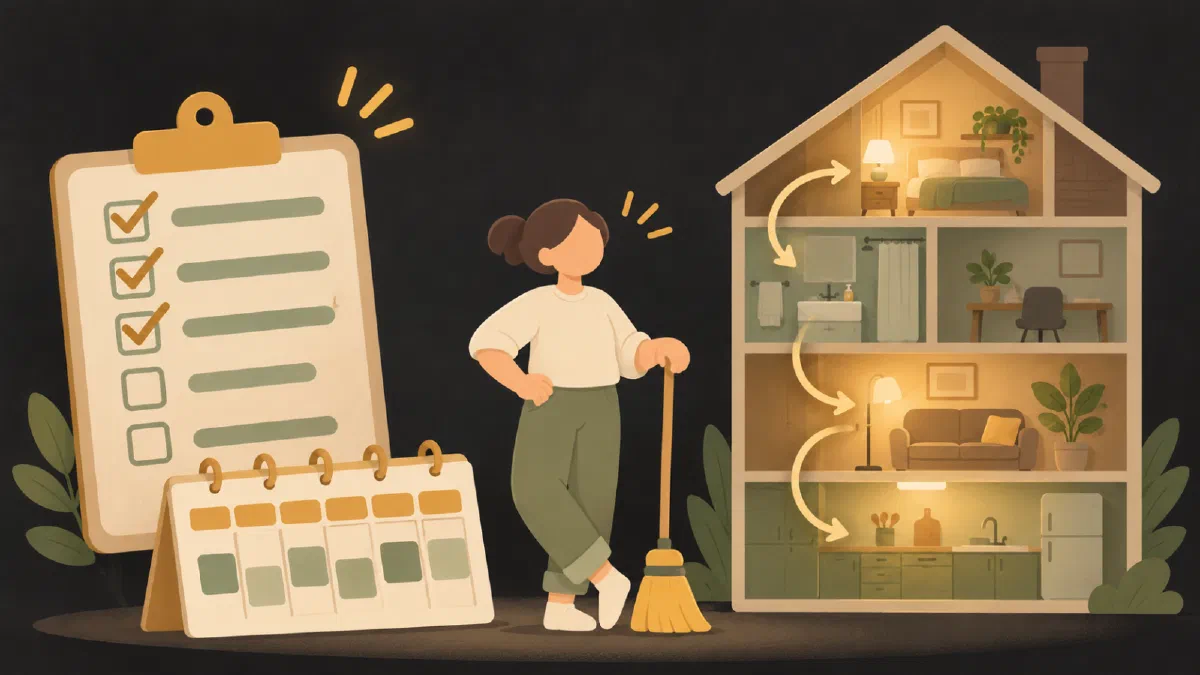
Most cleaning schedules assume you have the same energy every day and a free Saturday morning. This one is built for short sessions and uneven weeks: a tiny daily minimum, one zone per day, a tracker you can copy and a plan for the days when even the minimum feels like a lot.
If you need the method for a single session (how to sort a zone, what to do with “not sure” items), our step-by-step guide to how to clean with ADHD covers that. This page is the schedule that sits around those sessions.
How this schedule works
For many people, cleaning is not one hard task but dozens of small ones with no clear order. The CDC describes the predominantly inattentive presentation of ADHD as one where it is hard for the person to organize or finish a task, and where they are easily distracted or forget details of daily routines. A written schedule does some of that organising for you in advance, so you are not deciding what to clean while standing in the mess.
The schedule has four parts:
| Part | What it is | Time |
|---|---|---|
| Daily minimum | Five small tasks that stop the home sliding | About 15 minutes a day |
| Weekly zone rotation | One zone of the home per weekday | One or two 15-minute sessions |
| Tracker | One mark per day, no streaks to break | 30 seconds a day |
| Energy levels | Full, light, minimum or rest | Decided each day in a few seconds |
Two principles hold it together. First, every task has a clear size, so nothing on the list is “sort out the kitchen”. Second, the list lives somewhere you can see it. The National Resource Center on ADHD (CHADD) suggests posting your list of spaces on a bulletin board or the fridge door so it is in front of you often, and recording deadlines and work sessions in your planner.
The daily minimum: five tasks, about 15 minutes
The daily minimum is the floor, not the goal. It is what keeps the kitchen usable and the floor walkable on a normal day. It should be small enough that you could do it tired, and it should be the same every day, so it gradually needs less thought.
| Task | What “done” looks like | Rough time |
|---|---|---|
| 1. Dishes reset | Sink empty, or dishes stacked to soak and the dishwasher started | 5 minutes |
| 2. One surface clear | The kitchen counter or table you use most is clear and wiped | 3 minutes |
| 3. Rubbish out of sight | Any full bin emptied, obvious rubbish in the bag | 2 minutes |
| 4. Floor path | Nothing on the floor between the bed, the door and the kitchen | 3 minutes |
| 5. Launch pad | Keys, wallet, bag and tomorrow’s things in one spot by the door | 2 minutes |
The last item comes from CHADD’s guidance, which suggests a table or small shelf by the front door for the things you need when you leave. CHADD also suggests a quick ten-minute pickup each night, returning items to their homes. If ten minutes of general pickup suits you better than a fixed list, swap it in. The point is a small, repeatable reset, not these exact five items.
How to adapt the list
- Swap items to fit your home. If you have a cat, “litter tray” might replace “floor path”. If you have no dishwasher, the dishes task might need a little longer.
- Keep it at five. When the list grows to eight or nine, it stops being a minimum. Move extra tasks into the weekly rotation.
- Anchor it to something you already do. “After I put my coffee cup in the sink in the evening, I start the dishes reset.” Plans in this if-then form are called implementation intentions, and a meta-analysis of 94 independent tests found they had a medium-to-large positive effect on reaching goals (Gollwitzer and Sheeran, 2006). The research covered many kinds of goals, not cleaning specifically.
- Keep morning tasks separate. If you already have a morning routine, leave it alone and put the daily minimum in the evening. Our morning routine checklist covers the start of the day.
The weekly rotation: one zone per day
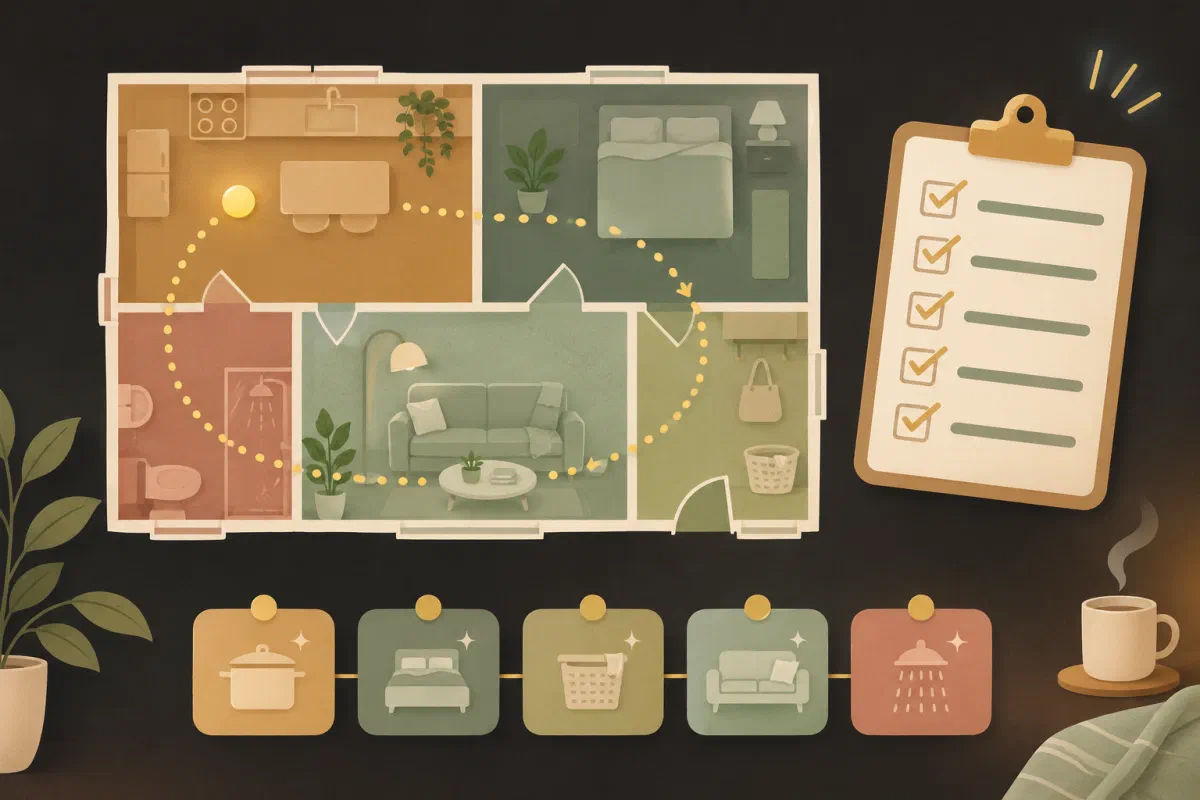
Instead of a big weekend clean, the rotation spreads the home across the week. Each weekday gets one zone. Each zone gets one or two 15-minute sessions at most, then you stop, even if there is more to do. Whatever is left simply waits until next week.
CHADD suggests planning organising sessions of 30 to 60 minutes, or 10 to 15 minutes and more of them if a longer session would leave you frustrated or bored. The rotation below uses 15-minute sessions as the default because they are easier to fit into a working day.
| Day | Zone | Sessions | Notes |
|---|---|---|---|
| Monday | Kitchen | 1 to 2 | Start of the week, food and dishes reset |
| Tuesday | Bathroom | 1 | Usually the quickest zone |
| Wednesday | Bedroom and laundry | 1 to 2 | Bedding, clothes chair, one laundry load |
| Thursday | Living area | 1 to 2 | Surfaces, floor, cushions, cables |
| Friday | Entrance and paper | 1 | Shoes, bags, post, bills to a tray |
| Saturday | Catch-up or one extra | 0 to 2 | Finish one unfinished zone, or one item from the extras list |
| Sunday | Rest and plan | 0 | Daily minimum only, glance at the tracker |
If your week looks different, move the zones around. Someone who works weekends might rest on Tuesday instead. Keep one day with no zone at all: a schedule with no slack breaks the first time life gets busy.
Zone checklists
Each zone has a short core list (do this first) and an extra list (only if you still have time in the session). The core list should fit in one 15-minute session. Stop when the timer ends, whatever is left.
Kitchen (Monday)
- Core: clear and wipe all counters, wipe the hob, clear the sink, take out rubbish and recycling.
- Extra: throw out old food from the fridge, wipe the front of the appliances, sweep or vacuum the floor.
Bathroom (Tuesday)
- Core: wipe the sink and tap, clean the toilet, swap the towels, empty the bin.
- Extra: clean the shower or bath, wipe the mirror, mop the floor.
Bedroom and laundry (Wednesday)
- Core: clear the clothes chair or floor pile, start one laundry load, clear the bedside table.
- Extra: change the bedding, put the clean laundry away, vacuum the floor.
Laundry has its own stages (wash, dry, fold, put away), and many people stall halfway. Our guide to ADHD and laundry breaks that into a stage-by-stage system.
Living area (Thursday)
- Core: clear the coffee table and main surfaces, return objects to their rooms, fold blankets, straighten cushions.
- Extra: dust shelves and screens, vacuum the floor, tidy cables and chargers.
Entrance and paper (Friday)
- Core: pair or put away shoes, empty bags of rubbish, sort the post into a tray (to act, to file, to recycle).
- Extra: deal with one item from the “to act” tray, wipe the door handle and light switches, shake out the doormat.
The extras list: one bigger job per week
Some jobs do not need doing weekly: inside the oven, the windows, the fridge shelves, under the bed, the balcony. Rather than a separate monthly schedule, keep a single extras list and do one item on Saturday, if you have the energy. Cross it off, and next time take the next item on the list.
| Extras list (one per week, in order) | Done (date) |
|---|---|
| Wipe the fridge shelves | |
| Clean inside the microwave and oven | |
| Wash the windows in one room | |
| Vacuum under the bed and sofa | |
| Wipe the skirting boards in one room | |
| Clear one cupboard or drawer | |
| Wash the bins | |
| Tidy the balcony, garden step or storage area |
When you reach the bottom, start again from the top. There is no deadline: a list that takes ten weeks instead of eight is still working.
Time each task once
Most people guess how long cleaning takes, and the guesses are usually too short. Psychologists call this the planning fallacy. Roger Buehler, one of the researchers who studied it, describes it as an optimistic prediction bias in which people underestimate the time it will take them to complete a task, and notes that it appears even for small tasks such as daily household chores, cleaning included. His suggested fixes include looking at how long similar tasks took in the past and breaking a plan into smaller steps.
For a cleaning schedule, the simplest version is this: the next time you do each core task, time it. Write the real number down once. Then build your sessions from real numbers, not hopes.
| Task | My guess | Real time (measured once) |
|---|---|---|
| Dishes reset | ||
| Kitchen core list | ||
| Bathroom core list | ||
| Clothes chair cleared | ||
| Post sorted into the tray |
If a core list takes 25 minutes instead of 15, do not push yourself through it in one go. Split it across two sessions, or move one item to the extras list. If a task you have been avoiding takes four minutes, that is useful to know too.
The tracker you can copy
The tracker is one line per week and one mark per day. It is not a streak counter. Its job is to show you what actually happened, so you can adjust the schedule instead of blaming yourself.
Use four marks:
- F (full): daily minimum plus the day’s zone.
- L (light): daily minimum plus a shorter version of the zone, for example one core task.
- M (minimum): daily minimum only, or part of it.
- R (rest): a planned or needed day off.
| Week of | Mon (kitchen) | Tue (bathroom) | Wed (bedroom) | Thu (living) | Fri (entrance) | Sat (catch-up) | Sun (rest) | Extra done |
|---|---|---|---|---|---|---|---|---|
| Week 1 | ||||||||
| Week 2 | ||||||||
| Week 3 | ||||||||
| Week 4 |
Copy it onto paper, into a notes app or a spreadsheet, and keep it next to the list of zones.
Why track at all? A meta-analysis of 138 experiments found that interventions that increased how often people monitored their progress toward a goal helped them reach it, and the effect was larger when progress was physically recorded or reported to others (Harkin et al., 2016). The studies covered many kinds of goals, not cleaning, so treat this as a sensible principle rather than proof that a cleaning tracker works.
There is also no need to restart after a missed day. In a study of 96 volunteers building a new daily habit, the time it took participants to reach 95% of their own peak level of automaticity ranged from 18 to 254 days, and missing one opportunity did not materially affect the process (Lally and colleagues, 2010). The study ran for 12 weeks, so the longest times were estimated from each person’s curve. A week full of M and L marks is still a week where the schedule kept going.
Reading your tracker after four weeks
- Mostly F: the schedule fits. Consider adding one item to a zone’s core list, or leave it as it is.
- Mostly L and M: the zones are too big for your weeks. Cut each core list to two or three items.
- The same day is always blank: move that zone to a quieter day, or merge it with another zone.
- Long runs of R that you did not plan: look at energy first, not discipline. The section below on low-energy days, and the note on tiredness further down, may help.
Scaling down on low-energy days
Energy is not the same every day, for anyone. A schedule that only works on good days will fail on the first bad one. So decide in advance what each level looks like, and on a low day you just pick a level instead of making a new plan.
| How today feels | Level | What you do | Tracker mark |
|---|---|---|---|
| Normal or good | Full | Daily minimum plus the day’s zone (core list) | F |
| Tired but able | Light | Daily minimum plus one core task from today’s zone | L |
| Very low | Minimum | Two tasks only: dishes reset and rubbish out | M |
| Ill, overwhelmed or no capacity at all | Rest | Nothing. Food, water, sleep | R |
A few rules make the levels work:
- Decide the level once, in a few seconds. Do not negotiate with yourself all evening. If you are unsure between two levels, pick the lower one.
- The minimum level is always tiny. Two tasks, five to ten minutes. On a very low day, starting something small is often easier than facing a full list.
- Do not carry tasks over. A skipped zone does not pile onto tomorrow. It waits until next week’s slot, or until Saturday’s catch-up if you have the energy.
- Take breaks between sessions. If you do two sessions, put a short break in between. A systematic review found that micro-breaks had small positive effects on vigour and on reducing fatigue (Albulescu et al., 2022), though it looked at work tasks in general, not cleaning.
If low-energy days are the main problem, our guide to motivation when you have no energy looks at that in more depth, and why cleaning can feel so tiring with ADHD explains where the effort goes.
Ongoing tiredness is also worth taking seriously in its own right. The NHS suggests seeing a GP if you have felt tired for a few weeks and are not sure why, if tiredness affects your daily life, or if it comes with other symptoms such as weight loss or mood changes. A cleaning schedule cannot fix that, and it should not have to.
A worked example: one week
Here is how the schedule could look for a working adult who works office hours, gets home tired most evenings and has never kept a cleaning routine for more than a fortnight. This is an illustration, not a real case.
Monday (kitchen). After dinner, the dishes reset starts the daily minimum. Then one 15-minute session on the kitchen core list: counters, hob, sink, rubbish. The timer ends with the hob half done. The session stops anyway. Tracker: F.
Tuesday (bathroom). A long day at work. The level check takes a few seconds: tired but able, so light. Daily minimum, then one bathroom core task: clean the toilet. Tracker: L.
Wednesday (bedroom and laundry). Normal energy. Daily minimum, then a session on the clothes chair and one laundry load into the machine. The bedding change from the extras list does not happen. Tracker: F.
Thursday (living area). A headache and no capacity. The plan says rest, so nothing is done, and nothing is carried over to Friday. Tracker: R.
Friday (entrance and paper). Very low energy after a long week. Minimum level: dishes reset and rubbish out, nothing else. Tracker: M.
Saturday (catch-up). Feeling better. One session on the living area, since Thursday was skipped, then one extras item: wipe the fridge shelves. Tracker: F, and the extras list gets a date.
Sunday (rest and plan). Daily minimum, and a one-minute look at the tracker: F, L, F, R, M, F, R. That is a week where every day had a plan, the home did not slide and nothing piled up. The bathroom only got a light clean, so next Tuesday it starts with the sink.
Making the schedule stick
A schedule on paper is the easy part. These small habits help it survive real weeks.
- Use the same start time. If evenings are chaotic, choose a fixed slot such as “right after dinner” or “when I get home and put my bag down”. If you already plan your days in blocks, add a 15-minute cleaning block to your plan; our time blocking template shows how.
- Start the timer before you start cleaning. Any timer works, including the free Cyklio Focus Timer in your browser. A visible end point makes “just 15 minutes” believable.
- Pick a reward in advance. CHADD suggests choosing a reward before you start an organising task and claiming it when you finish. It can be as small as an episode of a show or a walk.
- Ask for company if it helps. CHADD also notes that a friend helping can make the job easier and faster. Some people simply prefer someone else in the room or on a call while they work.
- Keep supplies in the zone. A cloth and spray under the bathroom sink and another under the kitchen sink mean one less trip, and one less chance to get side-tracked.
- Expect weeks, not days. The habit study mentioned above found big differences between people, with a range of 18 to 254 days. If the schedule still feels like effort after two weeks, that is normal, not a sign it has failed.
Common problems with cleaning schedules
| Problem | What to try |
|---|---|
| “I made a perfect schedule and dropped it after four days.” | Cut every core list to two or three items and keep one zone-free day. Start smaller than feels useful. |
| “I keep cleaning for two hours, then avoid it for weeks.” | Keep the session cap. Stop when the timer ends and leave the rest for next week’s slot. |
| “I forget which day is which zone.” | Post the rotation on the fridge or by the door, and put the zone name in your phone calendar. |
| “My partner or flatmate and I argue about who does what.” | Split the rotation by zone, not by task, so each person owns whole days. Track both on the same sheet. |
| “Everything piles up on Saturday.” | Do not carry tasks over. Saturday is for one catch-up session at most, then stop. |
| “I tick the tracker and feel bad about the M and R marks.” | Read the tracker as information. Many M marks mean the plan is too big, not that you are failing. |
| “I never get to the extras list.” | That is fine. The daily minimum and core lists keep the home usable. Extras are optional by design. |
When to get more support
Plenty of people can make a schedule like this work on their own, and some need more help. That is a reasonable choice, not a defeat.
- If you have an ADHD diagnosis, difficulties with organisation and daily tasks are worth raising with your clinician. The NHS notes that talking therapies such as cognitive behavioural therapy (CBT) may be recommended for adults with ADHD, alongside other support.
- If you think you might have ADHD but have never been assessed, the NHS suggests seeing a GP if symptoms affect your work, studies or relationships. A cleaning schedule cannot tell you whether you have ADHD.
- If tiredness or low mood is what keeps stopping you, follow the NHS advice on tiredness above and talk to a GP.
Summary and your next step
An ADHD cleaning schedule works best when it is small, visible and flexible:
- A daily minimum of five tasks, about 15 minutes, the same every day.
- One zone per weekday, with a short core list and a cap of one or two 15-minute sessions.
- One item from the extras list on Saturday, only if you have energy.
- A tracker with four marks (full, light, minimum, rest) and no streaks to break.
- Energy levels decided in advance, so a bad day means a smaller plan, not no plan.
Your next step: copy the daily minimum and the tracker onto one sheet, put it on the fridge, and tonight do the dishes reset with a 15-minute timer running. If you would like your sessions to add up, Cyklio, our focus timer app from Mindly 360, lets you run sessions from 10 to 60 minutes, rate each one and see them in daily, weekly and monthly reports. It has a 7-day free trial with full access, and no account or card is needed.