

If you look at a messy home and do not know where to begin, you are not lazy and you are not alone. This guide gives you a repeatable method for cleaning with ADHD: small zones, short timed sessions, a fast way to sort and a light routine that keeps the space from sliding back.
Why “clean the house” is the wrong task
“Clean the house” is not really a task. It is a pile of hundreds of small decisions and actions with no clear first step and no clear finish line. That kind of vague, oversized job is hard for anyone to start, and it is often where people get stuck, re-read the mess, feel worse and walk away. If that freeze is familiar, our guide to ADHD paralysis and how to get unstuck explains it in more depth, and how to start a task when you can’t get going covers starting techniques in general.
The method below turns the big job into something smaller and more concrete:
- A place: one zone you can see the edges of.
- A time: one session with a timer, short enough to say yes to.
- A rule: a simple way to decide what happens to each object.
- A finish line: you stop when the timer ends, even if the zone is not perfect.
This is close to what the National Resource Center on ADHD (CHADD) recommends for organising a home: rank the spaces, divide each one into sections, work in short sessions and sort one section at a time. The steps here add a few practical details for working adults who clean in the gaps between everything else.
One more thing before the steps. Shame is a poor cleaning tool. A simple practical rule works better: start from where the room is today, without a lecture.
The method at a glance
| Step | What you do | Time |
|---|---|---|
| 1. Zone map | List your spaces and split each into small zones | 10 minutes, once |
| 2. Pick a zone | Match today’s zone to your time and energy | 1 minute |
| 3. Set up | Containers, trash bag, timer, something to listen to | 3 minutes |
| 4. One session | Sort the zone with four simple rules | 10 to 15 minutes |
| 5. Stop and log | Stop on time, note what you did, take a break | 2 minutes |
| 6. Return trip | Put away the “goes elsewhere” basket | 5 minutes |
You can do one round of steps 2 to 6 and stop for the day. That counts.
Step 1: Make a zone map (once)
A zone is a piece of a room small enough to finish in one or two short sessions: the top of a desk, one kitchen counter, the floor around the bed, one shelf, the area just inside the front door.
CHADD suggests listing every space from easiest to hardest, starting with the easiest, and then dividing each space into sections. It gives three ways to split a room:
- Quarters: split the room into four parts and finish one before you touch the next.
- Clock: stand in the doorway and work around the room like the hands of a clock.
- Functions: group by activity, for example everything for paperwork in one corner and everything for exercise in another.
The clock method has one practical advantage: the next zone is always the one to the right, so there is nothing to decide.
Fill-in zone map
Copy this into a notebook or a note on your phone and fill it in once. Put the easiest spaces at the top.
| Space | Zone | Size (S / M / L) | Done? |
|---|---|---|---|
| Bathroom | Sink and counter | S | |
| Bathroom | Floor and bath edge | M | |
| Kitchen | Counter left of the sink | S | |
| Kitchen | Table | M | |
| Bedroom | Bedside table | S | |
| Bedroom | Chair with clothes | M | |
| Hallway | Shoes and bags by the door | S | |
| … | … | … |
Mark a zone S if you think you could clear it in one 10 to 15 minute session, M if it needs two or three, and L if it needs more. Any L zone should be split again until every piece is S or M. Large zones are where sessions go to die.
Keep the map where you will see it. CHADD suggests posting the list somewhere visible, so it decides for you what comes next.
Step 2: Pick today’s zone with a decision table
The zone map stops you from re-planning every time. Today you only need to match one zone to the time and energy you actually have, not the energy you wish you had.
| Your situation right now | Zone to pick | Session |
|---|---|---|
| Low energy, 10 minutes | One S zone you can see from where you sit | 1 session of 10 minutes |
| Normal energy, 20 to 30 minutes | Next S or M zone on the map | 1 to 2 sessions of 15 minutes with a break |
| Good energy, an hour free | One M zone, then the return trip | 2 to 3 sessions of 15 minutes with breaks |
| Guests coming soon | The zone visitors will see first, usually the entrance or table | 1 to 2 sessions of 15 minutes |
| Something is blocking daily life (no clean plates, cannot find keys) | The zone that unblocks it | 1 session, then stop |
If you cannot choose between two zones, pick the smaller one. Finishing a small zone usually helps more than half-finishing a big one.
Step 3: Set up in three minutes
Most cleaning sessions fail before they start, when you get up to fetch a bag, find a phone charger and end up in another room. Set up first, and keep the setup the same every time.
- Four containers. A basket or box for “goes elsewhere”, a box for “not sure”, a trash bag and a bag for donating or recycling. Anything that stays in the zone does not need a container.
- A timer. Any timer works: a kitchen timer, your phone, the free Cyklio Focus Timer in your browser, or our app.
- Something to listen to. CHADD suggests working with a timer for 15-minute stretches or until a favourite playlist ends. In one field experiment, people who could only listen to audiobooks they wanted to hear while at the gym went to the gym more often at first, though the effect faded over time (Milkman, Minson and Volpp, 2014). Researchers call this “temptation bundling”. It has not been tested for cleaning, but saving a podcast or playlist only for cleaning sessions is a reasonable, low-cost experiment.
- An if-then plan. Decide when the session starts, linked to something you already do: “If I finish my coffee on Saturday, then I set the timer for the bedside table.” Plans written like this are called implementation intentions, and a meta-analysis of 94 independent tests found they had a medium-to-large positive effect on reaching goals (Gollwitzer and Sheeran, 2006).
If you do better with another person in the room, or on a video call, that is a popular approach called body doubling. It is a practical habit rather than a researched treatment; our article on what body doubling is and how to try it explains the options.
Step 4: Run one 10 to 15 minute session
CHADD suggests splitting organising work into sessions of 30 to 60 minutes, or 10 to 15 minutes if you think you would get frustrated or bored in a longer one, with the aim of working “for a short enough time that you can experience success”. For a first round, 10 to 15 minutes is a good default. You can always run another session.
- Start the timer before you touch anything. The session has begun; there is nothing left to decide about starting.
- Trash first. Spend the first two minutes on anything that is obviously rubbish: wrappers, receipts you do not need, empty bottles. It is fast, it needs no decisions and the zone visibly changes.
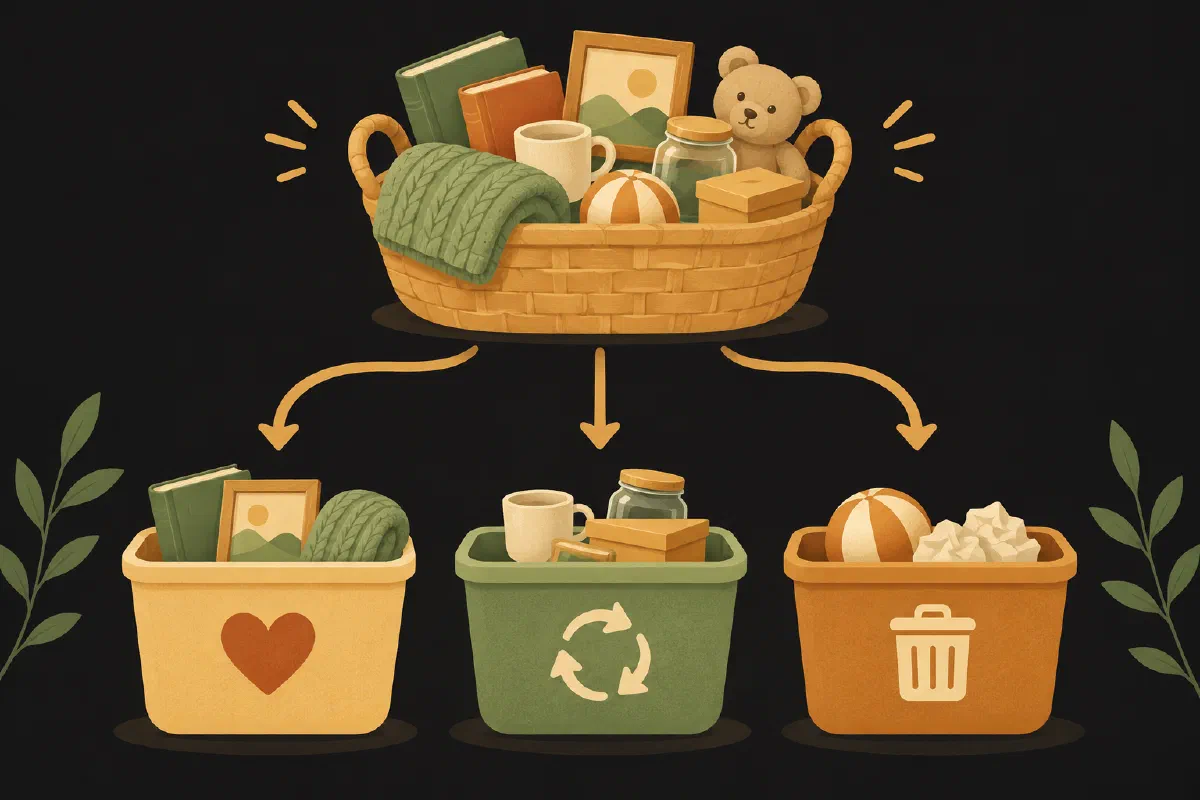
- Pick up one object at a time and decide in a few seconds. Each object goes to one of five places:
- Stays here: it belongs in this zone. Put it back neatly.
- Goes elsewhere: it belongs in another room. Into the basket. Do not walk it there now.
- Donate or recycle: you do not need it and someone else might. Into the bag.
- Trash: into the trash bag.
- Not sure: if you cannot decide quickly, CHADD’s advice is to put it in the “not sure” box and move on.
- Wipe the cleared surface. Once the zone is clear, a quick wipe or vacuum of that small area is the reward you can see.
- When the timer rings, stop. Even mid-pile. Put the containers by the door and stop the session.
The “goes elsewhere” rule is the most important one. Walking each item to its room is how a 15-minute bedside-table session turns into an hour in the kitchen with the bedside table untouched.
The “not sure” box needs a rule too, or it becomes a new pile. CHADD suggests sealing it, writing a date three to six months away on it and storing it. When that date comes, you get rid of anything you did not need, and find a proper home for anything you did.
Step 5: Stop, log and take a break
Stopping on time is part of the method, not a failure of it. A session that ends when you said it would makes the next one easier to agree to. A session that runs for three hours because you got absorbed can leave you avoiding the next one for weeks.
After the timer:
- Note what you did. One line is enough: “Bedside table, 12 minutes, cleared.” A meta-analysis of 138 experiments found that monitoring progress toward a goal helped people reach it, and the effect was larger when progress was physically recorded or shared (Harkin et al., 2016). The meta-analysis was not about cleaning, so treat it as a sensible principle rather than a cleaning-specific result.
- Tick the zone on your map if it is done.
- Take a real break before another session: drink water, step outside, sit down. A systematic review found that short breaks of up to about ten minutes slightly increased vigour and reduced fatigue (Albulescu et al., 2022). The review looked at well-being and performance in general, not at cleaning, but cleaning is work too.
- Give yourself the small reward you picked. CHADD suggests choosing a reward before you start and taking it after each session and each finished space.
Step 6: The return trip
The “goes elsewhere” basket is where the method succeeds or quietly fails. Give it its own short slot, either at the end of a session block or at a fixed time later in the day.
- Set a timer for five minutes.
- Carry the basket from room to room.
- In each room, drop the items in the right place. Not perfectly, just in the right room and roughly the right spot.
- Anything without a home goes into the “not sure” box.
- When the timer rings, put the basket back by your cleaning containers, even if it is not empty.
Take the donate bag to your car, bag or the door straight away, so it actually leaves the house. Take the trash out at the same time.
A worked example: one Saturday morning
Here is how the method could look for a working adult who has an hour on Saturday morning and a kitchen that has been sliding for two weeks. This is an illustration, not a real case.
9:00, zone map check. The kitchen is on the map as three zones: counter left of the sink (S), table (M), counter by the fridge (M). Energy is normal, so the decision table says one or two 15-minute sessions on the next zone: the counter left of the sink.
9:02, setup. Basket, “not sure” box, trash bag, donate bag on the floor. A favourite podcast on. The timer is set to 15 minutes.
9:03 to 9:18, session one. Trash first: two takeaway containers, a pile of old post and a dried-up sponge. Then object by object: the mugs go straight into the sink beside the counter, a charger and a book go into the basket, a gadget that has not been used in a year goes into the donate bag, and a mystery cable goes into the “not sure” box. At 9:15 the counter is clear enough to wipe. At 9:18 the timer rings and the session stops, even though the window ledge behind the counter is still cluttered.
9:18, log and break. One line in the notebook: “Kitchen counter left, 15 min, cleared, ledge left.” The zone gets a tick. Ten minutes outside with a coffee.
9:30 to 9:45, session two. The table, which was marked M. It does not get finished: half of it is clear, the rest is paper. The log says “Table, 15 min, half done, paper left.”
9:46 to 9:51, return trip. The basket goes round the flat: charger to the desk, book to the shelf, a jumper to the bedroom. Two items have no home and go into the “not sure” box. The donate bag goes by the front door.
Result: about 40 minutes of actual work, one zone done, one half done, nothing left in transit. The next session already has an obvious starting point: the paper on the table.
Keeping the space from sliding back
A big clean once a month tends to leave you starting from scratch every time. Small, regular resets are easier to keep going.
- A daily ten-minute reset. CHADD suggests a quick pickup of about ten minutes each night, plus small habits like closing drawers and hanging up clothes as you pass them.
- A launch pad by the door. A small table or shelf by the front door with a basket for keys, glasses and wallet, also from CHADD’s guidance, means the hallway zone stays clear and mornings start without a search.
- Subtract before you add. Before a new item comes in, an old one goes into the donate bag. Keep that bag in a fixed place so the rule is easy to follow.
- Attach the reset to an existing cue. “After I brush my teeth in the evening, I clear the kitchen counter.” In a 12-week study of 96 volunteers forming a new daily eating, drinking or activity habit, the time it took to get close to full automaticity ranged from 18 days to a projected 254 days, and missing a single day did not make much difference (Lally and colleagues, 2010). The researchers’ own summary puts the average at 66 days. In practice: expect weeks to months, not days, and do not restart from zero after a missed evening.
If you want a full weekly plan, our ADHD cleaning checklist and schedule covers that in detail. This guide focuses on how to run each session.
Common sticking points and what to try
| Sticking point | What to try |
|---|---|
| “I start in one room and end up in three others.” | The “goes elsewhere” basket and the five-minute return trip. Nothing leaves the zone during a session. |
| “I get stuck deciding about every object.” | The “not sure” box, sealed and dated. A few seconds per item, then move on. |
| “I am too tired to start.” | A 5 to 10 minute session on the smallest zone you can see. Or trash only. |
| “I got absorbed and cleaned for four hours, then avoided it for a month.” | Keep the timer and stop when it rings. Plan the next session instead of continuing. |
| “The zone looked fine for two days, then went back.” | Add the daily ten-minute reset and give every frequent item a fixed home. |
| “I dread the whole thing before I even start.” | Bundle it with a podcast or playlist you save only for cleaning, and set an if-then start time. |
| “I clean, but nobody can see any difference.” | Pick zones others notice first, like the entrance or table, and finish one fully. |
If dread is the main problem rather than method, our article on how to get motivated to clean goes deeper into that side, and why cleaning can feel so tiring with ADHD looks at energy.
When to get more support
Many people can make real progress on their own with a method like this. CHADD notes that others may need a coach, professional organiser or therapist to get started, and that is a reasonable choice, not a defeat.
- If you have an ADHD diagnosis, organisation and planning are things you can raise with your clinician. The NHS notes that talking therapies such as cognitive behavioural therapy (CBT) may be recommended for adults with ADHD, and that support at work or in study can include help from another person to plan and structure your tasks.
- If you think you might have ADHD but have never been assessed, the NHS suggests making an appointment with a GP if symptoms affect your work, studies or relationships. An article like this one cannot tell you whether you have ADHD.
- If letting go of things feels extremely hard, rooms have become too full to use, or belongings cause arguments at home, the NHS describes these as possible signs of hoarding disorder, a mental health condition that can be treated, and recommends seeing a GP. That is a different problem from an untidy week, and it deserves proper help.
Summary and your next step
Cleaning with ADHD gets easier when the job stops being “the whole house” and becomes one zone, one short session and one simple sorting rule.
- Make a zone map once, with every zone small enough for one or two sessions.
- Match today’s zone to your real time and energy.
- Set up four containers and a timer before you start.
- Sort for 10 to 15 minutes, stop when the timer rings and log what you did.
- Do a five-minute return trip, then a short daily reset to keep it.
Your next step: pick the smallest zone you can see from where you are reading this, set a timer for 10 minutes and do trash only. If you would like the sessions to add up, Cyklio, our focus timer app from Mindly 360, lets you run 10-minute sessions, rate each one and see them in daily and weekly reports. It has a 7-day free trial with full access and no account or card needed.