


You can spend four absorbed hours on a side project and then fail to send one two-line email. If you have ADHD, that swing can feel like proof that you are lazy or inconsistent. It is better understood as a pattern in how motivation works, and that pattern has a research side and a popular side worth separating.
This article is educational and does not replace advice from a doctor.
Why focus can swing between interesting and boring tasks
The National Institute of Mental Health describes ADHD as a neurodevelopmental disorder marked by inattention, hyperactivity and impulsivity, with inattention including difficulty paying attention, keeping on task or staying organized. The NHS lists finding it hard to follow instructions or finish tasks among adult symptoms.
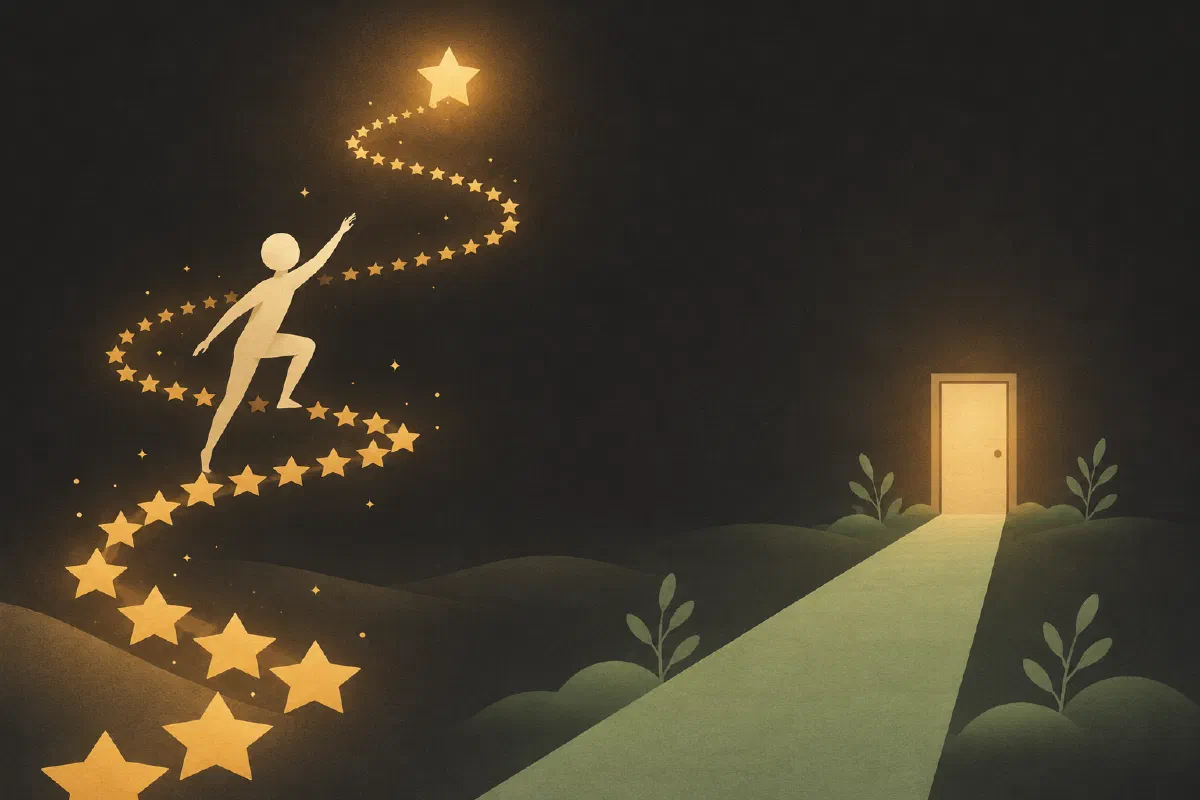
What those lists do not show is how uneven this can look day to day. A popular description, widely shared online, names three things that switch focus on: real interest, a close deadline and something new. Without any of them, a task can feel almost impossible to start. With one of them, the same person may work for hours, and research does find that adults with ADHD often report long spells of intense focus.
The three-part description itself comes from lived experience, not from studies. The research does not measure “interest, urgency and novelty” as one model. It does measure reward, delay and effort, and those findings explain a lot of the swing.
What research describes: reward, delay and effort
Several lines of research point in the same direction, with different levels of certainty.
Differences in the reward system. In a brain-imaging study of 45 never-medicated adults with ADHD and 41 controls, the ADHD group had lower markers of dopamine function in reward-related brain areas and lower scores on a questionnaire measure of achievement motivation, and in the ADHD group those two were linked. The design was correlational, so it cannot show cause, and the questionnaire was only a stand-in for motivation. A meta-analysis of brain-imaging studies found that people with ADHD showed, on average, less activity in a reward area called the ventral striatum while waiting for a reward, with a medium effect size.
Distant rewards pull less. A meta-analysis of 21 investigations with 3,913 participants found that people with ADHD discount delayed rewards more steeply than controls: a reward later is worth less to them, relative to a reward now. That fits the common experience that a project due in three weeks has almost no pull until it is due in three days. One researcher proposed a dual pathway model in which some ADHD difficulties come from weaker inhibitory control and others from a motivational style shaped by an altered response to delayed reward. Another theory, the dopamine transfer deficit, suggests that the brain’s reward signal may not shift as well to cues that predict a reward. Both are models to test, not settled facts.
Rewards can change performance. A review of 22 studies in children found that rewards improved task performance and motivation in children with and without ADHD, with a somewhat stronger effect on performance in ADHD, and that children with ADHD preferred immediate over delayed rewards. In a working-memory study, incentives improved performance more in children with ADHD than in other children and cut the gap roughly in half, but did not close it. So motivation matters, yet it is not the whole story. These studies were in children, so treat them as clues for adults rather than proof.
For a deeper look at the brain chemistry claims you will see online, see what research actually says about ADHD and dopamine.
Interest, urgency and novelty: how each one shows up
Here is how the three popular “switches” line up with the research above.
| Switch | What it feels like | Closest research finding | Strength of evidence |
|---|---|---|---|
| Interest | The task pays off while you do it, so there is nothing to wait for | Rewards improve performance; immediate rewards are preferred | Moderate, mostly lab tasks in children |
| Urgency | A deadline is so close that the payoff, or the cost of missing it, is right now | Steeper discounting of delayed rewards in ADHD | Moderate, meta-analysis of lab tasks |
| Novelty | Something new is engaging before it becomes routine | Reward-system differences; boredom as attention failing to engage | Limited and indirect for ADHD specifically |
A useful way to read the table: all three switches make the payoff feel close. Interest puts the reward inside the work. Urgency drags a distant reward, or penalty, into the present. Novelty often makes the first part of a task rewarding on its own. Why new things grab attention so strongly is covered in why ADHD brains like new things, and the deadline effect in ADHD and urgency.
The opposite case is boredom. Psychologists define boredom as the unpleasant experience of wanting to engage in something satisfying but being unable to. A task with no close payoff, no novelty and no deadline is exactly where that happens. More on that in ADHD and boredom.
Popular framing vs evidence
Online, this pattern is often called an “interest-based nervous system”. It is a popular term, not a diagnosis or a scientific model, and it can be helpful as long as you know where it stops.
| Popular claim | What the evidence supports |
|---|---|
| “ADHD brains run on interest, not importance.” | Research supports differences in reward processing and delay discounting. It does not show that importance plays no role. |
| “If I can focus on games, I can’t have ADHD.” | Not supported. Adults with more ADHD symptoms report more hyperfocus, including on hobbies and screens. |
| “It’s all dopamine.” | The dopamine findings come from correlational imaging studies. They do not show that one chemical explains ADHD. |
| “Rewards fix everything.” | Incentives help, but in one study they cut the gap in half rather than closing it. |
| “Everyone with ADHD has all three switches.” | Not established. One model describes different pathways to ADHD difficulties, so people may vary. |
Can people with ADHD focus on things they like?
Yes, often intensely. In two samples of adults, people with more ADHD symptoms reported more hyperfocus, both overall and in settings such as school, hobbies and screen time. Researchers note that hyperfocus is poorly defined and has little research so far, so treat strong claims about it with caution. For what the term means and its downsides, see what hyperfocus is.
Two practical conclusions follow. Focusing well on something you love is not evidence that you are faking struggles elsewhere. And it is not a self-test: plenty of people without ADHD also focus better on interesting work. Only a qualified professional can assess whether ADHD is part of the picture; the NHS suggests starting with a GP, who may refer you to an ADHD specialist.
Worked example: one person, two tasks, same day
Maya, an illustrative example, is a marketing analyst. On Tuesday she builds a new dashboard from 10:00 to 13:30 without noticing lunch. At 15:00 she needs to file her monthly expense report, which takes 20 minutes, and she avoids it until Friday.
Scoring both tasks makes the difference visible:
| Question | Dashboard | Expense report |
|---|---|---|
| Does doing it feel rewarding right now? | Yes, each chart is a small win | No |
| Is there a payoff or cost today? | Manager demo tomorrow | Due at month end, 10 days away |
| Is anything new about it? | New data source | Same form as always |
| Is the first step obvious? | Yes, open the data | Unclear, receipts are scattered |
| Score (yes answers) | 4 | 0 |
Maya is not lazier at 15:00 than at 10:00. The expense report has no close payoff, no novelty and a fuzzy first step. Seeing that, she changes the task rather than blaming herself: she gathers receipts into one folder at 15:00 (an obvious first step), books a 15-minute session for 15:05 (a near finish line) and saves a favourite podcast episode for while she types (borrowed interest).
Fill-in task profile
Copy this for any task you keep avoiding:
- Rewarding while doing it? Yes / No. If no, what could I pair with it?
- Payoff or cost today? Yes / No. If no, what checkpoint can I set for today?
- Anything new? Yes / No. If no, can I change the place, tool or order?
- First step obvious? Yes / No. If no, what is the smallest physical action?
Ways to make a low-interest task workable
The task profile shows which switch is missing. Here are four evidence-informed ways to add one. For a full list of motivation tactics, see how to get motivated with ADHD.
- Bring the reward closer. In lab studies, children with ADHD preferred immediate rewards, and rewards improved their performance, so give yourself a small reward right after a short block, not after the whole project.
- Borrow interest. In a field experiment on temptation bundling, people who could listen to gripping audiobooks only at the gym initially went 51% more often than controls, although the effect faded over time. Keep one enjoyable thing only for the dull task.
- Plan the exact start. A meta-analysis of 642 tests found that if-then plans (“If it is 15:05, then I open the expense form”) improved behavioural, cognitive and emotional outcomes, with stronger effects when the plan used an if-then format.
- Shorten the distance to the finish. A short timed session turns a vague task into one with a near end. This is a common practical strategy rather than a tested ADHD treatment. You can try it with the Cyklio Focus Timer in your browser.
When to talk to a professional
If motivation swings are costing you work, money or relationships, or you suspect ADHD, talk to a doctor. Effective help exists: in a randomised trial of 86 adults whose ADHD symptoms continued despite medication, cognitive behavioural therapy (CBT) reduced symptoms more than relaxation with educational support, and responders kept their gains at 12 months. Never change prescribed treatment without talking to your prescriber.
Low motivation across everything, including things you used to enjoy, may point to something other than an interest pattern. The NHS lists having no motivation or interest in things and not getting any enjoyment out of life among symptoms of depression, so this is worth raising with a doctor.
If you are in crisis or having thoughts of harming yourself, contact your local emergency number or a crisis line in your country straight away. If you are not sure which number to call, a doctor, pharmacist or local health service can tell you.
Summary and one next step
- Focus that switches on for interesting, urgent or new tasks is a commonly described ADHD experience, not a character flaw.
- Research links ADHD to differences in reward processing and a stronger pull from immediate rewards, while “interest-based nervous system” is a popular label, not a diagnosis.
- Dull tasks become more workable when you add a close payoff, borrowed interest, a planned start and a near finish line.
Next step: pick the one task you have avoided longest, run it through the four-question task profile and fix the first missing switch. If the gap is “no near finish line”, set one 15-minute session in Cyklio, our focus timer app (7-day free trial, no account or card needed), and stop when it ends.
This article is educational and does not replace advice from a doctor.