


You set three alarms, still wake up late, lose ten minutes looking for your keys and arrive at your desk already tired. If that sounds familiar, the problem is rarely willpower. This guide explains why mornings are often hard with ADHD, gives you a short routine template you can copy, and shows how to keep it going when real life gets in the way.
Why mornings are so hard with ADHD
A morning asks a lot of your brain in a short time: wake up, remember a sequence of small tasks, keep track of the clock, find the things you need and switch from home mode to work mode. Several of those demands overlap with how ADHD shows up in adults.
- Remembering and organising. The NHS page on ADHD in adults lists being easily distracted or forgetful, finding it hard to organise your time and often losing things such as your wallet, phone or keys among the inattentive symptoms. The NIMH guide to ADHD in adults adds trouble remembering daily tasks and poor time management, planning or organisation.
- Holding steps in mind. A meta-analysis of 38 studies in Neuropsychology found moderate differences in working memory between adults with ADHD and adults without it. Working memory is the mental notepad you use to keep “next: brush teeth, then pack lunch” in mind. When that notepad is less reliable, a routine that lives only in your head is fragile.
- Feeling time pass. Many people with ADHD describe losing track of time, often called time blindness. That is a popular term, not a diagnosis, and our guide to time blindness and how to manage it explains what research does and does not show.
- Sleep and body clock. A systematic review of 62 studies notes that sleep problems are commonly reported in children and adults with ADHD, and found consistent evidence that ADHD is linked with a later chronotype, meaning a natural tendency towards later sleep and wake times. For some people, an early start simply arrives before their body feels ready.
None of this means you cannot have good mornings. It means a routine that relies on remembering, guessing time and pushing through will keep breaking, and a routine built on outside support has a better chance.
What this guide does not cover. Sleep problems and the timing of any medication are medical questions. If you are exhausted most mornings, or wonder whether your treatment fits your schedule, talk to your doctor or prescriber rather than changing anything on your own. Our article on ADHD and sleep gives background on the link.
Six principles of a morning routine that sticks
Most morning routine advice is written for people who find routines easy: wake at 5 am, meditate, journal, exercise, read. A routine for an ADHD brain works better when it follows a few different rules.
1. Short beats impressive
The best morning routine is the one you will do on a bad day. In habit research summarised in the British Journal of General Practice, simple actions such as drinking a glass of water became automatic faster than more elaborate routines such as doing 50 sit-ups. Start with the few steps that actually get you out of the door, then add extras only once those run smoothly.
2. Anchor each step to a cue you already have
Psychologists define habits as actions triggered automatically by cues in your surroundings. The same BJGP paper describes decades of research showing that repeating a simple action in a consistent context makes that context start to trigger the action. A cue inside an existing routine, such as “after breakfast”, is a stable starting point.
Online this is often called habit stacking. The research term is context-dependent repetition, and the idea is the same: you do not need a reminder for “drink water” if the glass stands next to the kettle you switch on every day.
3. Turn steps into if-then plans
“When I switch off the alarm, then I sit up and put my feet on the floor” is an implementation intention: a plan that says when, where and how you will act. A meta-analysis of 94 tests by Gollwitzer and Sheeran found that forming such plans had a medium-to-large effect on reaching goals, including helping people get started and shield ongoing efforts from unwanted influences. That research looked at goal pursuit in general rather than at ADHD, so treat if-then plans as a well-supported general strategy rather than an ADHD-specific treatment.
4. Put the routine outside your head
Adults with ADHD often build their own workarounds. In a qualitative study of 32 adults with ADHD in PLoS ONE, organisational strategies, such as checklists, electronic calendars and reminder apps, were the most frequently reported group, and some participants described very rigid structures and detailed plans as helpful. A visible checklist, a fixed spot for your keys and a bag packed the night before all do the remembering for you, so your working memory is free for waking up.
5. Time it once instead of guessing
Most of us are optimistic about our own tasks. In classic studies in the Journal of Personality and Social Psychology, people’s predictions of when they would finish tasks were consistently too optimistic, and in one study the bias disappeared when people were asked to connect their estimate to how long similar tasks had taken before. For a morning routine, that means measuring real times for one or two mornings instead of trusting your guess that a shower “takes five minutes”.
6. Expect missed days
Habits take longer than the popular “21 days”. In a University College London study by Lally and colleagues, participants repeated one new daily behaviour, and the feeling of automaticity levelled off after an average of about 66 days, according to the summary in the BJGP. Individual results varied widely: a UCL research blog on the study reports that the fastest participant got there in 18 days, while one was projected to need up to 254 days. Importantly, missing an occasional day did not seriously harm progress. A skipped morning is a pause, not a reset.
The ADHD morning routine template
Instead of one perfect routine, build three versions of the same routine. On a rough day you do the minimum, and it still counts.
| Version | When to use it | What it includes | Typical length |
|---|---|---|---|
| Minimum | Overslept, low energy, bad night | Only what you must do to leave or start work: get up, basic hygiene, dress, take what you need | 10 to 20 minutes |
| Standard | Most workdays | Minimum plus breakfast, a quick look at today’s plan and one small home task | 30 to 45 minutes |
| Good day | Plenty of time and energy | Standard plus something you enjoy: a short walk, stretching, reading, a slow coffee | 45 to 75 minutes |
The lengths are only examples. Yours will come from timing your own steps.
Fill-in template
Copy this onto paper or into a note and keep it where you will see it, for example on the bathroom mirror or the inside of the front door.
| # | Cue (when…) | Step (then I…) | What I need and where it lives | Real time |
|---|---|---|---|---|
| 1 | Alarm goes off | Sit up, feet on the floor, lights on | Alarm across the room | ___ min |
| 2 | I stand up | Drink the glass of water on my bedside table | Glass filled the night before | ___ min |
| 3 | I walk into the bathroom | Shower or wash, brush teeth | Towel and toothbrush in fixed places | ___ min |
| 4 | I leave the bathroom | Put on the clothes laid out on the chair | Outfit chosen the night before | ___ min |
| 5 | Kettle or coffee maker is on | Eat a simple breakfast | Two default breakfasts I do not need to decide on | ___ min |
| 6 | I finish eating | Look at today’s plan, choose the first work task | Calendar or one sticky note | ___ min |
| 7 | I put on my shoes | Check the launch pad: keys, wallet, phone, bag | Basket or hook by the door | ___ min |
| Total plus 10 minutes of buffer | ___ min |
Mark which steps belong to your minimum version. For most people that is steps 1, 3, 4 and 7.
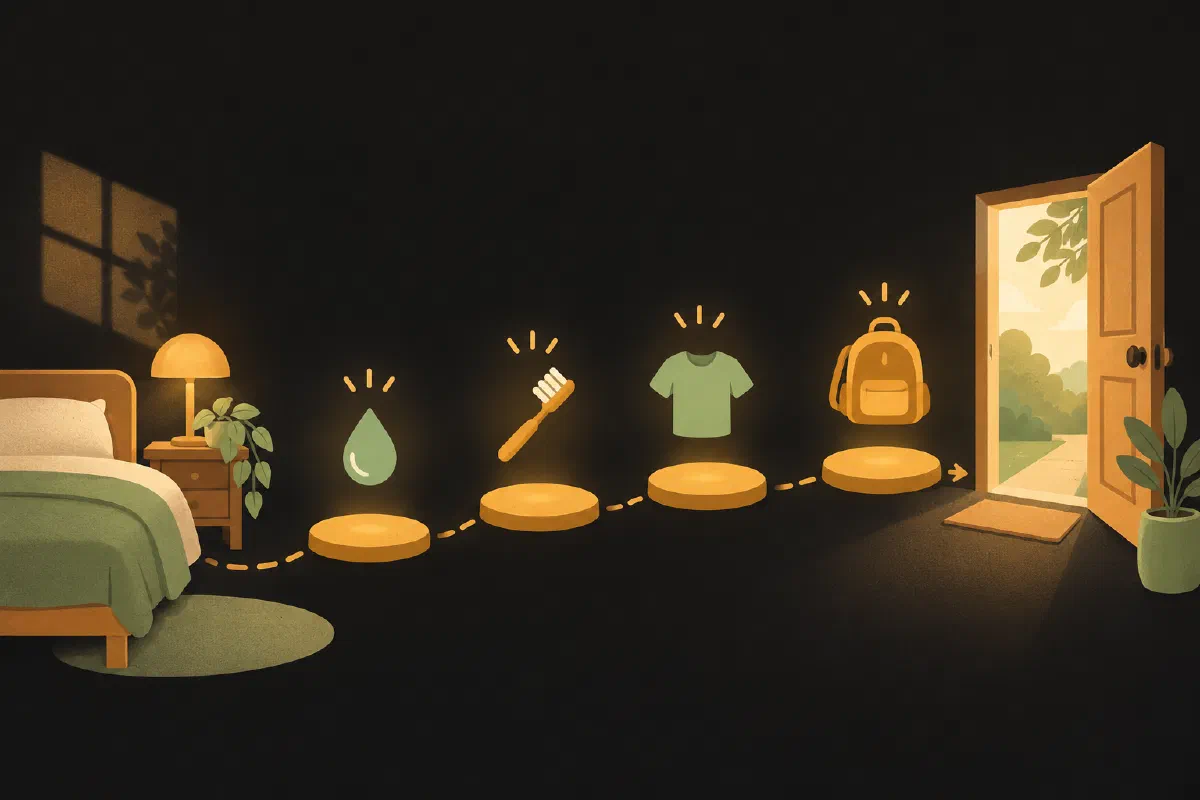
Build your routine in one evening
You do not need a whole weekend to set this up. One focused evening is enough for a first version.
- Pick your leave time or start time. Work backwards from the moment you need to be out of the door or at your desk.
- List what truly has to happen. Write every step of an ordinary morning, then cross out anything that is nice but optional. What remains is your minimum version.
- Find a cue for every step. Use moments that already happen: the alarm, the bathroom door, the kettle, putting on shoes. Write each step as “when…, then I…”.
- Remove decisions. Choose two default breakfasts, lay out clothes, decide where keys and bag will always live. Every decision you make the evening before is one you do not have to make half awake.
- Set up a launch pad. Pick one spot near the door, such as a basket, hook or shelf, for everything you take with you. Charge your phone there if you tend to grab it and scroll.
- Write it down and put it where you will see it. A list you have to open an app to find is a list you will forget.
- Time two mornings. Note how long each step really takes, add them up and add a buffer of about 10 minutes. Set your alarm by that total, not by your guess.
- Review after a week. Keep what worked, move steps that kept getting skipped, and simplify anything that caused friction.
Worked example: a hybrid worker’s Tuesday
This is an illustrative example, not a real person, showing how the template plays out on an ordinary day.
Alex works three days a week in the office and needs to leave at 8:15. Before building a routine, Alex guessed the morning took 30 minutes. Timing two mornings showed it actually took 52, mostly because of a long shower, phone scrolling at breakfast and a daily search for the train pass.
Monday evening, Alex spends 10 minutes on the night-before setup: outfit on the chair, glass of water by the bed, bag by the door with the train pass clipped inside, laptop charging on the hall shelf.
Tuesday morning:
- 7:10 The alarm rings across the room. Alex gets up to turn it off and drinks the water on the way back past the bed.
- 7:15 Bathroom. A short song playlist runs during the shower; when it ends, the shower ends. This was the biggest time saver.
- 7:30 Dressed in the clothes from the chair, no decisions needed.
- 7:35 Kettle on. Breakfast is one of two defaults: toast or yoghurt with fruit. The phone stays on the launch pad.
- 7:50 Alex reads the sticky note written the evening before: “First task: reply to the supplier email, then draft slides.” Today’s plan is now clear.
- 8:00 Shoes on, launch pad check: keys, wallet, phone, bag, pass.
- 8:05 Out of the door with 10 minutes of buffer, which on Tuesday gets eaten by a forgotten umbrella, and that is fine.
On Thursday Alex oversleeps by 20 minutes. Instead of abandoning the plan, Alex switches to the minimum version: quick wash, clothes from the chair, breakfast bar from the bag, launch pad, door. The routine still happened, just in its smallest form.
The night-before setup
Many ADHD-friendly routines actually start in the evening. Ten minutes before bed can remove most of the morning decisions:
- Lay out tomorrow’s clothes, including shoes and anything weather-related.
- Put everything you need to take on the launch pad.
- Write your first work task on a sticky note and leave it where you will see it.
- Fill the glass of water or prepare the coffee maker.
- Check tomorrow’s calendar for anything unusual, such as an early meeting or an appointment.
Keep this list just as short as your morning one. If you want to build a full wind-down, see our guide to a night routine that prepares you for tomorrow. For sleep problems themselves, speak to a doctor.
When your routine falls apart: troubleshooting
Every routine breaks sometimes. The useful question is not “why can’t I stick to anything?” but “which step is failing, and why?”
| What happens | Likely reason | What to try |
|---|---|---|
| You lie in bed scrolling | The phone is within reach and more interesting than getting up | Charge the phone on the launch pad and use a separate alarm clock across the room |
| One step eats the whole morning | No end point for the step, so time slips away | Give that step a clear finish: a song, a short timer, a playlist |
| You forget something at the door | The list lives in your head | Launch pad by the door plus a short checklist at eye level |
| It works for four days, then collapses | The routine is too long or depends on motivation | Drop to the minimum version for a week, then add back one step at a time |
| Weekends wipe out the habit | Different cues and wake times | Keep two or three anchor steps every day, even on weekends |
| Low-energy mornings | Bad night, stress or simply a hard day | Use the minimum version without guilt; see our gentle low-energy morning routine |
| Other people change the plan | Partner, children or housemates share the morning | Agree on who uses the bathroom when and keep your launch pad separate |
If you have a routine that keeps failing, our guide on how to stick to a routine with ADHD goes deeper into keeping habits going over months.
From morning routine to the first work task
For many working adults the hardest moment of the morning is not getting dressed. It is sitting down and actually starting work. The routine gets you to the desk; something else has to get you into the first task.
A few ways to make that transition easier:
- Decide the first task the night before. Write it in one concrete line, like “open the budget file and fill in the January column”, not “work on budget”.
- Make the first block short. Ten minutes is enough to break the inertia. If you keep going, great; if not, you have still started.
- Make time visible. A countdown on screen shows you how much is left instead of leaving you to guess. You can use our free browser-based Cyklio Focus Timer.
- Set a realistic daily target. Decide in the morning how many hours of focused work today should hold, so “a good day” has a clear, achievable meaning.
This is where our own app, Cyklio (made by Mindly 360), fits in. It lets you set a daily goal in hours and watch a progress ring fill as you complete focus sessions, which can last from 10 to 60 minutes. After each session you rate it as full focus, distractions or not today, and daily, weekly and monthly reports show how your focus time adds up. It is available on Android with a 7-day free trial, full access, no account and no card needed, and it is a planning tool, not a treatment.
If even a short first session feels impossible, our guide on how to start a task when you can’t get going has more ways to get unstuck.
When to talk to a professional
A routine is a self-help tool. It can make mornings smoother, but it does not replace assessment or treatment.
Consider talking to a GP or doctor if:
- Mornings keep going wrong despite a simple routine, and it affects your work, studies or relationships. The NHS advises booking a GP appointment if ADHD symptoms are affecting those areas of your life.
- You are tired most mornings, struggle to fall asleep or wake up, or rely on many alarms. Sleep problems deserve a proper medical look.
- You have questions about when to take medication or how it fits your day. Those belong with your prescriber.
Structured support can also help with the skills behind a routine. In a randomised trial in the American Journal of Psychiatry, involving 88 adults with ADHD, a 12-week group programme that taught time management, organisation and planning skills led to greater improvement in inattention symptoms than supportive group therapy without those skills. The NIMH also mentions psychotherapy and ADHD coaching as options. Ask your doctor what is available where you live.
Summary
- Hard mornings with ADHD are linked to forgetfulness, time management and sometimes a later body clock, not to laziness.
- Keep the routine short, visible and tied to cues you already meet every morning.
- Build three versions, minimum, standard and good day, and let the minimum count as success.
- Prepare the hardest parts the night before, time your real steps once, and add a buffer.
- Missed days are normal and do not reset your progress.
Your next step: tonight, write down your minimum version, four or five steps with a cue for each, and stick it where you will see it tomorrow morning. Then, when you sit down to work, start with one 10-minute focus session on the first task you chose.