

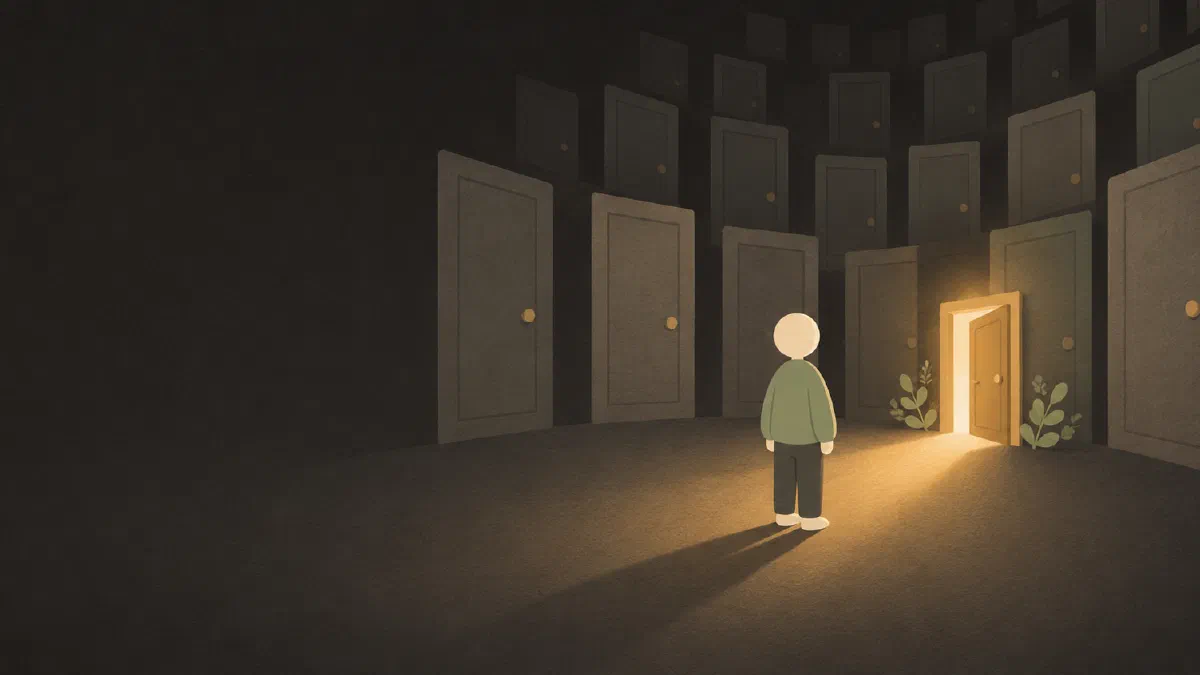
You know exactly what you need to do, you may even want to do it, and yet you sit there for an hour, unable to begin. Many adults with ADHD call this “ADHD paralysis”. This guide explains what the term means, what research does and does not say about it, and ten concrete ways to get moving again.
This article is educational and does not replace advice from a doctor.
What is ADHD paralysis?
ADHD paralysis is an informal name for getting stuck: you freeze before starting a task, while choosing between tasks, or halfway through something that suddenly feels like too much. People also call it “task paralysis”, “decision paralysis” or “ADHD freeze”.
It is important to be clear about what the term is not. ADHD paralysis is not a diagnosis or a clinical term. You will not find it in official descriptions of ADHD. Those descriptions use plainer language: the NIMH describes inattention as “difficulty paying attention, keeping on task, or staying organized”, and the NHS lists adult symptoms such as finding it hard to organise your time and finding it hard to follow instructions or finish tasks. “ADHD paralysis” is the name people have given to how those difficulties can feel from the inside.
That also means two things:
- Feeling stuck does not mean you have ADHD. Most people freeze sometimes, especially when tired, stressed or facing something unpleasant.
- Having ADHD does not mean you will freeze on every task or every day.
What it can look like
People who use the term usually describe some mix of these:
- Knowing the next step but not being able to take it.
- Spending long stretches “getting ready” (tidying, checking email, opening and closing tabs) without starting.
- Feeling that every task is equally urgent, so choosing one feels impossible.
- Scrolling on your phone while feeling worse with every minute.
- Being fine with small tasks but freezing completely on one big, vague or boring one.
- A wave of guilt or frustration that makes the next attempt even harder.
An illustrative working day
The example below is a composite to show the pattern, not a real person.
It is 9:10 on a Tuesday. A project manager has four things on her list: a status report due at noon, a reply to a difficult client email, booking a dentist appointment and preparing slides for Thursday. She opens the report, sees a blank page, switches to the client email, rereads it twice, feels her stomach tighten, closes it, checks the slide template “just quickly”, then picks up her phone. At 10:25 nothing has moved, and she now has 95 minutes less for the report. Nothing about this is laziness. Each task triggered a different kind of stuck: a vague start (the report), an unpleasant emotion (the email), and too many open options (the whole list).
We come back to this morning later and show how she could get out of it.
Why does it happen? What research actually says
“ADHD paralysis” is not a defined condition, so it has not been studied as one. But there is solid research on related processes that can make starting hard. Here is what it supports, and how strongly.
Executive functions: starting needs planning and working memory
Executive functions are the mental skills that help you hold a goal in mind and organise steps toward it. A large meta-analysis of 83 studies (Willcutt and colleagues, 2005) found that groups with ADHD performed worse than groups without ADHD on executive function tasks, with the strongest and most consistent differences in response inhibition, vigilance, working memory and planning. The effects were medium-sized, and the authors stress that executive function weaknesses are neither necessary nor sufficient to cause all cases of ADHD.
In everyday terms: starting a task requires you to work out a first step, keep it in mind and hold it against distractions. If planning and working memory are under strain, a task with no obvious first step can feel like a wall. This is a reasonable link, but it is an interpretation of the research, not a proven mechanism for “paralysis” specifically.
Emotions: avoiding the bad feeling a task brings
Procrastination researchers Fuschia Sirois and Timothy Pychyl argue that procrastination has a great deal to do with short-term mood repair: we avoid a task to escape the unpleasant feeling it creates right now, and our future self pays the price. A later review by Sirois (2023) argues that stressful situations raise the risk of procrastinating, proposing that putting things off is a low-effort way to avoid difficult task-related emotions.
This matters for ADHD because, according to a review in The American Journal of Psychiatry (Shaw and colleagues, 2014), emotion dysregulation is common in ADHD across the lifespan and is a major contributor to impairment. If emotions hit harder and settle more slowly, a task that brings dread, boredom or fear of judgement may be much harder to approach.
Too many options: why choosing can freeze you
“Decision paralysis” has a research cousin called choice overload. A meta-analysis by Chernev and colleagues (2015) found that large sets of options are more likely to overwhelm people when the decision is difficult, the options are complex, preferences are uncertain, and the person wants to minimise effort. One of the outcomes they measured was choice deferral, in other words, not choosing at all. That research was about product choices, not ADHD, so treat it as a useful analogy for a long to-do list rather than direct evidence.
ADHD symptoms and procrastination are linked
Studies do connect ADHD symptoms with procrastination. In a small study of 54 university students (Niermann and Scheres, 2014), symptoms of inattention were linked with general procrastination once the other ADHD symptom domain was accounted for; the authors describe the finding as preliminary. A survey of 470 adults (Oguchi and colleagues, 2021) found that people with more ADHD symptoms reported more procrastination and more symptoms of depression and anxiety. Both studies are correlational, so they show a relationship, not a cause.
Three kinds of stuck, and the first move for each
Not all freezing is the same. Spotting which kind you are in helps you pick the right first move. This table is a practical guide based on the research above, not a clinical tool.
| Kind of stuck | What it sounds like in your head | What is probably missing | Best first move |
|---|---|---|---|
| Vague start | “I don’t even know where to begin.” | A concrete first step | Shrink the task to one physical action (way 2) |
| Emotional block | “I really don’t want to face this.” | A tolerable way in | Name the feeling and lower the bar (ways 1 and 7) |
| Too many options | “Everything is urgent, I can’t choose.” | One clear priority | Cut the options to one for the next 10 minutes (way 4) |
| Restart freeze | “I stopped and now I can’t get back in.” | A visible re-entry point | Leave yourself a next step before you stop (way 10) |
10 ways to get unstuck from ADHD paralysis
You do not need all ten. Pick the one that matches your kind of stuck and try it for ten minutes.
1. Name it without judging yourself
Say, or write: “I’m stuck. This is the freeze, not a character flaw.” That sounds soft, but there is some evidence behind it. In a study of first-year students across two rounds of midterm exams (Wohl, Pychyl and Bennett, 2010), those who reported forgiving themselves for procrastinating before the first exams reported less procrastination before the second ones. Research by Sirois (2014) also found that people who procrastinate more tend to have lower self-compassion and higher stress. These are student and survey studies, not ADHD trials, but the direction is consistent: self-criticism tends to add weight, not momentum.
2. Shrink the first step until it is physical and tiny
“Write the report” is not a step. “Open the report file and type the heading” is. A good first step is:
- physical (open, type, pick up, write one line),
- specific (you could film someone doing it),
- short (under two minutes),
- slightly silly in how easy it is.
If you still cannot start, the step is still too big. Cut it again. Our guide to task initiation goes deeper into breaking work down.
3. Write an if-then plan
An if-then plan, which researchers call an implementation intention, spells out when, where and how you will act: “If it is 9:30 and I’ve made my coffee, then I open the report and write the first heading.” In a meta-analysis of 94 tests (Gollwitzer and Sheeran, 2006), forming implementation intentions had a medium-to-large positive effect on reaching goals and helped people start goal-directed action. The studies were mostly not on ADHD, but it is one of the better-supported strategies for getting started in general.
Template: “If [time or situation], then I will [tiny first step] in [place].”
4. Cut your options down to one
When everything feels urgent, make the decision smaller. You are not deciding the order of your whole day, only what you do for the next ten minutes. Try one of these tie-breakers:
- Which task has the nearest real deadline?
- Which task would make the others easier if it were done?
- If both are equal, pick the one on the left of your list, or flip a coin.
Then hide the rest: close the tabs, turn the list face down, or write the chosen task on a sticky note and put it in front of you. This mirrors the choice-overload research above: fewer, simpler options lower the chance of not choosing at all.
5. Time-box it: one task, 10 minutes
“I’ll work on this until it’s done” is frightening. “I’ll work on this for ten minutes and then I’m allowed to stop” is not. A short, fixed block gives the task a visible end. Set a timer, work only on that one task, and when the timer ends, decide freshly whether to continue or stop. Stopping is allowed.
This is the idea behind interval methods like the Pomodoro Technique, which we explain for ADHD brains in Pomodoro for ADHD. You can try it right now with our free Cyklio Focus Timer in the browser.
6. Get it out of your head and onto paper
If working memory is one of the things under strain, stop trying to hold everything in your head. Spend three minutes writing down every task and worry that is circling, in any order. Then circle one. A brain dump does not finish anything, but it can turn a fog of “everything” into a visible list you can choose from. If the list itself feels overwhelming, our guide to feeling overwhelmed has more ways to sort it.
7. Lower the bar on purpose
Perfectionism and fear of judgement can hide inside the freeze. Give yourself explicit permission to do a bad version first:
- a “rubbish first draft” of the email, written in your own words with no greeting,
- a report outline with only bullet points,
- slides with just titles and no design.
You can improve something that exists. You cannot improve a blank page. This works on the emotional block: the task becomes less threatening, so there is less to avoid.
8. Change the setting or add a person
Sometimes the environment carries the freeze. Moving to a different room, a café table or the kitchen can break the loop. Another common strategy among adults with ADHD is body doubling: working alongside another person, in person or on a video call, while each of you does your own task. It is a popular approach rather than a clinical treatment, so treat it as an experiment. Our guide to body doubling explains how to set it up.
9. Reset your body for two minutes
When you are frozen in a chair, a short physical reset can interrupt the spiral: stand up, drink a glass of water, walk to the window and back, or wash your face. Keep it short and set a clear return point (“after the water, I sit down and open the file”), because a reset without a return point can quietly turn into a longer break.
10. Plan the restart before you stop
Getting back into a task after a break can be as hard as starting it. Before you stop, write one line at the top of your work: “Next: write the second paragraph about budget.” When you come back, you do not have to rebuild the plan; you just follow the note. If you use a timer app, rating how the session went (for example, full focus or distracted) can also help you notice which times of day and kinds of task are easier for you.
A 15-minute plan for when you are stuck right now
If you are reading this instead of doing the thing, here is a short, complete plan. You can copy it into your notes.
- Minute 0–1: Name it. Write “I’m stuck on: ____”. No judgement.
- Minute 1–3: Brain dump. List everything on your mind. Circle one task using the tie-breakers in way 4.
- Minute 3–4: Shrink it. Write the first physical step: “Open ____ and ____”.
- Minute 4–5: If-then. “If the timer starts, then I will ____.”
- Minute 5–15: Ten-minute session. Start the timer and do only that step, then the next obvious one.
- Minute 15: Decide. Continue for another session, or stop and write your restart note (way 10).
Back to our illustrative project manager. Using this plan, she writes “I’m stuck on everything”, dumps the four tasks, picks the report because of the noon deadline, and writes the first step: “Open the report and paste last week’s headings.” She sets a 10-minute timer. By the end of it she has an outline. The client email is still unpleasant, but now it is a separate, later problem with its own tiny first step: “Write one sentence saying I’ve received the email.”

Is it ADHD paralysis, depression or burnout?
Feeling stuck can overlap with other conditions, and it is worth looking at the wider picture. The NHS describes depression symptoms that include having no motivation or interest in things and finding it difficult to make decisions, which can look a lot like “paralysis” from the outside. The NHS advises seeing a GP if you have symptoms of depression for most of the day, every day, for more than two weeks.
Some rough signals (these are not a diagnosis):
- If you freeze on specific tasks but still enjoy other things and feel like yourself, it may be more about task difficulty, emotions or load.
- If you feel low, empty or hopeless most of the time, and things you used to enjoy no longer interest you, talk to a doctor about your mood.
- If you have been running on empty for weeks and even easy tasks feel impossible, exhaustion or burnout may be part of the picture.
We cover the differences in more detail in ADHD paralysis vs depression. Only a qualified professional can tell you what is going on for you.
When to get professional help
Self-help strategies are useful, but they are not a substitute for an assessment or treatment. The NHS advises that if ADHD-type symptoms are affecting your studies, work or relationships, you should make an appointment with a GP to find out what support is available. A GP may also consider other conditions and may refer you to a specialist for an assessment.
Consider talking to a doctor or mental health professional if:
- being stuck is regularly costing you at work, in your studies or at home,
- you have tried practical strategies for several weeks and nothing shifts,
- you think you might have ADHD but have never been assessed,
- you already have an ADHD diagnosis and your current support no longer seems to be enough,
- you notice low mood, anxiety or exhaustion alongside the freezing.
Professional support can include more than medication. The NIMH notes that standard ADHD treatments include medication and psychosocial interventions such as cognitive behavioural therapy (CBT). In a randomised trial (Safren and colleagues, 2010), adults with ADHD who still had symptoms despite medication improved more with CBT than with a relaxation and education comparison, and kept their gains at 12 months. Any change to your treatment should be discussed with your doctor.
If you are in crisis or having thoughts of harming yourself, contact your local emergency number or a crisis line in your country straight away. If you are not sure which number to call, a doctor, pharmacist or local health service can tell you.
Questions people often ask
Is ADHD paralysis real?
The experience is real and common, but the name is informal. It is not a diagnostic term. What research supports is that ADHD is linked to weaker executive functions, harder emotion regulation and more procrastination, which together can make starting very hard.
Is ADHD paralysis just laziness?
No. Laziness implies not caring. People describing ADHD paralysis usually care a lot and feel distressed that they cannot start. Research on procrastination links it closely to short-term mood repair, in other words, escaping difficult emotions in the moment.
Can you have ADHD paralysis without ADHD?
Anyone can freeze, especially under stress, fatigue or with too many choices. The term is mostly used by people with ADHD, but the strategies in this guide work for anyone who gets stuck.
Summary
- “ADHD paralysis” is a popular name, not a diagnosis, for freezing before or during tasks.
- Research links ADHD to weaker planning and working memory, stronger emotional reactions and more procrastination, all of which can make starting hard.
- Identify your kind of stuck (vague start, emotional block, too many options, restart freeze) and match the first move to it.
- Keep it small: one task, one physical first step, ten minutes.
- If being stuck is persistent, comes with low mood, or is hurting your work or relationships, talk to a doctor.
Your next step: choose one task you are avoiding, write its tiny first step, and start a single 10-minute session. You can use the free Cyklio Focus Timer in your browser, or Cyklio, our focus timer app (made by Mindly 360), which offers a 7-day free trial with full access and no account or card needed, sessions from 10 to 60 minutes, and a quick rating after each one so you can see what helps. More about the app is on the Cyklio app page.
This article is educational and does not replace advice from a doctor.