


You close a report to answer a quick question, and forty minutes later you are still not back in the report. If moving from one task to the next feels like dragging an anchor, you are not imagining it: switching has a real, measurable cost for everyone. This guide explains what research says about that cost and about ADHD, then gives you three habits for smoother transitions.
Why is task switching hard with ADHD?
Every switch has a price, for everyone
Psychologists have studied task switching for decades. In a well-known review in Trends in Cognitive Sciences, Stephen Monsell summarised that people respond substantially slower, and usually make more errors, immediately after switching tasks. This “switch cost” shrinks when people get a chance to prepare, but it does not disappear.
The cost also depends on the tasks. In experiments by Rubinstein, Meyer and Evans, the time lost when alternating between tasks grew with the complexity of the rules involved and fell when clear cues signalled which task came next. Their results also suggest that switching from a familiar task to an unfamiliar one takes longer than the reverse. In everyday terms, moving from routine email into an unfamiliar, rule-heavy project is likely the more expensive direction.
Part of your attention stays behind
Switching is not only about starting the new task. It is also about letting go of the old one. Management researcher Sophie Leroy calls this attention residue: in her experiments, people who left a task unfinished had more trouble shifting their attention away from it, and performed worse on the next task. Interestingly, simply finishing the first task was not always enough to clear the residue.
Interrupted work also changes how people feel. In a study by Mark, Gudith and Klocke, interrupted participants finished their tasks faster with no loss of quality, but reported more stress, frustration, time pressure and effort. Getting through it does not mean it was free.
Where ADHD comes in
ADHD is not defined by task switching, and “trouble with transitions” is not a diagnostic criterion. But several everyday signs overlap with it. The NHS lists being easily distracted or forgetful, finding it hard to organise your time and finding it hard to finish tasks among the inattentive signs in adults, and the CDC notes that symptoms can continue into adulthood and may look different there.
Research on executive functions, the mental skills that keep you working toward a goal, adds detail:
- A meta-analysis of 83 studies found that groups with ADHD scored lower on all executive function tasks, with the strongest effects for response inhibition, vigilance, working memory and planning. The authors also stressed that these weaknesses are not present in everyone with ADHD.
- A meta-analysis of adult studies found medium-sized differences in set shifting, the lab measure closest to task switching, alongside differences in inhibition and other areas.
- A review of 34 meta-analyses found that set shifting showed the smallest average difference of the domains studied, while working memory and reaction time variability showed larger ones.
So the honest picture is mixed. Lab switching tests show only modest differences on average, yet everyday signs such as distractibility and difficulty finishing tasks can make workday transitions feel hard. One plausible reading, not a proven one, is that real switches lean on several skills at once: holding your place in memory (see working memory and ADHD), resisting the pull of the new thing, and planning the way back. Whatever the mechanism, the practical response is the same: make switches fewer, and make each one cheaper.
Planned switches, forced switches and self-interruptions
Not all switches are alike. Naming which kind you are facing helps you choose the right tool.
| Type of switch | Example | What usually goes wrong | What helps most |
|---|---|---|---|
| Planned switch | Your focus block ends and a meeting starts | You run over, or carry the old task into the meeting in your head | A short transition ritual and a parking note |
| Forced interruption | A colleague asks an urgent question mid-task | You lose your place and come back cold | A 30–60 second parking note before you turn around |
| Self-interruption | You “just check” chat and land in a new task | Many small switches, none of them chosen | Batching chat and email into set slots |
| Mid-task drift | You start fixing a side issue you spotted | The main task quietly stalls | Write the side issue on a capture list and keep going |
The last row is worth a pause. If you find yourself drifting away from a task because it feels heavy, the problem may be avoidance rather than switching; ADHD and task avoidance covers that pattern. And if your issue is the opposite, being unable to stop at all, see what hyperfocus is.
Parking notes: leave yourself a way back
The habit in this guide with the most direct research support is also the simplest. In four studies, Leroy and Glomb tested a “ready-to-resume” plan: before switching, people briefly noted and planned their return to the interrupted task. This reduced attention residue and protected performance on the interrupting task. According to the University of Washington’s summary, the note covers where you stopped, what remains to be done and anything you need to postpone, and it can take as little as a minute. The studies did not test whether the plan also improves work on the original task once you return, though Leroy sees no reason it would not.
A related line of research points the same way. In studies by Masicampo and Baumeister, unfinished goals caused intrusive thoughts and hurt performance on unrelated tasks, but letting people make a specific plan for the unfinished goal removed those effects. A plan seems to tell your mind “this is handled for now”.
These studies were done with general samples, not specifically with adults with ADHD. Still, a parking note directly offloads the things a switch asks you to hold in your head, which is exactly where many people with ADHD struggle.
Fill-in parking note template
Keep this in a sticky note, a text file or the first line of the document you are leaving:
- I stopped at: ___ (the exact sentence, cell, ticket or step)
- Next physical action: ___ (a verb you can start in under two minutes, such as “write the intro to section 3”)
- Open questions: ___
- Parked for later: ___ (side ideas, things to check)
- Coming back: ___ (a time, or “after the 2 pm call”)
Write it before you switch, not after. The value is in capturing your place while it is still fresh.
Transition rituals: a short bridge between tasks
A transition ritual is a small, repeated sequence you do between tasks. It is a common practical strategy rather than a clinically tested ADHD intervention, but it borrows from two solid findings. First, preparation reduces switch costs even if it cannot remove them. Second, Gollwitzer and Sheeran’s meta-analysis of 94 tests found that “if-then” plans, which spell out when and how you will act, had a medium-to-large effect on reaching goals, including on starting and on shielding a goal from distractions.
Here is a ritual you can run in about three minutes:
- Close the loop. Write your parking note for the task you are leaving.
- Clear the screen. Close the tabs and files of the old task, or move them to one window you can reopen later.
- Move your body. Stand up, refill your water, walk to the window. A physical break marks the boundary.
- Open the next task’s cue. Open the one file or ticket you will start with. Read your last parking note for it, if there is one.
- Set an if-then. “If I sit down, then I write the first line of the agenda.” Make the first step small and specific.
- Start a timer. A defined block, for example with the Cyklio Focus Timer, gives the new task a clear start and a planned end.
Keep the ritual the same every time. The point is that it becomes automatic, so the switch costs less thought.
Batching: fewer switches per day
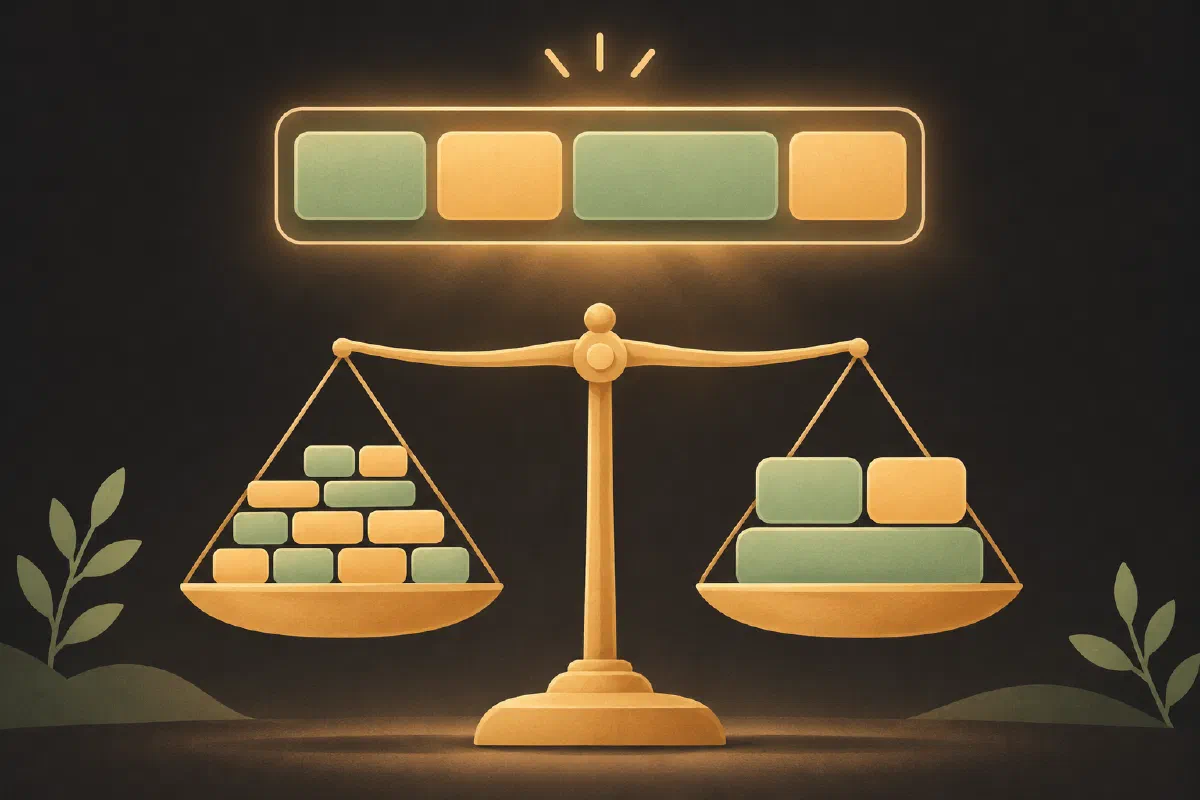
If each switch has a price, the simplest saving is to switch less often. Batching means grouping similar tasks, such as replies, admin, calls or small fixes, into one block instead of scattering them through the day. This follows from the switch-cost research above: each switch slows you down, and switching between complex rules costs more, so fewer switches means fewer of those costs. It is a logical application, not something tested in ADHD studies.
Practical ways to batch:
- Communication slots. Check email and chat at set times, for example on the hour, rather than whenever a notification appears.
- Similar-tool blocks. Do all spreadsheet tasks together, then all writing tasks.
- A capture list. When a new small task appears during a focus block, write it down for the next admin batch instead of doing it now.
- Protected deep blocks. Put your most complex task in a block with notifications off, since the expensive switches are into hard, unfamiliar work.
Be realistic. Some roles require quick responses, and a batch you cannot keep is worse than none. Start with one daily admin batch and adjust. For how batching compares with scheduling every hour, see time blocking vs task batching.
Batching is different from chaining small habits together into a routine; that is covered in ADHD task stacking. And if your main question is how long it takes to recover after a break in focus, read how long it takes to regain focus after an interruption.
A worked example: one afternoon, three switches
Here is an illustrative example. Maya is a project coordinator with ADHD. Her afternoon has a budget update, a 3 pm team call and a backlog of messages.
- 1:00 pm. She starts a 45-minute focus block on the budget update. Chat is closed; new requests go onto her capture list.
- 1:20 pm. Her manager calls with an urgent question. Before answering, she spends 40 seconds typing a parking note at the top of the spreadsheet: “Stopped at row 48 (travel costs). Next: check Q3 invoices. Parked: ask finance about VAT line.”
- 1:35 pm. After the call, she reads the note and is back at row 48 within a minute, instead of re-scanning the whole sheet.
- 2:45 pm. Her block has ended. She runs her ritual: parking note, closes the spreadsheet, refills her water, opens the call agenda, and sets an if-then: “When I sit down, I list the three decisions we need.”
- 3:30 pm. After the call, she does one 30-minute message batch, working through the capture list as well.
Nothing about this afternoon is perfect. The interruption still happened, and the ritual took a few minutes. But each switch had a planned landing spot, so less of her attention stayed behind.
When switching difficulties need more than habits
Habits help many people, but they are not a substitute for support. If problems with focus, organisation or finishing tasks are affecting your work or relationships, the NHS advises booking an appointment with a GP to find out what support is available. If you were diagnosed as a child and need help with symptoms now, the NHS notes you can ask your GP for a referral.
Summary
- Switching tasks costs time and accuracy for everyone, and the cost is higher when the rules are complex or the new task is unfamiliar.
- ADHD is linked to executive function weaknesses on average, which can make transitions harder, but individual patterns vary.
- A one-minute parking note is the habit here with the most direct research support.
- A short, repeated transition ritual and batching similar tasks reduce how often you pay the switch cost, and how much.
Your next step: pick the next planned switch in your day. Before it, write a five-line parking note and start the next task with a timed block. If you would like a tool for that, Cyklio, our own app, lets you set focus sessions from 10 to 60 minutes and rate each one afterwards, so you can see which sessions went well after a switch. It comes with a 7-day free trial, with no account or card needed.