


ADHD and autism can look alike from the outside: trouble concentrating, a hard time at work, social situations that drain you. Underneath, they are two different conditions that also often occur together. This guide compares their core features, explains the overlap and describes how adults are assessed for each.
This article is educational and does not replace advice from a doctor. If you are in crisis or thinking about harming yourself, contact your local emergency number or a crisis line in your country straight away.
What are ADHD and autism?
Both are neurodevelopmental conditions, which means they relate to how the brain develops and they begin early in life.
ADHD. The National Institute of Mental Health describes ADHD as a neurodevelopmental disorder marked by inattention, hyperactivity and impulsivity that occur often, across several settings, and interfere with daily life. Symptoms begin in childhood and usually continue into adulthood. The NHS notes that symptoms usually start before the age of 12, and that most people have symptoms of both types, inattention and hyperactivity-impulsivity, though some have only one.
Autism. The World Health Organization describes autism as a diverse group of conditions related to brain development, involving some difficulty with social interaction and communication, atypical patterns of activity and behaviour, a focus on details and unusual reactions to sensations. It estimates that about 1 in 127 people worldwide were autistic in 2021. The NHS stresses that autism is not an illness: there is no cure, but there are ways to manage it and get support.
Under DSM-5, as summarised by the CDC, an autism diagnosis needs two things: persistent differences in social communication and interaction, and restricted, repetitive patterns of behaviour, interests or activities. Symptoms must be present early in development, but they may not show fully until social demands exceed a person’s capacities, and in later life they may be masked by learned strategies. That is one reason some people are first recognised as autistic in adulthood.
Core differences at a glance
The table compares how authoritative sources describe the defining features of each condition in adults. It is a summary to help you understand the two conditions, not a self-test. Many people recognise themselves in both columns, and only a clinician can make sense of that.
| Area | ADHD (NHS and NIMH descriptions) | Autism (NHS, CDC and WHO descriptions) |
|---|---|---|
| Core definition | Inattention, hyperactivity and impulsivity (NIMH) | Social communication differences plus restricted or repetitive behaviours and interests (CDC) |
| Attention | Easily distracted, forgetful, losing things (NHS) | Strong focus on specialist interests (NHS) and a focus on details (WHO) |
| Social life | Being very talkative, interrupting conversations (NHS) | Finding it hard to read facial expressions or tone of voice, taking language literally (NHS) |
| Routine and change | Finding it hard to organise time and finish tasks (NHS) | Preferring fixed ways of doing things and becoming distressed when routines change (NHS) |
| Movement and energy | Restlessness, a lot of energy (NHS) | Repetitive movements, known as stimming (NHS) |
| Decisions | Making quick decisions without thinking about the consequences (NHS) | Not a defining feature in these descriptions |
| Senses | Not part of the NHS ADHD symptom list | Being very sensitive, or not sensitive at all, to light, sound, smell, taste or texture (NHS) |
Sensory sensitivity is a large topic of its own. If noise and light are your main struggle, see our guide to ADHD vs sensory processing issues. For a fuller picture of ADHD on its own, read ADHD symptoms in adults.
Where ADHD and autism overlap
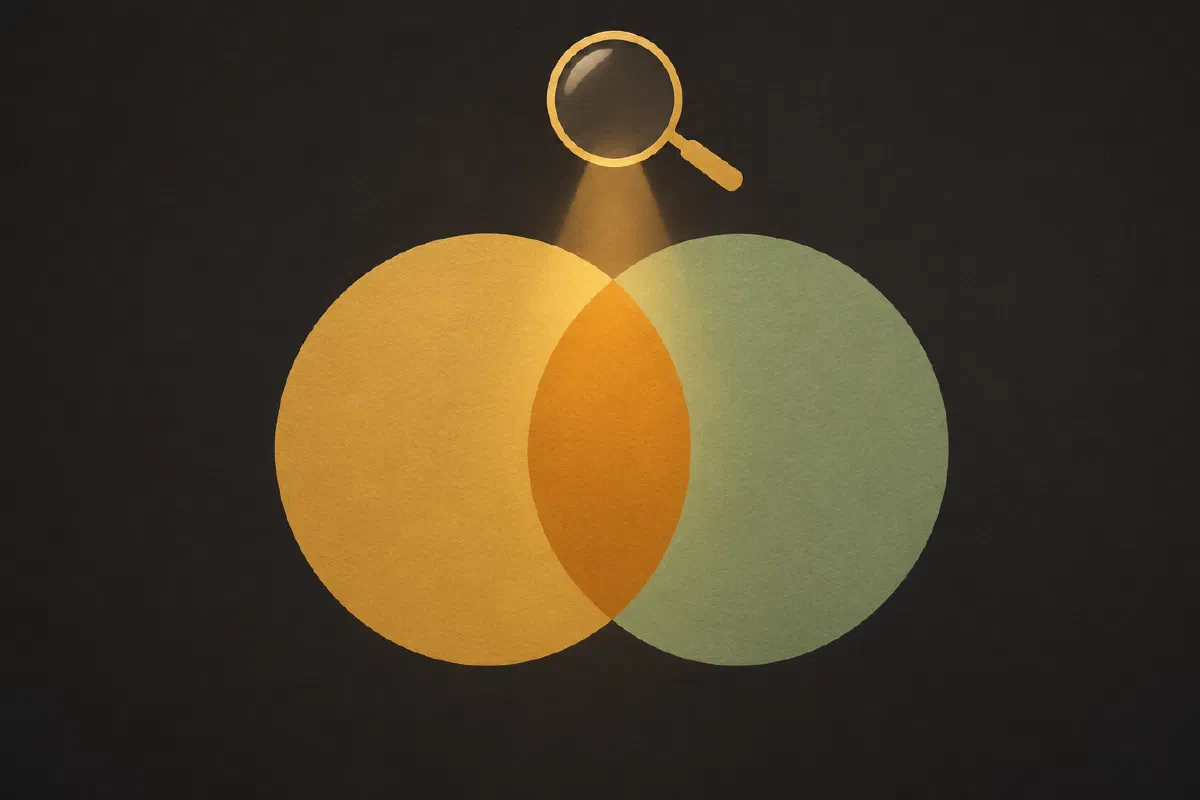
The table makes the two conditions look neatly separate. In real life they are not. The CDC lists “hyperactive, impulsive, and/or inattentive behavior” among the characteristics many autistic people have in addition to the core features.
Two research reviews describe overlap in three areas:
- Executive function. A 2019 review in Current Psychiatry Reports found that the two conditions share some difficulties with executive functioning, the mental skills behind planning, organising and switching between tasks.
- Social functioning. The same review notes shared social difficulties, but says they differ in how they show up, both in degree and in kind.
- Attention. A 2022 review in Frontiers in Psychiatry explains that executive difficulties usually linked to ADHD are also found in autistic people. It also notes that intense, narrow attention, which some researchers link to sensory over-reactivity in autism, can be mistaken for ADHD inattention.
The researchers also point to real differences. The Frontiers review notes that ADHD, unlike autism, is more directly tied to problems with inhibition, meaning stopping an action or a response. The Current Psychiatry Reports review concludes that the overlap is real, but the two conditions are distinct enough to stay separate diagnoses.
Same struggle, different reasons: a worked example
The example below is fictional and simplified. It shows why one behaviour can have different roots. It is not a way to decide which condition someone has.
Two colleagues, Maya and Tom, both miss the same Friday deadline after a week in which their team moved to a new open-plan floor and the project plan changed twice.
| Maya | Tom | |
|---|---|---|
| What colleagues saw | Started the report late, kept switching tabs | Started the report late, went quiet in meetings |
| What was going on for her or him | The new floor offered constant small interruptions. She opened the report many times but drifted to email and chat, and lost track of time until Thursday. | The noise and bright lights wore him out by midday. The changed plan meant his careful outline no longer fitted, and he found it hard to restart without a clear new structure. |
| Pattern this resembles | Easily distracted, hard to organise time (NHS ADHD description) | Sensory differences and distress when routines change (NHS autism description) |
| What helped the next week | Short timed blocks with notifications off, and a visible checklist | A quieter desk, headphones, and a written update whenever the plan changed |
A manager who saw only “missed deadline” would have offered both people the same fix. A person can also have both patterns at once, which is the subject of our guide to AuDHD.
How common is it to have both?
Having both conditions is common, though estimates vary a lot.
- A 2019 meta-analysis in The Lancet Psychiatry pooled studies and estimated that about 28% of autistic people also have ADHD.
- The Frontiers review cites a meta-analysis putting the figure at 50 to 70%, while noting that published rates range from 10 to 90% depending on how studies were done.
- A Swedish register study found that autistic people had far higher odds of also having ADHD, and that their relatives were also more likely to have ADHD. The authors see this as support for a genetic overlap between the two conditions.
Diagnostic rules have caught up with this. The Frontiers review explains that older manuals (DSM-IV and ICD-10) treated ADHD and autism as mutually exclusive, while DSM-5 mentions each in its description of the other and allows both to be diagnosed. The CDC summary of DSM-5 includes a specifier for autism associated with another neurodevelopmental, mental or behavioural condition.
Knowing about both matters for support, not only for labels. The Current Psychiatry Reports review concludes that, for autism support to be as effective as possible, co-occurring ADHD needs to be considered, and the other way round.
What about ADHD and Asperger’s?
Many adults search for “ADHD and Asperger’s” because they were diagnosed, or first heard about autism, under that name. According to the National Autistic Society, Asperger syndrome was removed as a separate diagnosis in DSM-5 (2013) and ICD-11 (2019) and folded into autism spectrum disorder, so it should no longer be given as a new diagnosis. Some people still describe themselves with the term, and that is their choice.
In practice, “ADHD and Asperger’s” today means ADHD and autism. Everything in this article applies.
How are ADHD and autism assessed in adults?
The two conditions are assessed separately. In the NHS descriptions below, both assessments rely mainly on questions about your history and daily life, and the NHS pages give a typical picture for adults.
Autism assessment. According to the NHS, a GP or a mental health professional can refer an adult to a local autism team. The assessment may involve one or more appointments with different healthcare professionals, who may:
- ask you to fill in questionnaires about yourself;
- ask how you behave with other people, and about your early life, home life and work;
- speak to someone who knew you as a child, and someone who knows you now;
- read GP reports and documents such as school reports or workplace assessments.
ADHD assessment. The NHS describes an assessment by an ADHD specialist, such as a psychiatrist. The specialist looks at your symptom history, especially in childhood and at school, and at how symptoms affect your work, relationships and health. With your involvement, they may also contact someone who knows you well.
Why telling them apart is hard. The NHS says a GP may consider other conditions with similar symptoms, such as autism, Tourette’s or anxiety, before referring for ADHD. The NHS also notes that signs of autism in adults can be harder to spot when someone also has ADHD, anxiety or depression. NIMH adds that conditions occurring alongside ADHD can make it harder to diagnose. And the Frontiers review describes a long-standing view in research that the two conditions are hard to tell apart at diagnosis.
This is why online quizzes cannot settle the question. If what you have read here sounds familiar, the next step is a conversation with a GP or doctor. Our guide on how an ADHD assessment works describes the stages in more detail.
Masking and energy
Many autistic adults learn to hide their signs. The NHS notes that this masking can make everyday activities exhausting and stressful. If you have felt drained for weeks and can no longer manage things you used to, read about autistic burnout and talk to a health professional.
Summary and one next step
ADHD and autism are separate neurodevelopmental conditions with different core features. ADHD centres on inattention, hyperactivity and impulsivity. Autism centres on social communication differences, plus repetitive behaviours, strong interests and sensory differences. They share difficulties with attention, executive function and social life, often for different reasons, and they frequently occur together. Asperger syndrome is now part of autism spectrum disorder. Only a clinician, using your history, can tell what applies to you.
Your next step: look back at the worked example and think about one recent hard day. Was the problem mostly interruptions and losing track of time, mostly noise, change and lack of structure, or both? Whatever your answer, you can test one adjustment this week, such as a quieter spot or short timed blocks with the Cyklio Focus Timer. If the pattern keeps showing up, take it to a GP or doctor.