

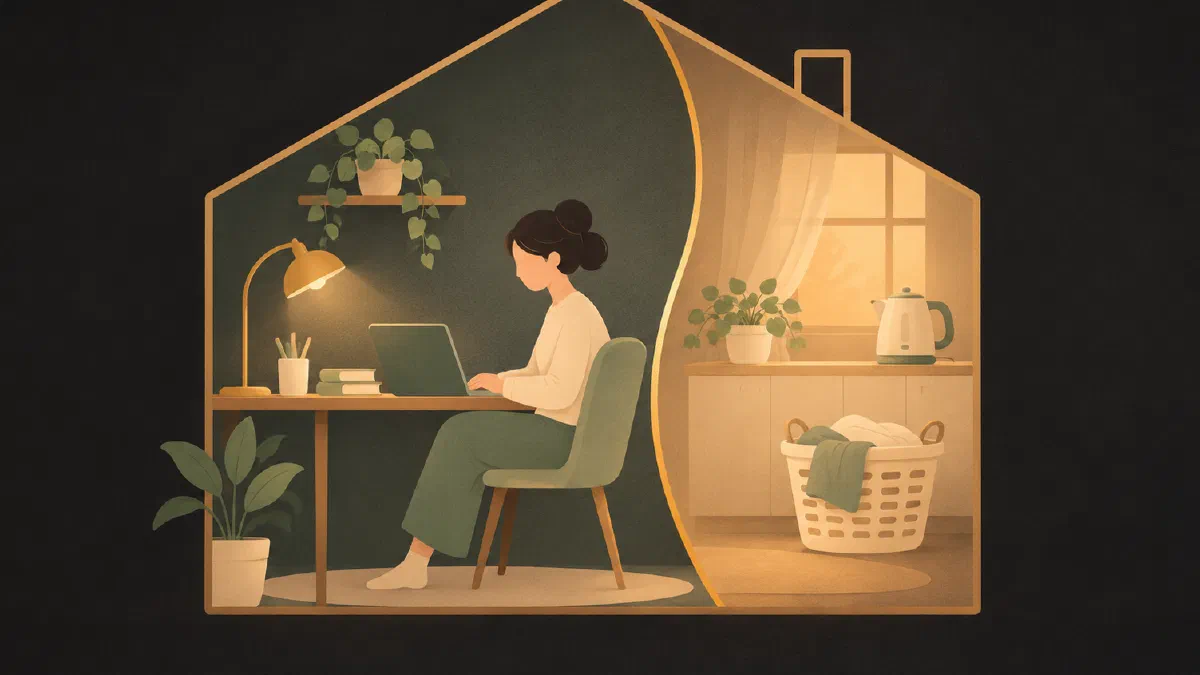
Working from home can feel like freedom for the first week and like quicksand by the third. If you have ADHD, this guide helps you rebuild the structure an office quietly provided: clear start and stop points, a workspace with rules, planned focus sessions, a plan for the household and someone to check in with.
Why working from home can be harder with ADHD
The NHS lists being easily distracted, finding it hard to organise your time and finding it hard to finish tasks among the common symptoms of ADHD in adults. NIMH notes that these symptoms show up across settings, including at home and at work, and can make it hard to get things done.
An office tends to supply outside cues without you noticing: a commute that marks the start of the day, colleagues who can see you, set meeting times and a building you leave in the evening. At home, many of those cues disappear, and the laundry, the fridge and the sofa sit a few steps away. Remote work is common: in 2023, Pew Research Center found that 35% of US workers whose jobs can be done remotely worked from home all the time and 41% worked a hybrid schedule.
A note on evidence: research on ADHD support at work is thin. A 2022 systematic review of 143 studies found that none evaluated an intervention in a real workplace. The structure below draws on clinical guidance and general research on planning and interruptions. It is a reasonable starting point, not a proven ADHD remote-work programme, so test each part and keep what works for you.
The core idea: rebuild the structure on purpose
The NICE guideline on ADHD describes environmental modifications as changes to your surroundings that reduce the impact of ADHD on daily life. Its examples include changes to lighting and noise, reducing distractions (for example with headphones), shorter periods of focus with movement breaks and backing up spoken requests with written instructions. NICE also says what fits depends on each person’s needs, and for adults it places these changes first: medication is offered if symptoms still cause significant problems after environmental modifications have been put in place and reviewed.
For a home office, that becomes five building blocks:
- a start ritual that tells your brain work has begun
- workspace rules that keep work and home apart
- scheduled focus sessions instead of an open-ended day
- a household plan for interruptions you can predict
- check-ins and an end ritual that give the day edges
If you split your week between home and an office, the office side is covered in ADHD at work: practical tips for focus and productivity. General home-office habits for anyone are in remote work productivity tips for home offices.
A start ritual that replaces the commute
A start ritual is a short, fixed sequence you repeat every workday. It works best as an if-then plan: “If it is 9:00 and my coffee is poured, then I sit at my desk and open the first task.” In a meta-analysis of 94 tests, if-then plans (called implementation intentions) had a medium-to-large effect on reaching goals. Those studies were not limited to people with ADHD, so take this as general support for the format.
A five-minute start ritual:
- Same cue every day. Pick something that already happens, such as finishing breakfast or a short walk around the block as a “fake commute”.
- Go to the work spot. Sit only where you work, not on the sofa “just to check email”.
- Read yesterday’s resume note (see the end ritual below).
- Choose one first task and make it tiny. “Open the report and write the first heading” beats “work on the report”.
- Start a timer for the first session. Keep the first block short, such as 15 to 25 minutes, so the start feels small.
Workspace rules that keep work and home apart
You may not have a spare room, and that is fine. What matters is that one spot means work. Useful rules:
- One work spot, used only for work. Even a corner of the kitchen table with a mat or a lamp you switch on only for work can mark the zone.
- Nothing household in view. Face away from the laundry pile or dishes where you can.
- Headphones or steady background sound. NICE mentions headphones as one way to reduce distractions, and the Job Accommodation Network lists noise cancellation or white noise and a quiet workspace among accommodation ideas for ADHD.
- Phone in another spot during sessions. Keep it on silent or face down out of reach.
- Work device, work browser profile. Keep personal apps and tabs out of the work setup. For tab and app habits during the day, see how to concentrate online in remote work.
- A capture pad on the desk. When a home task pops into your head (“buy dog food”), write it down and get back to work.
An end ritual that closes the workday
Without a commute home, work can leak into the evening, or the evening can start at 2 p.m. An end ritual draws the line.
Research on interruptions supports one piece of it. In lab studies by Leroy and Glomb, writing a short “ready-to-resume” plan (even a minute’s work, noting where to resume and what is left to do) reduced lingering thoughts about the unfinished task and improved performance on the next one. The studies tested interruptions within a session, not the end of a workday, so using it at day’s end is an adaptation.
A five-minute end ritual:
- Write the resume note: where you stopped, the very next step, anything blocking you.
- Pick tomorrow’s first task and write it at the top of the note.
- Clear the capture pad. Move home items to your personal list, work items to your task list.
- Close the work setup. Shut the laptop, switch off the work lamp, put the headphones away.
- Leave the spot. A short walk or changing clothes can act as the “commute home”.

Schedule focus sessions instead of a whole open day
“I have all day” is one of the hardest sentences for an ADHD brain at home. A day split into named, timed sessions gives you a series of small starts instead of one huge one. NICE’s examples include shorter periods of focus with movement breaks, which fits this approach.
A simple way to plan:
- Mark fixed points first: meetings, school runs, lunch.
- Fill the gaps with sessions of 25 to 50 minutes, each with one named task.
- Put the hardest task where your energy is usually best. Many people know their better hours from experience; use yours.
- Add a short movement break after each session. Stand up, stretch, refill water.
- Leave one buffer block in the afternoon for spillover.
For longer stretches of demanding work, see deep work with ADHD. You can run sessions with the free Cyklio Focus Timer in your browser.
Handling household distractions
Home brings its own interruptions: deliveries, family members, pets, chores that suddenly feel urgent. Interruptions have a cost even when you keep up. In a study by Mark, Gudith and Klocke, people finished interrupted tasks in less time with no loss in quality, but they reported more stress, frustration, time pressure and effort. That study did not involve ADHD or home offices, but it shows why fewer interruptions matter.
Decide in advance what you will do with common distractions:
| Distraction | Rule during a focus session | When to deal with it |
|---|---|---|
| A chore you suddenly notice | Write it on the capture pad | Next break or after work |
| Doorbell or delivery | Answer it, then read your last line before restarting | Immediately, then return |
| Family member or housemate asks something | Agreed signal (closed door, headphones on) means “ask me at the break” | Next break, unless urgent |
| Urge to snack or make coffee | Prepare water and a snack before the session | Planned break |
| Pet needs attention | Walk or feed before longer sessions | Fixed times |
| Personal phone message | Phone out of reach, notifications off | Lunch or a set break |
Share the rules with the people you live with, and agree what counts as truly urgent. If you work at home with young children around, expect to need a separate plan built around their care.
Check-ins that bring back accountability
In an office, a manager or colleague might see you and ask how a task is going. At home, that light accountability can vanish. A short, regular check-in can bring it back.
Acas describes regular check-ins on how work is going as a possible workplace adjustment, with the example of a 10-minute morning check-in with a manager to go through the plan for the day. JAN also lists meetings to discuss expectations and adjusting the method of supervision among its ideas. If you want to ask your employer for adjustments like these, ADHD accommodations at work explains how; rules differ by country.
Options that do not need your employer:
- a two-line message to a colleague each morning: “Today: X and Y. First up: X.”
- a short end-of-day note to yourself or an accountability partner on what got done
- working alongside someone on a video call; this popular method is called body doubling, covered in body doubling
Worked example: one home workday
Maya is a marketing coordinator who works from home three days a week. These steps are an illustration, not a real case.
- 8:45: Coffee, then a ten-minute walk around the block as her “commute”.
- 8:55: Start ritual. She reads yesterday’s note (“Next step: write the newsletter intro”) and starts a 25-minute session on that one step.
- 9:20: Break. She stands, stretches and notices the laundry. She writes “laundry” on her capture pad instead of starting it.
- 9:30 to 11:00: Morning check-in message to her manager, then two 40-minute sessions on the campaign plan with headphones on.
- 11:05: A delivery. She signs for it, then rereads her last sentence before restarting.
- 12:30: Lunch and the laundry, now a planned task.
- 13:30 to 15:30: Meetings and email in shorter sessions, because her focus is lower after lunch.
- 15:30: Buffer block for what spilled over.
- 16:55: End ritual. Resume note, tomorrow’s first task, laptop shut, lamp off, change of clothes.
Fill-in template: your home-work structure
Copy this into your notes and fill it in once. Review it after a week.
- My start cue: ________ (for example, after breakfast)
- My first-session length: ________ minutes
- My work spot and its marker: ________ (desk, lamp, mat)
- Phone goes to: ________
- My best hours for hard work: ________
- Household rule I will tell others: ________
- My check-in person and time: ________
- My end ritual signal: ________ (laptop shut, lamp off, walk)
- One thing to change next week: ________
When to look for more support
If work keeps slipping despite good structure, that is not a personal failure. The NHS says ADHD support can include workplace adjustments, talking therapies such as cognitive behavioural therapy (CBT) and medicines started by a specialist. In a randomised trial with 88 adults with ADHD, a group therapy that taught time management, organisation and planning skills reduced inattention symptoms more than supportive therapy. If you have not been assessed, or your current support is not enough, talk to your doctor.
Summary and one next step
Working from home with ADHD often goes better when you rebuild the structure an office used to give you: a start ritual, one work spot with rules, planned focus sessions, a household plan, check-ins and an end ritual. Evidence specific to ADHD and remote work is limited, so treat each piece as an experiment.
Next step: tomorrow, try only the start ritual. Pick your cue, choose one tiny first task and run one 25-minute session. If you want to track sessions toward a daily goal, Cyklio, the focus timer app we make, offers a 7-day free trial with no account or card needed.