

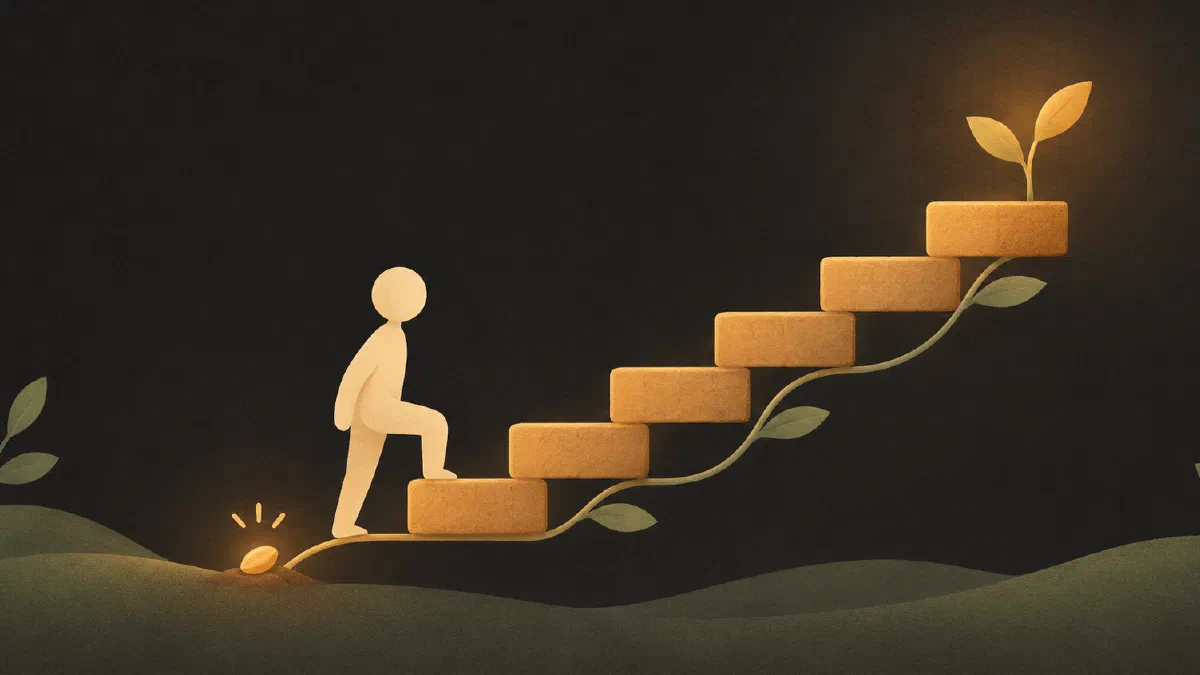
Atomic Habits by James Clear is about small, repeatable changes rather than big bursts of willpower. This is not a summary of the book. It takes a few of its central ideas and turns them into one concrete habit for work: reliably starting a focus session.
The core model in two minutes
The book explains every habit as a four-stage loop. In the author’s own summary of the book, the stages are:
- Cue: something that triggers the behaviour.
- Craving: the desire the cue creates.
- Response: the action you take.
- Reward: the payoff that satisfies the craving and links back to the cue.
Each stage has a matching “law” for building a good habit: make it obvious, make it attractive, make it easy, make it satisfying. To break a bad habit, the same summary inverts them: make it invisible, unattractive, difficult and unsatisfying.
A note on evidence. Atomic Habits is a popular book, not a research paper. Some of its ideas line up with habit research, such as the role of cues and repeating a behaviour in the same context. Others, like the two-minute rule or “votes for your identity”, are presented as practical rules of thumb. Where research exists, this article links to it; where it does not, we say so.
Why build a habit of starting
Most focus problems at work are not about the 40th minute. They are about the first one: the moment between “I should work on the report” and actually opening it.
That is where habits help most. Researchers describe habits as actions that are triggered automatically by cues after being repeated in the same context, and the same paper notes that habits are likely to persist even after conscious motivation or interest fades. A start that runs on habit does not need you to feel motivated at 9:05 on a grey Tuesday.
So the target is narrow on purpose. You are not building “two hours of deep work every day”. You are building “after X, I open the task and start a session”. Everything else grows from that.
The habit loop, applied to one focus session
Here is how the four laws translate into the setup for a single focus session:
| Stage | Law | Focus-session version | Example |
|---|---|---|---|
| Cue | Make it obvious | A fixed trigger in your day, plus a visible sign at your desk | “After I fill my water glass, I start” and the task already open on screen |
| Craving | Make it attractive | Something about the session you look forward to | Your usual focus playlist, or starting with the most interesting part of the task |
| Response | Make it easy | A first step that takes under two minutes | “Write the heading of section 2”, not “finish the proposal” |
| Reward | Make it satisfying | A small, immediate sign that you did it | Ticking a box, rating the session, a short break you enjoy |
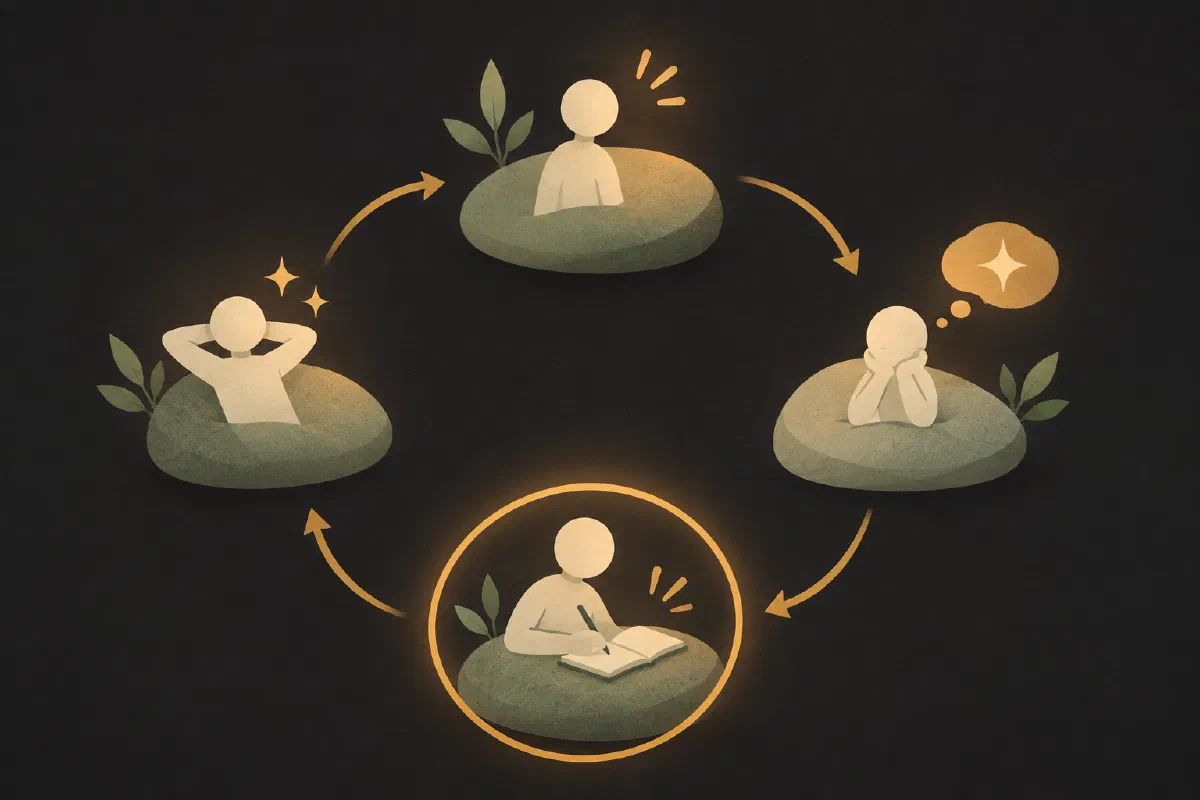
The sections below take each row in turn.
Make the start obvious: anchor it to an existing habit
The book’s main tool for cues is habit stacking. Its formula, from the author’s article on habit stacking, is: “After [current habit], I will [new habit].” The author credits the method to BJ Fogg’s Tiny Habits program, where it is called “anchoring”, and describes it as a form of implementation intention.
Implementation intentions are the best-researched part of this picture. They are if-then plans that set in advance when, where and how you will act. A meta-analysis of 94 independent tests found that if-then plans had a medium-to-large effect on reaching goals, and that they made people more likely to get started. Those studies covered goals in general, not focus sessions specifically, but the mechanism is the same: the decision is already made before the moment arrives.
A good anchor is something that happens every workday at roughly the right time. The British Journal of General Practice paper on habit formation suggests a cue that is noticed frequently and consistently, with an existing routine as a convenient starting point. Workday anchors that tend to work:
- After I hang up my coat and sit down.
- After I pour my first coffee.
- After the morning stand-up call ends.
- After I come back from lunch.
Then make the cue visible. The author’s article on environment design argues that your surroundings set your defaults and suggests small visual cues, such as putting the thing you want to use where you will see it. At a desk, that can mean:
- leaving tomorrow’s document open on the screen when you shut down;
- placing a printed page or notebook on the keyboard;
- writing the first step on a sticky note at the edge of the monitor.
If you want to set up the evening side of this, our guide to daily habits that reduce procrastination covers shutdown rituals and next-action notes in detail.
Make it attractive: give the session something to look forward to
The craving stage is the least concrete in practice, and the book offers ideas rather than a single method. A few common strategies for focus work (practical suggestions, not tested techniques):
- Use a start ritual you like. The same drink, the same playlist, the same chair. Over time, the ritual becomes part of the cue.
- Open with the most interesting slice. If the report has a chart you enjoy building, start there and write the dull introduction later.
- Pair the session with a small treat afterwards. A walk outside, a chat with a colleague, five minutes of a podcast.
Keep the treat after the session, not during it, so it does not compete with the work.
Make it easy: the two-minute rule
This is the idea most people remember from the book. The 2-Minute Rule says: “When you start a new habit, it should take less than two minutes to do.” The author calls the tiny version a “gateway habit” that leads into the larger behaviour. It is a rule of thumb, not a technique with its own body of research.
It does fit one finding from habit research. In the study behind the BJGP paper, simpler behaviours reached peak automaticity sooner than more demanding ones (drinking water versus doing 50 sit-ups). A two-minute start is about as simple as a work behaviour gets.
Scaling work tasks down:
| Full task | Two-minute start |
|---|---|
| Write the quarterly report | Open the file and write the three section headings |
| Prepare the client presentation | List the slide titles on paper |
| Clear the inbox backlog | Archive everything older than a month from one sender |
| Review the contract | Read clause 1 and mark one question |
| Learn the new software | Open the tutorial and watch the first video |
The two-minute step is the doorway, not the whole session. Once you are through it, a timed session carries you further. Our article on the 10-minute timer for starting a task you are avoiding shows how to bridge from a tiny step to a short block of work.
“Easy” also means removing friction. The same environment-design article suggests reducing the steps to good habits and adding steps to bad ones. Before a session, close the tabs you will not need and put your phone out of reach. For distractions you want to cut back on, the inverted laws apply; our guide on how to break bad habits with cues, cravings and replacements goes deeper.
Make it satisfying: close the loop right away
The reward stage links back to the cue, which is what makes the loop repeat. For focus work, the reward of finishing a project may be weeks away, so add a small, immediate one:
- tick a box on a paper grid;
- rate the session in one word;
- say “done” out loud and stand up for your break.
A simple tracker also shows you the pattern over time. For layouts and rules, see our habit tracker grid.
Votes, not streaks
The book’s identity idea is that each action is a “vote” for the kind of person you want to be, as described in the author’s book summary. For focus work, the identity could be: “I am someone who starts one focus session before opening email.” One session is one vote. You do not need every vote to win.
This matters because habits take longer than most people expect. In the best-known study on habit formation, people took about 66 days on average to reach peak automaticity, with individual times ranging from 18 to an estimated 254 days. The same body of research found that missing an occasional day did not seriously impair habit formation. A blank box is a missed vote, not a lost election.
A worked example: one week of a start habit
This is an illustrative example for an office worker who keeps postponing a large proposal.
Monday, setup (5 minutes). He writes his habit card: “After I come back from the morning stand-up, I open the proposal and write one paragraph heading.” He leaves the file open before the call and puts his phone in his bag. His treat is a coffee with a colleague after the session.
Tuesday. The call ends at 9:20. The file is already on screen. He writes the heading, keeps going, and starts a 25-minute session. He ticks the box.
Wednesday. The stand-up is cancelled, so his anchor is missing. He uses his backup anchor: “after my first coffee”. It works, but late.
Thursday. An urgent request lands at 9:15. He does the two-minute start only: one heading, then switches. He still ticks the box, because the habit is the start.
Friday. He looks at the week: four starts out of four workdays, three full sessions. He keeps the card unchanged for next week and adds a backup anchor to it.
Nothing in this week required a burst of motivation. The habit was small enough to survive a cancelled meeting and an urgent request.
Fill-in template: your focus habit card
Copy this into a notebook or a note on your computer:
- Anchor: After I ________________ (something that happens every workday),
- Two-minute start: I will ________________ (a first step you can see someone doing).
- Backup anchor: If that does not happen, after I ________________.
- Visible cue: At my desk I will leave ________________.
- Friction removed: Before I start, I will ________________ (close, move or switch off).
- Attractive part: The session includes or ends with ________________.
- Reward: When it is done, I will ________________ (tick, rate, break).
Keep the card for at least two weeks before changing it, unless something clearly is not working.
When it does not stick
| Problem | Likely cause | Adjustment |
|---|---|---|
| You forget to start | The anchor is not consistent | Pick an anchor that happens every workday at about the same time |
| You remember but avoid it | The first step is too big | Shrink it until it takes under two minutes |
| You start, then drift to email | Friction is too low for distractions | Close the inbox and move the phone before the first step |
| It feels like a chore | No attractive part, no reward | Add a ritual you like and a small treat after |
| You stop after a bad week | All-or-nothing thinking | Count starts, not perfect days; restart at the next anchor |
If you have ADHD and these ideas feel harder to apply than they sound, our guide on how to build habits with ADHD adapts them with more external reminders and smaller steps.
Summary and next step
The most useful idea from Atomic Habits for focus is to build a habit of starting. Tie a two-minute first step to something you already do, make the cue visible, remove friction, and close the loop with a small reward. Count votes rather than streaks, and give it weeks, not days.
Your next step: fill in the habit card today and use it tomorrow at your anchor. If you want a clear container for the session after the two-minute start, the Cyklio Focus Timer is free on our site, and Cyklio, our own app from Mindly 360, runs sessions of 10 to 60 minutes and lets you rate each one as full focus, distractions or not today. It has a 7-day free trial with no account or card needed.