


AuDHD is a word many people now use for being autistic and having ADHD at the same time. This guide explains what the term does and does not mean, what research says about the overlap, how it can shape an ordinary working day, and how assessment for both conditions works.
This article is educational and does not replace advice from a doctor. If you are in crisis or thinking about harming yourself, contact your local emergency number or a crisis line in your country straight away.
What does AuDHD mean?
“AuDHD” (autism plus ADHD) is a community term, not a diagnosis. You will not find it as a label in the diagnostic manuals. Clinicians assess autism and ADHD as two separate conditions, and a person can be diagnosed with both.
That was not always possible. Earlier editions of the main manuals (DSM-IV and ICD-10) treated autism and ADHD as mutually exclusive diagnoses, while DSM-5 mentions each condition in its description of the other, as a 2022 review in Frontiers in Psychiatry explains. The current DSM-5 criteria for autism, as summarised by the CDC, include a specifier for when autism is associated with another neurodevelopmental, mental or behavioural disorder.
So when someone says “I’m AuDHD”, they usually mean one of three things:
- they have formal diagnoses of both autism and ADHD;
- they have one diagnosis and are waiting for, or exploring, assessment for the other;
- they identify with the combined experience without a formal diagnosis.
All three are common uses of the word, but only the first reflects a clinical assessment. For the core features of each condition on its own, see our comparison of ADHD vs autism.
How common is it to have both?
Co-occurrence is common, but there is no single settled number.
- A 2019 systematic review and meta-analysis in The Lancet Psychiatry estimated that about 28% of autistic people also have ADHD. It found large differences between studies, with higher figures in clinical samples than in population-based or registry-based studies.
- The Frontiers review cites literature estimates of ADHD in 50 to 70% of autistic people, while noting that published rates range from 10 to 90%.
- A Swedish register study of about 1.9 million people found that autistic people had much higher odds of also having ADHD, and that relatives of autistic people were also more likely to have ADHD. The authors read this pattern as support for shared genetic factors.
The spread in estimates reflects how studies sample people and which criteria they use. The fair summary is that having both is far more common than chance would suggest.
Where ADHD and autism overlap, and where they differ
Researchers describe real overlap. A 2019 review in Current Psychiatry Reports says the two conditions share genetic heritability and difficulties with social and executive functioning, yet differ enough in how symptoms present to remain separate diagnoses. The Frontiers review adds that several executive function difficulties typically linked to ADHD are also found in autistic people, and that overfocused attention linked to sensory differences can be mistaken for ADHD inattention.
That is why one behaviour can have different roots. The table below shows how. It is not a self-test: it shows why a professional needs a full history to tell the conditions apart.
| What you might notice | Possible link to autism | Possible link to ADHD |
|---|---|---|
| Losing focus in a busy, noisy office | Sensory overload, which can cause difficulty focusing (National Autistic Society) | Being easily distracted (NHS) |
| Distress when plans change at short notice | Insistence on sameness and inflexible routines (CDC summary of DSM-5) | Not listed among the adult symptoms on the NHS ADHD page, so a clinician may look for other explanations |
| Conversations going off track | Finding it hard to talk to people or understand tone of voice (NHS) | Being very talkative or interrupting conversations (NHS) |
| Starting tasks and not finishing them | Executive function difficulties are also found in autism (Frontiers review) | Finding it hard to finish tasks or organise time (NHS) |
| Long, deep focus on one subject | Strong focus on specialist interests (NHS) | “Hyperfocus” is a popular term often used by people with ADHD, not a diagnostic criterion |
Whether having both means more pronounced difficulties is still debated. The Frontiers review describes a study that found more severe autistic traits, especially in social interaction, in people diagnosed with both than in people with autism alone. The review’s authors caution that this may instead reflect more severe autism, so it is not a settled profile.
What AuDHD can look like in daily life
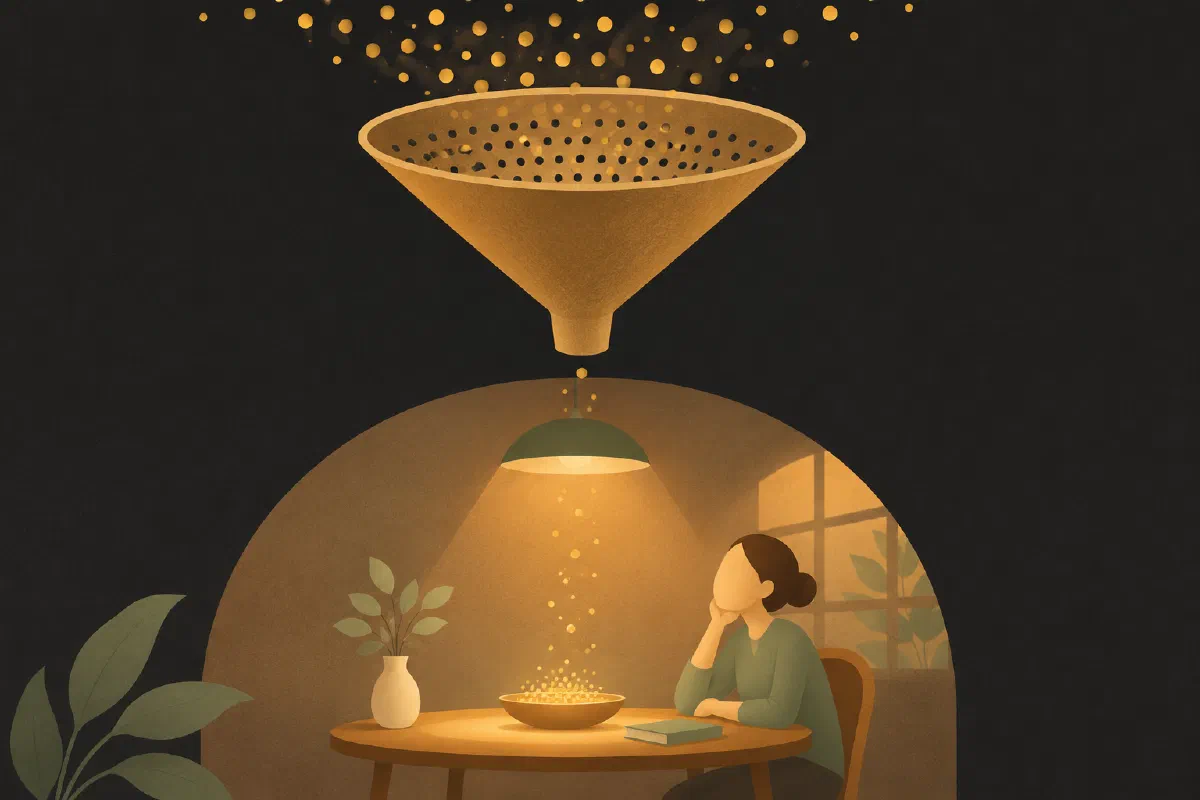
UK workplace guidance from Acas notes that having more than one neurodivergent condition creates an experience that differs from having just one. Its example is an autistic person with ADHD who needs clear structure but finds it hard to stick to, and who focuses intensely on specific interests while also switching quickly between tasks. Every person’s mix is different, but a few themes come up often.
Two sets of needs at once
Needs can seem to pull against each other: wanting predictability, then finding the routine dull. If that tension is familiar, our guide to AuDHD contradictions covers ways to give both sides a place in your day.
Sensory load
The National Autistic Society explains that autistic people can be much more or much less sensitive to sensory input than other people, and that this can vary over time and between environments, with tiredness and stress also affecting how well someone copes. Its practical suggestions include removing triggers where possible, moving to a quieter space, and having a safe space away from sensory triggers.
Masking and energy
The NHS notes that some autistic adults learn to adapt so that signs are not always noticeable, and that this masking can make everyday activities and social interactions feel exhausting and stressful. If everyday life has felt exhausting for a long time, read about autistic burnout and talk to a health professional. How masking and late diagnosis affect women in particular is covered in AuDHD in women.
Mental health alongside
The Lancet Psychiatry meta-analysis gave pooled estimates for autistic people of about 20% for anxiety disorders, 13% for sleep-wake disorders and 11% for depressive disorders, mostly higher than in the general population. Persistent low mood, worry or poor sleep deserve a conversation with a doctor rather than being written off as “just AuDHD”.
Worked example: a working day
Sam is a fictional project coordinator who was diagnosed with ADHD in his late twenties. He uses a focus timer and lists, which help with starting tasks. But he notices other things his ADHD strategies do not touch: he is wiped out after open-plan days, a cancelled meeting can derail his afternoon, and he rehearses small talk before calls.
Rather than deciding for himself what this means, Sam keeps two weeks of short notes. Each note records the situation, what was hard, and what helped. He finds a pattern: quiet mornings with a fixed plan go well, while noisy afternoons with last-minute changes do not. He books a GP appointment and brings the notes. Meanwhile he tries two small changes: headphones in the open-plan area, and asking colleagues for a day’s notice when meetings move. If your challenges show up mostly at your job, AuDHD at work covers adjustments you can ask for.
Is there an AuDHD test?
There is no single AuDHD test. Autism and ADHD are assessed separately, sometimes by the same service and sometimes by different ones. Online quizzes can prompt a conversation, but they cannot diagnose either condition. If your results worry you, the right next step is a GP or doctor, not a self-diagnosis.
What UK guidance says
- Each condition should prompt a look at the other. NICE’s adult autism guideline CG142 (recommendation 1.2.2) lists a history of a neurodevelopmental condition, including ADHD, among the factors that, alongside persistent social or communication difficulties or rigid behaviours, should lead professionals to consider an autism assessment. NICE’s ADHD guideline NG87 (1.2.1) asks professionals to be aware that people with other neurodevelopmental disorders, including autism, may have a higher prevalence of ADHD. A 2019 clinical review similarly says that co-occurring ADHD needs to be considered for autism support to work as well as possible, and vice versa.
- Screening is not diagnosis. For adults without a moderate or severe learning disability, CG142 (1.2.3) suggests professionals consider a short screening questionnaire, the AQ-10, alongside clinical judgement, when deciding whether to offer a full autism assessment. NG87 (1.3.2) says ADHD should not be diagnosed only from rating scales or observation.
- A full assessment looks at your history. For ADHD, NG87 (1.3.1) says a specialist should diagnose based on a full clinical and psychosocial assessment, including a developmental and psychiatric history and observer reports. For autism, CG142 (1.2.5 and 1.2.7) recommends a team-based assessment, drawing on several professions where possible, that involves an informant or uses documents such as school reports. It also covers early development, sensory sensitivities and other neurodevelopmental conditions.
- Diagnosis is possible at any age. NIMH states that autism can be diagnosed at any age. The NHS describes adult routes for both: a GP may refer you for an autism assessment or to an ADHD specialist.
Waiting can be long. The NHS says you may wait several months or years for ADHD specialist services, and notes that support may be available while you wait for an autism assessment. Routes differ outside the UK, so ask your own doctor how assessment works where you live. For a step-by-step view of the ADHD side, see how an ADHD assessment works.
Fill-in notes for your appointment
Clinicians ask about your history and daily functioning, so written notes can make a short appointment more useful. Copy this and fill in what you can.
| Question | Your notes |
|---|---|
| What prompted you to seek help now? | |
| Which situations are hardest (work, social, home)? Give two recent examples. | |
| Sensory experiences: what is too much, or not enough? | |
| How do you cope with changes to plans? | |
| Attention, starting and finishing tasks: what happens? | |
| What were you like as a child? Who could describe it (parent, sibling, old reports)? | |
| Existing diagnoses and current support | |
| What would you like to get from the assessment? |
Questions you might ask: Will this service assess for both conditions, or will I need a separate referral? What happens while I wait? Who can I contact if things get worse? Treatment decisions belong in that conversation with your clinician, not in an article.
Summary and one next step
AuDHD is a community word for being autistic and having ADHD. Clinically, they are two separate diagnoses that often occur together, share some features and differ in others. The same behaviour can come from either condition, which is why a proper assessment matters more than any checklist. In daily life, many people find it helps to meet both sets of needs on purpose: some structure, some flexibility and fewer sensory demands.
Your next step: for the next two weeks, jot one line after each work block noting where you were, what was hard and what helped. If you want a steady frame for those blocks, the Cyklio Focus Timer can keep time while you work. Notes like these are not a diagnosis, but they give you and a professional something concrete to discuss.