


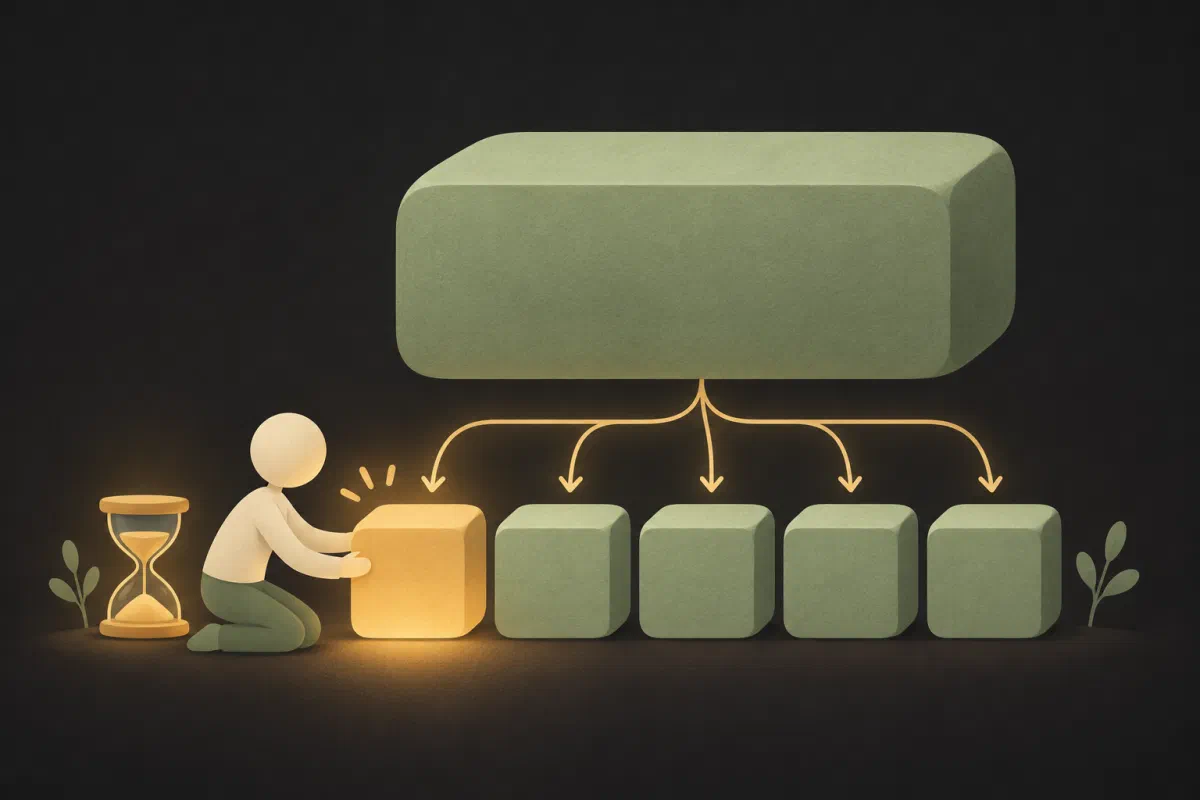
“Prepare the budget proposal” looks like one task on your list, but it is really twenty small ones hiding behind a single line. This guide gives you a step-by-step method for splitting a big work task into doable steps, a full worked example from a working week, the first-action rule and a simple way to put a timer on every step.
Why breaking down tasks is harder with ADHD
Breaking a task down sounds like the easy part. In practice it is a planning job, and planning is often exactly where ADHD makes things harder.
The NHS lists finding it hard to organise your time and to follow instructions or finish tasks among the symptoms of ADHD in adults. The US National Institute of Mental Health (NIMH) describes adults with ADHD who may find it challenging to stay organised and complete large projects, and lists trouble focusing on a large task and poor planning among common problems.
Research on thinking skills points the same way:
- A meta-analysis of 83 studies comparing groups with and without ADHD found that the ADHD groups showed the clearest weaknesses in response inhibition, vigilance, working memory and planning, with moderate effect sizes. The authors also stress that these weaknesses are not present in every person with ADHD.
- A meta-analysis of 38 studies in adults found moderate working memory differences between adults with ADHD and controls. Our explainer on working memory and ADHD covers what that means day to day.
- A meta-analysis of 21 studies found that people with ADHD tend to discount delayed rewards more steeply than people without ADHD. This was measured with money, not with work tasks, but it fits a common experience: the payoff of a big project feels far away, while the effort is right now.
Put together, this explains a familiar trap. To split a task well, you need to hold the whole thing in mind, see the order of the pieces and imagine a future result clearly enough to care. Those are the same skills that may be under strain. So the answer is not “try harder to plan in your head”. It is a fixed method on paper that does most of the holding for you.
What “ADHD task analysis” means
You may see the phrase “task analysis” in ADHD resources. In psychology, task analysis is the breakdown of a complex task into component tasks to identify the skills each part needs. It is a professional term, not an ADHD diagnosis or a special technique. For a working adult, the everyday version is what this guide teaches: turning a goal into a sequence of concrete steps you can actually do.
What the research says about splitting tasks
The studies below do not test “break your task into steps” on its own as an ADHD treatment. They test structured therapy programmes that include task splitting as one of their core skills.
- In a randomised controlled trial with 86 adults with ADHD who were already on medication, a 12-session cognitive behavioural therapy (CBT) programme included problem-solving practice that covered breaking down overwhelming tasks into steps. The CBT group improved more on ADHD symptoms than a group that received relaxation training with education.
- In another randomised trial with 88 adults, a 12-week group programme called meta-cognitive therapy taught time management, organisation and planning. Its early sessions aimed to “dismantle complex tasks into manageable parts”, and later sessions used flow-charting of goals and their sub-components. Participants also learned short cue phrases, including one that links trouble getting started to a first step that is too big. The programme produced greater improvement in inattention symptoms than a supportive therapy group.
Both results come from full programmes run by clinicians over many weeks, so they show that task splitting is a recognised skill in ADHD care, not that a method on a web page works on its own.
Breaking tasks into smaller steps also has a benefit that applies to everyone. People tend to underestimate how long tasks will take, a bias known as the planning fallacy. Psychologist Roger Buehler describes decomposing a plan into smaller steps, or unpacking, as one way to bring obstacles and interruptions into view, along with planning backwards from the goal. That is why the method below asks you to estimate each step separately rather than the whole task at once.
The splitting method: six steps
Use this method for any task that will take more than an afternoon. You need paper or a blank note and about 15 to 25 minutes the first time. It gets faster with practice.
- Write the finish line. One sentence that describes the finished result, where it ends up and for whom: “A two-page budget proposal with a cost table, sent to my manager by Friday the 21st.” If you cannot write this sentence, your first step is to find out what done looks like, usually by asking someone.
- Empty the task onto paper. For five minutes, write every piece of the task you can think of, in any order: things to find, people to ask, files to open, decisions to make, worries. Do not sort yet. Getting it out of your head is a form of what researchers call cognitive offloading, using a physical action such as writing to reduce how much a task demands from your mind.
- Group the pieces into parts. Look at your list and circle pieces that belong together. Many work tasks fall into three to six parts, often phases like “gather”, “decide”, “draft”, “check” and “deliver”. Put the parts in rough order.
- Cut the next part into steps. Take only the first part and turn it into steps. A step starts with a verb, names an object and can be finished in one sitting of 60 minutes or less. Leave the later parts as one line each. They will change once you learn more, and a list of 40 steps can feel worse than the original task.
- Choose the first action. Pick the step you will do first and shrink it until it passes the first-action rule below. It does not have to be the first step in the list; choose the one that cannot fail.
- Give each step a timer session. Next to each step, write an estimate in minutes and plan to run one timed session per step. After each session, write down how long it really took. The timer section below explains why this matters.
When you finish a part, repeat step 4 for the next one. This “detail only what is next” rhythm keeps the plan short enough to read at a glance while still covering the whole project.
Five ways to cut a part into steps
When a part will not split, try a different angle. These lenses are practical heuristics, not research findings; use whichever makes the steps obvious.
| Lens | Question to ask | Example for “gather cost data” |
|---|---|---|
| By phase | What happens first, next, last? | Find last year’s file, then update prices, then total |
| By section | What are the pieces of the finished thing? | Staff costs, software, training, travel |
| By person | Who do I need something from? | Ask finance for actuals, ask Ana for the training quote |
| By tool or place | Where does each piece of work happen? | Spreadsheet work, email, shared drive |
| By question | What do I not know yet? | “Is travel in this budget or a separate one?” becomes a step: ask the manager |
The last lens is often the most useful. Unknowns make a task feel impossible to start because you cannot picture the steps. Turning each unknown into a “find out” step gives you something concrete to do, even before you know the answer.
The first-action rule
The first-action rule is the most important part of the method: if you cannot get started, the first step is too big, so cut it until it takes ten minutes or less. It echoes one of the cue phrases taught in the meta-cognitive therapy programme described above.
A first action passes the rule when:
- it starts with a physical verb such as open, write, list, copy or send;
- you can see when it is finished;
- it needs no decision you have not already made;
- you can do it now with what is at hand; and
- it takes ten minutes or less.
Here is how first steps from a typical work project shrink until they pass:
| Too big | Still too big | Passes the first-action rule |
|---|---|---|
| Work on the budget | Update the cost table | Open last year’s budget file and save a copy with this year’s name |
| Prepare the client presentation | Write the slides | Write the three questions the client asked in their last email on one slide |
| Sort out the vendor contract | Review the contract | Print the contract and highlight the dates and the price |
| Plan the team offsite | Pick a venue | Send Mia one message asking for the date range and headcount |
| Write the process document | Draft the first section | Write five bullet points of the steps you do every Monday |
Why ten minutes? There is no research-backed magic number. Ten minutes is short enough that the step feels easy to face and long enough to produce something visible. If ten minutes still feels like too much, cut again to five or two.
To make the first action happen, attach it to a time and place. A meta-analysis of 94 tests found that if-then plans that name when and where you will act had a medium-to-large effect on reaching goals. A simple version: “When I sit down after the 9:30 stand-up, I will open last year’s budget file.” If you have a clear, tiny first action and a plan and you still cannot begin, the problem is probably starting itself rather than the breakdown; our guide to task initiation deals with that directly.
Worked example: a budget proposal over two weeks
Here is the method applied to a realistic work project. It is an illustration of how the steps fit together, not a real person’s data.
The situation. Kasia is a team lead. On Monday her manager asks for next year’s training budget proposal by Friday of the following week. She has meetings most mornings and roughly six free hours in total before the deadline. The task sits on her list as “budget proposal” for two days and she keeps skipping it.
Step 1, finish line. “A two-page proposal with a cost table and a short justification, sent as a PDF to my manager by Friday the 21st at noon.”
Step 2, empty the task. Her five-minute list: last year’s file, which courses the team wants, conference costs, ask finance for actual spending, travel, is software included?, justify the increase, the manager likes short documents, check the numbers, convert to PDF, worried the total is too high.
Step 3, parts.
- Gather: last year’s file, actual spending, team requests, prices.
- Decide: what to include and what to cut.
- Draft: cost table and justification.
- Check and send.
Step 4, steps for part 1 only.
| Step | Estimate | Timer session | Actual |
|---|---|---|---|
| Open last year’s budget and save a copy with this year’s name | 5 min | 10 min | 4 min |
| Email finance asking for this year’s actual training spend | 5 min | 10 min | 8 min |
| Message the manager: is software in this budget? | 5 min | 10 min | 3 min |
| Ask the team in chat for their top training request each | 10 min | 10 min | 12 min |
| Look up prices for the four requested courses | 20 min | 25 min | 45 min |
| Paste prices into the cost table | 15 min | 15 min | 15 min |
Parts 2 to 4 stay as single lines until part 1 is done.
Step 5, first action. “Open last year’s budget and save a copy with this year’s name.” It cannot fail, takes under ten minutes and makes the project real on her screen. She ties it to a cue: right after Tuesday’s stand-up.
Step 6, timer per step. Kasia runs one timed session per step and writes the actual time in the last column. By Wednesday she notices something useful: the messages and file steps took about as long as she expected, but looking up course prices took more than twice her estimate, because two providers hid their prices behind forms.
How the plan changed. With that information, she does three things:
- She moves “ask finance” and “ask the team” to the very start, so replies can arrive while she does other steps.
- She adds a buffer to every research-type step in parts 2 to 4, because her own data shows those run long.
- When a session ends before a step is finished, she writes one line about exactly where to resume, for example: “Prices done for courses 1 to 3. Next: fill in the form for course 4.”
By the following Tuesday part 1 is done and she cuts part 2 into steps the same way. The proposal goes out on Thursday afternoon, a day early. Not because she suddenly found more willpower, but because every time she sat down, the next step was already small and written.
If you would rather fill in a ready-made page than start from a blank sheet, our task breakdown template turns these steps into a printable form.
Put a timer on each step
The breakdown tells you what to do next. A timer gives each step a clear start, a clear end and a record of how long it really took.
Why time each step
- It makes time visible. In the CBT trial mentioned earlier, the distractibility sessions included learning to time the length of one’s attention span. Timing steps is a related habit: instead of guessing, you find out.
- It corrects your estimates. Time perception in adults with ADHD is a popular topic, but a 2023 review found the research mixed, with some studies showing deficits in time estimation and others not. Whatever applies to you, your own records are better than general rules. Comparing estimates with past results is the “outside view” that Buehler describes as a remedy for the planning fallacy.
- It shows progress. A meta-analysis of 138 studies found that monitoring progress toward a goal improved goal attainment, with larger effects when progress was physically recorded. A column of finished sessions next to your steps is a simple way to record it.
How to match the timer to the step
| Step type | Typical session | What to do when the timer ends |
|---|---|---|
| First action, message, quick admin | 10 minutes | Tick it off and start the next session, or take a short break |
| Research or reading | 20 to 30 minutes | Write where you stopped and what you still need to find |
| Writing or building | 25 to 45 minutes | Stop mid-sentence or write the next sentence as a note |
| Deep, uninterrupted work | 45 to 60 minutes | Write the exact next step before you stand up |
These lengths are practical starting points, not research findings. Adjust them once your “actual” column shows what works for you. If even ten minutes feels too long to begin, our guide to using a short timer to start tasks explains how to begin with less.
When a step does not fit its session
Two things will happen often, and both are fine:
- The timer ends before the step is done. Write one line about where to resume. In a series of experiments, unfinished goals produced intrusive thoughts and hurt performance on other tasks, but making a specific plan for the unfinished goal removed those effects. A resume line is a small version of that plan.
- You finish early. Note the real time, then decide: start the next step, or take the rest of the session as a break. Either way, you now know that step type is quicker than you thought.
You can try this today with our free Cyklio Focus Timer in your browser: one session per step, and the actual time written next to your estimate.
If you want this on your phone, Cyklio is the focus timer app we make at Mindly 360. Focus sessions run from 10 to 60 minutes, so a ten-minute first action and a 45-minute drafting step each get a session of their own. Sessions count toward a daily goal in hours, shown as a progress ring, and you can rate each one as full focus, distractions or not today, which helps you spot which kinds of steps tend to go off track. Daily, weekly and monthly reports show how the steps add up. Cyklio is available on Android in English and Polish, with iPhone coming, and the 7-day free trial gives full access with no account and no card needed. See the Cyklio app page for details.
When the breakdown itself gets stuck
| What happens | Likely reason | What to try |
|---|---|---|
| You cannot see any parts at all | The task is new to you or the goal is unclear | Make the first step “find out what done looks like” and ask someone who has done it |
| Every part feels equally urgent | The problem is choosing, not splitting | Decide the order first; our guide to prioritising tasks with ADHD can help |
| The list keeps growing | You are detailing the whole project at once | Go back to detailing only the next part |
| Breaking down turns into its own procrastination | Planning feels productive and safe | Give the breakdown a 15-minute session; whatever is not split by then becomes “decide later” |
| Steps keep stalling on other people | Hidden dependencies | Use the “by person” lens and send all requests first |
| You lose track of the plan between days | It lives in your head or in a place you do not check | Keep it next to the task on your list; for choosing a tool, see our comparison of task managers for ADHD |
When to get more support
A method for splitting tasks is a practical tool. It does not diagnose or treat anything. If organising, planning and finishing tasks has been hard for most of your life and is causing real problems at work or at home, it is worth talking to your doctor. The NHS notes that talking therapies, including CBT, may be recommended for adults with ADHD, and NIMH mentions that some adults benefit from a coach who teaches executive function skills. Only a qualified professional can assess whether ADHD or something else is behind what you are experiencing.
Summary
- Breaking a task down is a planning job, and planning and working memory are common pressure points with ADHD, so use a fixed method on paper.
- The six steps: write the finish line, empty the task onto paper, group into parts, cut only the next part into steps, choose a first action and give each step a timer session.
- The first-action rule: if you cannot start, the first step is too big. Cut it to ten minutes or less and tie it to a time and place.
- Writing down actual times next to your estimates turns each project into better plans for the next one.
Your next step: pick the task that has sat on your list the longest, write its finish line in one sentence and choose a first action that takes ten minutes or less. Then start a ten-minute session in the Cyklio Focus Timer and do just that action.