


“My nervous system is fried” has become a common way to describe burnout, and many calming routines now promise to “regulate” it. Some of that framing matches stress research, and some of it goes well beyond the evidence. This article separates the two and lays out the habits that studies actually support, with an honest note on how strong that support is.
Does burnout affect the nervous system?
Partly, in the sense that burnout grows out of long-term stress, and stress runs through the nervous system. But there is no evidence of a specific “burnout nervous system” that a test can detect.
Start with what burnout is. The World Health Organization defines burn-out as a syndrome resulting from chronic workplace stress that has not been successfully managed, marked by exhaustion, mental distance or cynicism about your job, and reduced professional efficacy. The WHO classifies it as an occupational phenomenon, not a medical condition. For the full picture of signs and causes, see what burnout is.
Now the stress side. When the brain reads a situation as a threat, it can rapidly activate two main stress pathways: the sympathetic-adreno-medullary (SAM) axis and the hypothalamus-pituitary-adrenal (HPA) axis. In plain terms, the first is the fast response driven by adrenaline and related hormones; the second is a slower, longer-lasting hormonal response that releases cortisol.
These responses are useful in the short term. Stress researcher Bruce McEwen described how mediators such as adrenalin and cortisol help the body adapt after acute stress but also contribute to “wear and tear” on the body and brain when someone stays “stressed out”. He called this allostatic overload. So the everyday intuition that long stress keeps your system revved up has a real research basis.
What the evidence does not show is a reliable biological marker of burnout. A systematic review of 31 studies on 38 possible biomarkers, covering the HPA axis, the autonomic nervous system, immune markers and sleep, found no biomarker that could identify burnout. Pooled analyses showed no differences in morning cortisol response, blood cortisol or blood pressure. The authors put this down largely to the studies being too different to compare, so the question is open rather than closed. But anyone who claims to measure your “burnout nervous system state” is going beyond the science.
Popular framing vs what the evidence says
“Nervous system regulation” is a popular wellness phrase, not a diagnosis. It often bundles together reasonable ideas and shaky ones. Here is how common claims compare with the research above.
| Popular claim | What the evidence says |
|---|---|
| “Burnout means your nervous system is stuck in fight-or-flight.” | Long-term stress keeps stress mediators active and can cause wear and tear (McEwen), but no biomarker reliably shows this in burnout (Danhof-Pont review). Reasonable as a metaphor, not as a measurable state. |
| “You are in a ventral or dorsal vagal state.” | This language comes from polyvagal theory. A 2023 paper in Biological Psychology argued that each of the theory’s five basic premises is untenable or highly implausible based on the available literature. The theory is still debated, so treat these labels as a vocabulary, not as established physiology. |
| “Your cortisol is burned out.” | The burnout biomarker review found no consistent cortisol differences. The related idea of “adrenal fatigue” has its own article: adrenal fatigue and burnout. |
| “Calm the body and the burnout goes away.” | Body-based habits can lower stress, but burnout is defined by chronic workplace stress. Studies of interventions suggest changes at work matter for lasting results (see below). |
The useful takeaway: you do not need a theory of vagal states to benefit from sleep, movement and breathing. Those habits have their own evidence.
What actually helps, and how strong the evidence is
Sleep
Sleep is the clearest place to start. In a prospective study of 388 working adults, the 15 people identified as clinical burnout cases and referred for treatment over the next two years were more likely to have reported too little sleep (under six hours) at the start, along with high work demands and thoughts of work during leisure time. The authors suggested a chain of causation, but with only 15 burnout cases the finding is preliminary.
The CDC recommends that adults aged 18 to 60 get 7 or more hours of sleep a night, and suggests going to bed and waking at the same times every day, turning off electronic devices at least 30 minutes before bed, and avoiding caffeine in the afternoon or evening.
Movement
A systematic review of ten longitudinal and intervention studies found consistent evidence that physical activity is linked to less exhaustion, the core component of burnout. The catch: only one of those studies was rated high quality, so the authors asked readers to interpret the results with some caution.
You do not need a training plan. The WHO recommends at least 150 minutes of moderate-intensity activity a week for adults and stresses that any amount of physical activity is better than none. On an exhausted week, a 10-minute walk counts.
Slow breathing
Breathing is the habit most often sold as “nervous system regulation”, and it does have some support. A meta-analysis of 12 randomised trials with 785 adults found that breathwork was linked to lower self-reported stress than control conditions, with a small-to-medium effect. Most studies had a moderate risk of bias, and the authors explicitly warned against hype outrunning the evidence.
On the physiology side, a systematic review of 15 studies found that slow breathing techniques were linked to higher heart rate variability, a marker associated with parasympathetic activity, and to reports of more relaxation and less anxiety. In a one-month randomised study, five minutes a day of cyclic sighing, which emphasises long exhalations, improved mood and lowered breathing rate more than the same time spent in mindfulness meditation.
None of these studies tested people with burnout specifically. Think of breathing as a way to take the edge off stressful moments, not a treatment for burnout. A simple version from the NHS: breathe in gently, counting from 1 to 5 if that helps, let the breath flow out while counting from 1 to 5 again, and repeat for at least five minutes. For more on why this works, see why deep breathing calms you down.
Boundaries and real distance from work
The habit that gets the least attention may matter most. Researchers describe four distinct recovery experiences after work: psychological detachment, relaxation, mastery and control.
Detachment, meaning not thinking about work in your free time, has been studied most. A meta-analysis of 91 samples and over 38,000 employees found that more detachment went with less exhaustion, better sleep and more well-being. Interestingly, it found no significant link with physiological stress indicators, which is a reminder that feeling recovered and measurable body changes do not always line up.
Boundaries are also about the job, not only about you. A review of 25 burnout intervention studies found that person-directed programmes reduced burnout in the short term, up to about six months, while programmes combining personal and organisational changes had effects lasting 12 months or more. In every case the benefits faded over time. Practically: a breathing routine helps more when it comes with a talk about workload, deadlines or after-hours messages.
Evidence at a glance
| Habit | What studies show | Strength of evidence |
|---|---|---|
| Sleep of 7+ hours | Short sleep predicted later clinical burnout | Preliminary (one small prospective study) |
| Regular movement | Linked to less exhaustion | Consistent but mostly lower-quality studies |
| Slow breathing | Lower self-reported stress, calmer physiology | Small-to-medium effects, moderate risk of bias; not tested in burnout |
| Detachment from work | Less exhaustion, better sleep | Large body of mostly correlational research |
| Workload changes plus self-care | Longer-lasting reduction in burnout | Review of 25 studies; effects fade without follow-up |
A one-week starter plan
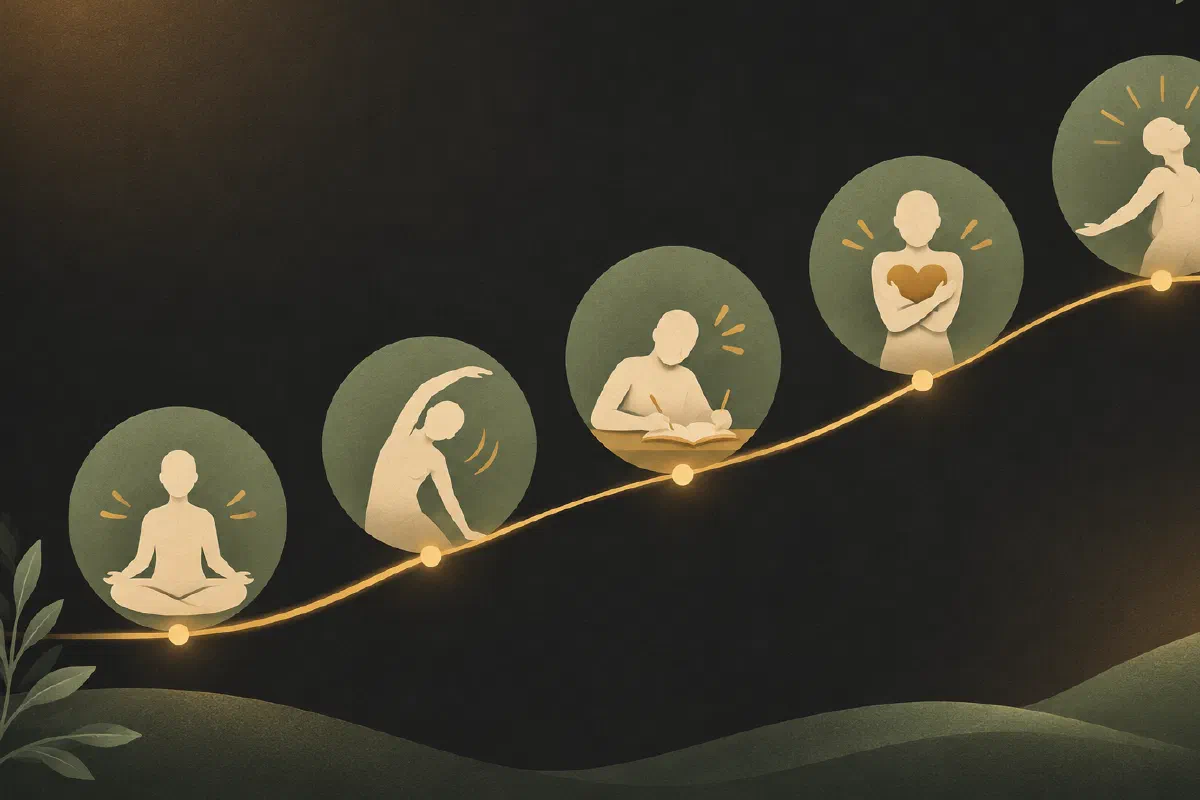
Here is how a working adult might turn the evidence into a light first week. It is an example, not a prescription; scale it to your energy.
| Day | Sleep | Movement | Breathing | Detachment |
|---|---|---|---|---|
| Mon | Pick a fixed wake-up time | 10-minute walk at lunch | 5 minutes, 5-in / 5-out | Write tomorrow’s top task, then close the laptop |
| Tue | Screens off 30 minutes before bed | Same walk | 5 minutes before a hard meeting | No work email after a set hour |
| Wed | Same wake-up time | Stretch or walk, any length | 5 minutes after work | One hour of something absorbing and non-work |
| Thu | No caffeine after early afternoon | 10-minute walk | 5 minutes | Note one workload issue to raise |
| Fri | Same wake-up time | Walk | 5 minutes | Raise the workload issue with your manager |
| Weekend | Keep wake-up time within an hour | Something you enjoy | Optional | Choose freely how to spend one block of time |
At the end of the week, fill in this short check:
- Nights with 7 or more hours of sleep: ___
- Days with any movement: ___
- Evenings I mostly stopped thinking about work: ___
- One thing at work that drains me most: ___
- One change I can ask for next week: ___
If you live with ADHD, our article on what people mean by ADHD burnout covers that overlap.
When to see a doctor
Burnout-like exhaustion can overlap with other conditions. The NHS lists causes of tiredness that include sleep problems such as sleep apnoea, iron deficiency anaemia, an overactive thyroid, stress and depression, and advises seeing a GP if you have felt tired for a few weeks without knowing why, or if tiredness affects your daily life. It also advises against self-diagnosis.
For stress, the NHS suggests getting help if you are struggling to cope or your own efforts are not helping. Low mood that does not lift is worth raising too; see burnout vs depression. If you ever feel unable to keep yourself safe, contact your local emergency number or a crisis line in your country straight away.
This article is educational and does not replace advice from a doctor.
Summary and next step
Burnout involves the body’s stress systems, but there is no measurable “burned-out nervous system”, and some popular frameworks are disputed. What helps is less exotic: protect sleep, move a little most days, use slow breathing for stressful moments, and create real distance from work, ideally alongside changes to the workload itself. For a fuller plan, read how to recover from burnout.
Next step: choose one row from the starter plan for tomorrow. If giving work a clear end point is the hard part, the free focus timer or Cyklio, our app, can help you work in defined sessions and stop when the session ends.