


There is a chair, a corner of the kitchen counter or a spot on the floor where things land and stay: post, a charger, a receipt, a jumper, a form you need to sign. If that pile keeps coming back no matter how often you clear it, this guide explains why, gives you a short method to sort one pile, and offers a few small rules that stop the next one growing.
What is a doom pile?
“Doom pile” is a popular internet term for a mixed heap of objects that were put down “for now” and never given a decision. It is not a clinical or diagnostic term, and it does not appear in the symptom descriptions published by health bodies. It is simply an informal name, used widely online, for a pattern many people recognise.
What makes a doom pile different from ordinary mess:
- It is mixed. Bills sit next to socks, a library book, a broken cable and a birthday card. Nothing in it belongs together.
- It is made of postponed decisions. Each object is waiting for an answer to “where does this go?”, “do I need this?” or “what do I have to do about it?”.
- It moves rather than shrinks. When guests come, the pile goes into a bag or a cupboard, and the decisions travel with it.
- It often hides something important. An unpaid invoice or a letter with a deadline can sit under three takeaway menus for weeks.
Why piles build up so easily with ADHD
The NHS lists finding it hard to organise your time, being easily distracted or forgetful, finding it hard to finish tasks and losing things often among the inattentive signs of ADHD in adults. The CDC describes the inattentive presentation as making it hard to organise or finish a task, with the person easily distracted or forgetting details of daily routines. A doom pile is what those difficulties can look like on a kitchen counter: the start of a task (coming home, opening the post) happens, and the finishing step (putting it away, dealing with it) gets lost.
A few common explanations, which are practical ideas rather than findings from ADHD research:
- Putting away needs a decision; putting down does not. Dropping something is instant. Deciding where it lives, or what to do about it, takes a moment of effort at the exact time you are tired or distracted.
- “Out of sight, out of mind.” Many people with ADHD keep things visible so they will not forget them, and surfaces slowly become storage. This is a popular explanation, not a diagnosis; our article on object permanence and ADHD looks at it more closely.
- The pile becomes a task in itself. Once a pile is big, clearing it feels like one huge, vague job, which makes it easy to avoid.
Does a pile affect how you feel? The evidence is suggestive, not settled. In a study of 60 spouses from dual-income couples who gave recorded tours of their homes, wives who used more words about clutter and unfinished projects had flatter daily cortisol patterns and a depressed mood that rose over the day (Saxbe and Repetti, 2010). That is an association in one small group, not proof that clutter causes stress, and it did not study ADHD.
Doom piles are not the same as hoarding
A recurring pile of undecided things is common and usually harmless. Hoarding disorder is different: the NHS describes it as a mental health condition in which you collect lots of things and find it very difficult to get rid of them, even if it is affecting your life. One study of 88 patients at an adult ADHD clinic found clinically significant hoarding symptoms in about 20% of them compared with 2% of matched controls, with inattention as the only significant predictor of hoarding severity among the patients. So most adults with ADHD in that study did not have it. If you find it very hard to get rid of things, or you cannot use rooms in your home because they are too full, read ADHD, clutter and hoarding: where is the line? and consider talking to a doctor.
The pile-sorting method: one pile, 20 minutes
The goal is not a tidy home. The goal is to turn one pile into a handful of small, finished decisions. CHADD’s National Resource Center on ADHD suggests breaking organising into steps, starting with the easiest space and using a timer, with sessions of 10 to 15 minutes if longer ones feel like too much. This method uses 20 minutes, but shorten it freely.
Set up (2 minutes, not counted)
- Pick the smallest or most annoying pile, not the worst one.
- Set out five destinations: a bin bag, a “goes elsewhere” box, an “action” tray, a clear space for “keeps here” and a “not sure” box. Their names matter more than the containers.
- Start a 20-minute timer. Any timer works, including the free Cyklio Focus Timer in your browser.
Sort (15 minutes)
- Pick up the top item. Do not dig for the “important” things first.
- Give it one of the five destinations within a few seconds, using the table below.
- Do not walk away to put anything in another room. That is how a sorting session turns into a house tour.
- Repeat until the timer rings or the pile is gone.
| The item is… | Destination | What happens next |
|---|---|---|
| Rubbish, packaging, expired or broken beyond repair | Bin bag | Out of the house at the end of the session |
| Something that lives in another room or belongs to someone else | Goes elsewhere | One trip around the house at the end |
| Paper or an object that needs you to do something (pay, sign, return, reply) | Action tray | Each item becomes one line on your task list |
| Something that really belongs on this surface | Keeps here | Stays, in a defined spot |
| Anything you cannot decide on in a few seconds | Not sure | Sealed and dated, reviewed later |
For paper, CHADD’s four options fit inside this table: throw away or recycle, pass to someone else, act on it now or file it. For the “not sure” box, CHADD suggests sealing it and writing a review date three to six months ahead; anything you did not miss by then can go.
Finish (5 minutes)
- Take the bin bag out.
- Do one loop to return the “goes elsewhere” items.
- Write each item in the action tray as one short task with a verb: “pay water bill”, “return parcel”, “sign school form”. The tray itself stays in one fixed place.
- Stop, even if part of the pile is left. Write the date on a sticky note on what remains and plan the next session.
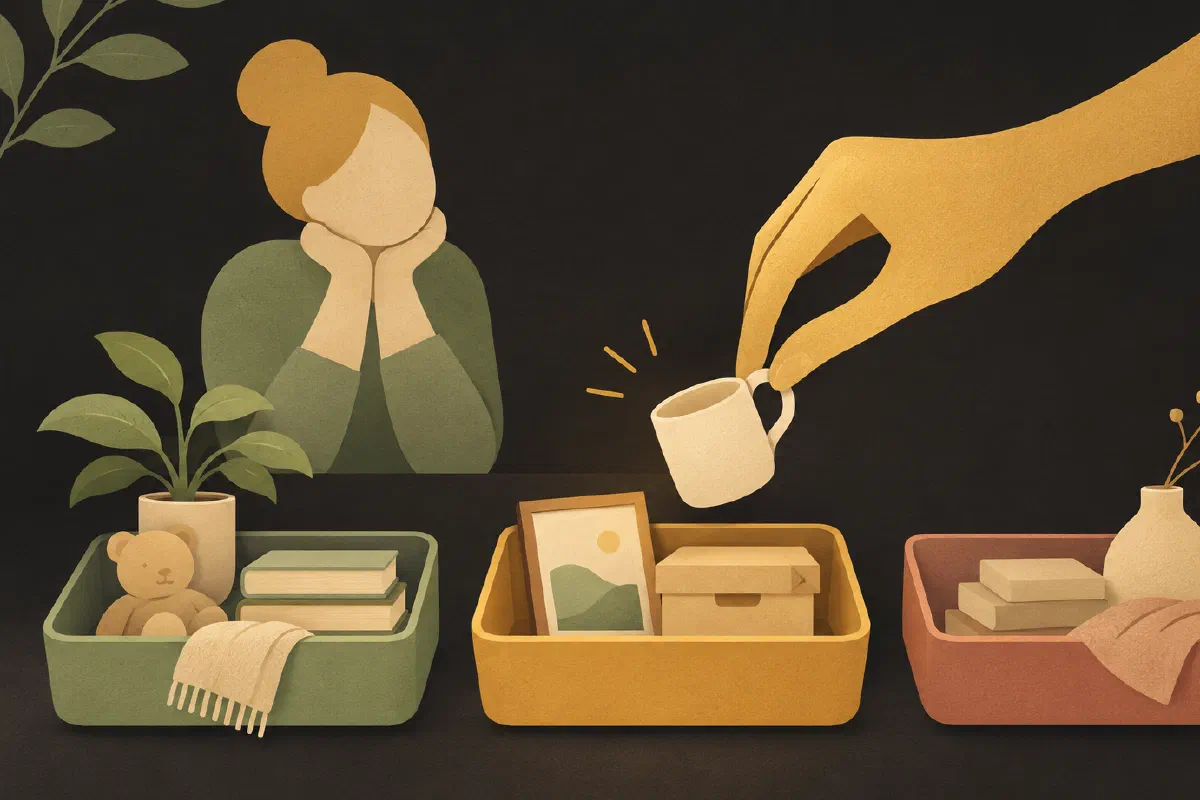
The action tray is the easiest part to skip, and it is the part that matters most. A doom pile is often scary because it hides tasks. Once those tasks are on a list, the objects themselves are just objects.
Small rules that stop new piles forming
Clearing a pile is a one-off. Keeping new piles small comes from a few rules that need almost no willpower in the moment. One well-studied way to set such rules is the implementation intention, a plan written as “if situation X happens, then I will do Y”. A review of this research reports that if-then plans improved goal attainment, including in groups with weaker self-regulation. It did not test doom piles specifically, so treat the rules below as reasonable experiments, not proven fixes.
| If… | Then I will… |
|---|---|
| I walk in the front door | Put keys, wallet and glasses in the basket on the hall shelf |
| I bring in the post | Open it standing at the bin and drop anything to act on straight into the action tray |
| I put something down “for now” | Put it in the one allowed “for now” basket, not on a surface |
| The “for now” basket is full | Sort it with a 10-minute timer before adding anything else |
| I finish dinner | Spend 10 minutes putting dropped items back |
| I buy something new for the house | Let one similar thing go |
These rules echo CHADD’s practical suggestions: a “launch pad” by the front door with a basket for keys, glasses and wallets, a quick 10-minute pick-up each night, clear containers so you can see what is inside and a “subtract before you add” rule for buying.
A few extra tips:
- Choose two or three rules, not six. Add another only when the first ones happen without thinking.
- Make the allowed pile official. A basket that is allowed to be messy is easier to live with than a promise that you will never make a pile again.
- Give the action tray a weekly slot. Try fifteen minutes on the same evening each week.
If many things in your home have no fixed place at all, that is an organising job rather than a pile problem; see ADHD organisation systems for stuff and paperwork. For a full approach to cleaning rooms, which this article does not cover, see how to clean with ADHD, step by step.
Example: clearing the chair pile on a Thursday evening
This is an illustrative example, not a real case.
Marta works in a busy accounts team and gets home around 18:30. The armchair in her bedroom has disappeared under two weeks of clothes, post, a laptop charger and a bag from a weekend away. She has been meaning to “deal with it at the weekend” for three weekends.
- 18:45 She sets out a bin bag, a laundry basket as “goes elsewhere”, a tray for action items and an empty shoebox for “not sure”. She starts a 20-minute timer.
- 18:47–19:02 She takes items from the top only. Clothes go to the basket or the wardrobe rail if clean. Packaging and receipts she does not need go in the bin bag. Three letters go into the action tray. A cable she does not recognise and a gift she is unsure about go in the shoebox.
- 19:02–19:07 She takes out the bin bag, carries the basket to the washing machine and writes three tasks: “pay dentist invoice”, “reply to council letter”, “return weekend bag to sister”.
- 19:07 The chair is clear, the bag from the weekend is still half full, and she stops anyway. She tapes a note on the bag: “Sunday, 10 minutes.”
- The next morning she adds one rule: “If I take clothes off and they are not dirty, then they go on the hook on the door, not the chair.”
Twenty minutes did not fix her flat. It turned an avoided pile into three visible tasks and one new habit, which is a realistic result for a weekday evening.
When piles point to something bigger
For many people, a doom pile is just a doom pile. But if piles spread through the whole home, regularly cause missed bills or deadlines, or come with feeling stuck in many areas of life, it may help to get support. CHADD notes that some people need a coach, a professional organiser or a therapist to get started. For adults with diagnosed ADHD whose symptoms continued despite medication, a randomised trial of 86 adults found that 12 sessions of cognitive behavioural therapy improved symptoms more than relaxation with educational support, and responders kept their gains at 12 months. A GP or your ADHD clinician can tell you what is available where you live.
If you want a wider plan for letting go of things room by room, our guide on how to declutter when you have ADHD uses the same small-steps approach. If even the first step feels impossible, the 10-minute timer method is built for exactly that moment.
Summary
- A doom pile is a popular name for a mixed pile of postponed decisions. It fits the organising difficulties linked with ADHD and says nothing about your character.
- Sort one pile at a time, from the top, into five fixed destinations: bin, goes elsewhere, action, keeps here, not sure.
- Turn the action tray into a short task list; that is where the stress usually hides.
- Keep new piles small with two or three if-then rules, one allowed “for now” basket and a short nightly pick-up.
Your next step: pick the smallest pile you can see right now and give it one 20-minute session. If you would like to track sessions like this, Cyklio, our focus timer app, lets you rate each one and see your weekly report.