


Grad school asks you to steer a project that lasts years with very little structure from outside, and that is exactly the kind of work executive dysfunction makes hard. This guide explains why research and writing stall, how to borrow structure from outside, and gives you a plan for your next work session.
Why open-ended research is so hard to start and keep going
Executive functions are the mental processes you use to concentrate, hold information in mind and override autopilot, and planning and problem-solving are built on top of them, according to a review by Adele Diamond. “Executive dysfunction” is an everyday umbrella term for when those processes keep letting you down. It is not a diagnosis in itself, and our executive dysfunction explainer covers the basics. This article stays with grad school; if your struggle is a regular job, see executive dysfunction at work.
Graduate research leans heavily on these processes:
- The payoff is far away. A thesis due in two or three years gives you very little reason to start today. In a meta-analysis of procrastination research, Piers Steel found that task delay (how far away the reward or consequence is) and task aversiveness (how unpleasant the task feels) were among the strong and consistent predictors of procrastination.
- The next step is not defined. “Work on chapter two” is not a task. Before you can start, you first have to invent the task, which takes the planning that is already hard for you.
- Scholarly writing is unstructured. Psychologist Robert Boice studied procrastination among academics and concluded that putting off a relatively unstructured activity like scholarly writing has at least two central components, bingeing and busyness (Boice, 1989).
- Stress, poor sleep and isolation make it harder. Diamond’s review notes that stress, lack of sleep, loneliness and lack of exercise each impair executive functions. She also warns that these factors can make someone look as if they have an executive function disorder such as ADHD when they do not.
If you have ADHD, the NHS lists “finding it hard to organise your time” and finding it hard to follow instructions or finish tasks among the inattentive signs in adults, so a self-directed degree can feel built against you. This is not a character flaw. The task gives you very little structure, and structure is something you can add.
Build the outside structure your program does not give you
If the problem is too little structure, the practical fix is to add it from outside, so that less depends on starting from willpower alone. These are common strategies; pick two, not all five.
- A fixed start. Same time and same place for research blocks, at least three days a week. Decide this in advance as an if-then plan (more on this below).
- One visible project map. One list or board that shows every part of the thesis and the next physical action for each. It takes the plan out of your head, so you don’t have to hold it in memory.
- Deadlines with a person attached. A deadline only you know about is easy to move. A deadline someone else expects, like an advisor, a lab mate or a writing partner, is harder to slide.
- Company while you work. Writing groups, “shut up and write” sessions or a study partner on a video call. Working next to someone is often called body doubling. It is a popular term, not a clinical one, and our guide to body doubling for studying explains what is and is not known.
- A timer that marks the session. A clear start and end turns “I should be writing” into “I am writing until the timer ends.” The Cyklio Focus Timer works in the browser.
Turn advisor check-ins into structure
Your advisor is the biggest source of outside structure you have, but only if meetings produce small, agreed outputs. Vague meetings (“how’s it going?”) give you nothing to work towards. You can ask for a regular rhythm, such as a short meeting every two weeks and a written update in between, without explaining why. Whether you mention ADHD or any other condition is your choice.
A short weekly update email keeps you accountable even between meetings. Copy and fill in this template:
Subject: Weekly update, [date]

Done this week: [one or two lines, rough is fine]
Stuck on: [one specific problem]
Next week I will send you: [one concrete deliverable] by [day]
One question for you: [optional]
Sending this every Friday turns a three-year project into a weekly promise to another person. It also gives your advisor an early chance to catch problems before they grow.
Shrink the thesis into small weekly deliverables
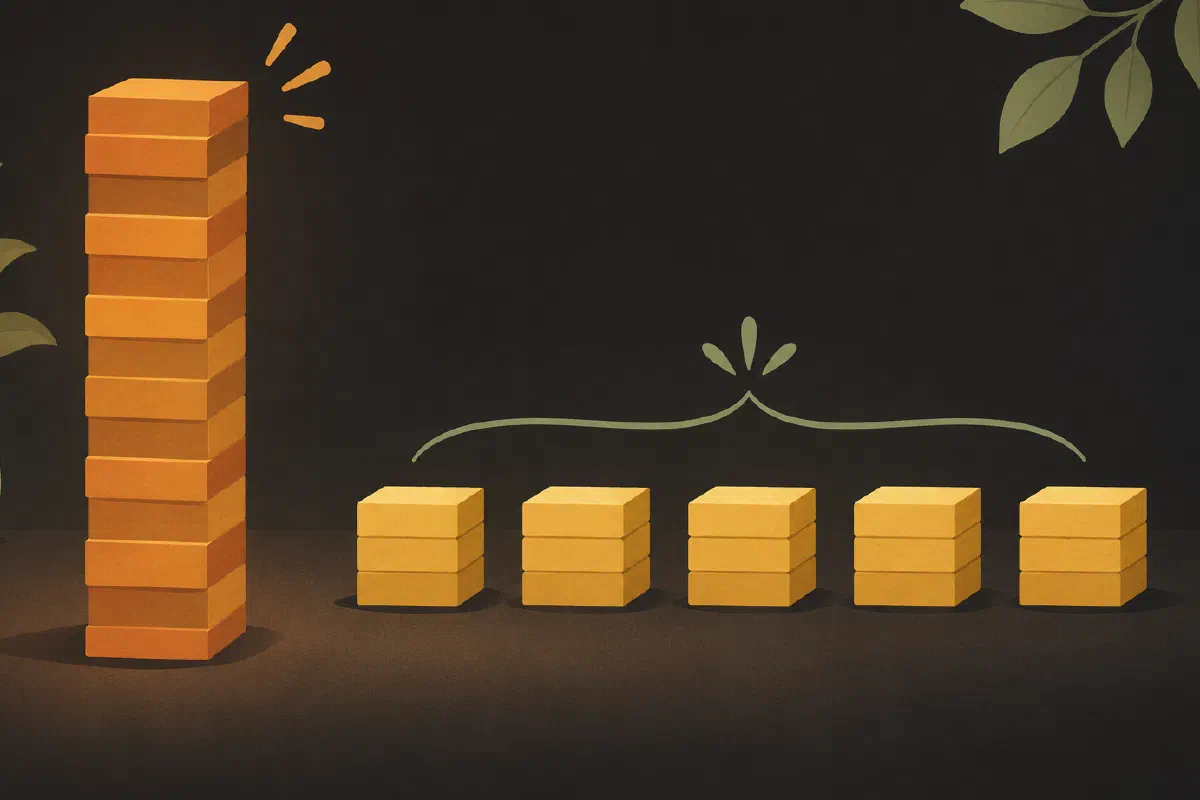
A weekly deliverable is a small, visible piece of work that someone else could look at. Use this table to turn a vague goal into one:
| Vague goal | Weekly deliverable | Done looks like |
|---|---|---|
| “Do the literature review” | Notes on 5 papers for one sub-question | 5 entries of 3–5 sentences each |
| “Write chapter two” | Rough draft of one section (about 600 words) | File sent to a peer or advisor |
| “Analyse the data” | One cleaned dataset and one exploratory plot | Plot pasted into a shared document |
| “Fix the methods” | Advisor’s comments listed, with a response to each | Two-column table finished |
| “Prepare the conference talk” | Outline of 10 slide titles | Outline shared with a lab mate |
A good weekly deliverable meets four criteria:
- You can finish it in two to four work sessions.
- It is visible: a file, a list or a plot, not “progress”.
- Someone else will see it.
- A rough version counts as done.
A one-session plan for research or writing
This plan covers one block of about an hour. It uses an if-then plan, also called an implementation intention: you decide in advance when, where and how you will start. A meta-analysis by Gollwitzer and Sheeran of 94 independent tests found a medium-to-large effect of these plans on reaching goals, including on getting started.
- Pick one output (2 minutes). Take it from this week’s deliverable: “a rough paragraph on sampling”, not “work on methods”.
- Write your if-then plan. “If it is 9:30 and I am at the library desk, then I open the draft and write one sentence for section 2.3.”
- Set up the start. Open only the files you need. Close email and chat.
- Lower the entry bar (5 minutes). Write ugly bullet notes before proper sentences. Starting rough is still starting.
- Work for one timed block (25–45 minutes). When a distraction pops up, write it on a “later” list and go back.
- Leave a next-step note (2 minutes). Write the very first action for next time, such as “Start with the paragraph on dropouts; the source is in folder B.”
- Take a short break, then decide. Do another block or stop for the day. Both are fine.
Short, regular sessions are one alternative to binge writing. In Boice’s research, an intervention that helped new faculty members find brief, daily writing sessions was effective and, in his words, relatively unaversive (Boice, 1989). It is an older study of faculty, not students, so treat it as a promising idea for thesis writing rather than proof.
Worked example (illustrative)
A second-year PhD student who also teaches a seminar has this week’s deliverable: a rough draft of the methods section on participant recruitment. On Tuesday her if-then plan reads: “If it is 9:30 and I’ve dropped my bag at the library, then I open the methods file and write one bullet.” She opens only the draft and two papers. The first five minutes are bullets. At 9:52 she wants to check the seminar inbox, so she writes “reply to students” on her later list and keeps going. At 10:15 the timer ends with about 250 rough words. Her next-step note says: “Start with exclusion criteria; see last year’s ethics form.” On Friday the weekly update email lists the draft as done and asks one question about sample size.
When strategies aren’t enough: support options
Structure helps many people, but sometimes you need more support. These are the main routes:
- Your university’s disability or accessibility service. The NHS notes that adults with ADHD can request changes at their place of study to help manage ADHD, for example having help from another person to plan and structure tasks. Ask what applies to research degrees specifically, since thesis work is not organised like taught courses. Our guide to ADHD college accommodations covers the process.
- Funding in England. The Disabled Students’ Allowance covers undergraduate and postgraduate students and does not have to be paid back. The eligibility page is for students who live in England and meet its funding conditions, and it names ADHD as an example of a specific learning difficulty. Elsewhere, support works differently, so ask your disability office.
- A doctor, if you suspect ADHD or another condition. The NHS describes assessment by an ADHD specialist, such as a psychiatrist, which a GP can refer you to; an online quiz cannot tell you. Executive dysfunction has many possible causes, as our article on executive dysfunction without ADHD explains. Questions about medication belong with your doctor or prescriber.
- Skills-based therapy. The NHS says talking therapies such as cognitive behavioural therapy (CBT) may be recommended for adults with ADHD. In one randomised trial with 88 adults with ADHD, a 12-week group programme teaching time management, organisation and planning improved inattention symptoms more than supportive therapy (Solanto et al., 2010). That is one trial, not proof for everyone, but it suggests these skills can be learned.
- Counselling and peers. University counselling services, graduate writing groups and peer support can help with stress and isolation, which Diamond’s review links to weaker executive functions. If you feel exhausted all the time rather than stuck, read about executive dysfunction and burnout.
Summary and one next step
Grad school combines a far-away payoff, undefined next steps and a lot of working alone. That makes executive dysfunction more noticeable, but it doesn’t mean you can’t do research. Add structure from outside: a fixed start, advisor check-ins with agreed outputs, one weekly deliverable someone will see, and short planned sessions with a next-step note at the end.
Next step: before your next research block, write this week’s deliverable and one if-then plan, then run a single timed session. You can use the Cyklio Focus Timer or Cyklio, our own app from Mindly 360, which lets you rate each session and see weekly reports, with a 7-day free trial and no account needed.