


You know you need a shower. You have known for an hour. The problem is not that you don’t care; it is that the gap between knowing and actually standing under the water feels oddly huge. This guide shows how to shrink that gap with minimal versions, routine stacking, cues and a checklist that counts what you did rather than what you missed.
Why hygiene tasks feel so hard with executive dysfunction
Executive functions are, in one widely cited review, “a family of top-down mental processes” you need when you have to concentrate, and the three core ones are inhibition, working memory and cognitive flexibility, with planning and problem solving built on top. “Executive dysfunction” is a popular description of ongoing trouble with these skills, not a diagnosis in itself. If you want the background, start with what executive dysfunction is and where it comes from.
Hygiene tasks lean on exactly these skills. A shower looks like one task, but it is really a chain: decide to go now, stop what you are doing, find a towel, check there is shampoo, get undressed, tolerate the temperature change, wash in some order, get out, get dressed again. Each link is a small decision that working memory has to hold and order.
This overlaps with how ADHD is described by health bodies. Describing the inattentive presentation of ADHD, the CDC says the person “is easily distracted or forgets details of daily routines”, and the NHS describes adults with ADHD finding it hard to organise their time and to finish tasks. Executive functions are also sensitive to the rest of your life: the same review notes that stress, lack of sleep, loneliness or lack of exercise each impair them. So a week with poor sleep can make self-care harder even if your routine has not changed.
None of this means you are lazy or dirty. It means the task needs a different design.
Give every hygiene task a minimal version
The most useful change is to stop treating each task as all or nothing. Decide in advance what the smallest acceptable version looks like, so a bad day still has an option you can actually do.
| Task | Full version | Minimal version | Floor (bad day) |
|---|---|---|---|
| Teeth | Floss, then brush about 2 minutes, morning and night | Brush at night, any length you can manage | Brush at night, even quickly |
| Shower | Full wash, hair, shave or skincare | Quick body wash, no hair | Wash face, underarms and groin with a cloth at the sink |
| Hair | Wash and style | Rinse or tie back | Brush or tie back |
| Clothes | Fresh outfit | Fresh underwear and top | Fresh underwear |
| Face and skin | Full routine | Cleanse and moisturise | Splash of water |
| Deodorant | Shower, then deodorant | Deodorant only | Deodorant only |
The tooth row is based on NHS guidance: brush twice a day for about 2 minutes, with one of those times “last thing before you go to bed”, and spit rather than rinse straight away so fluoride stays on your teeth. That makes the night brush the obvious one to protect when you can only do one. The other rows are practical suggestions, not health rules. Adjust them to your body, skin and work.
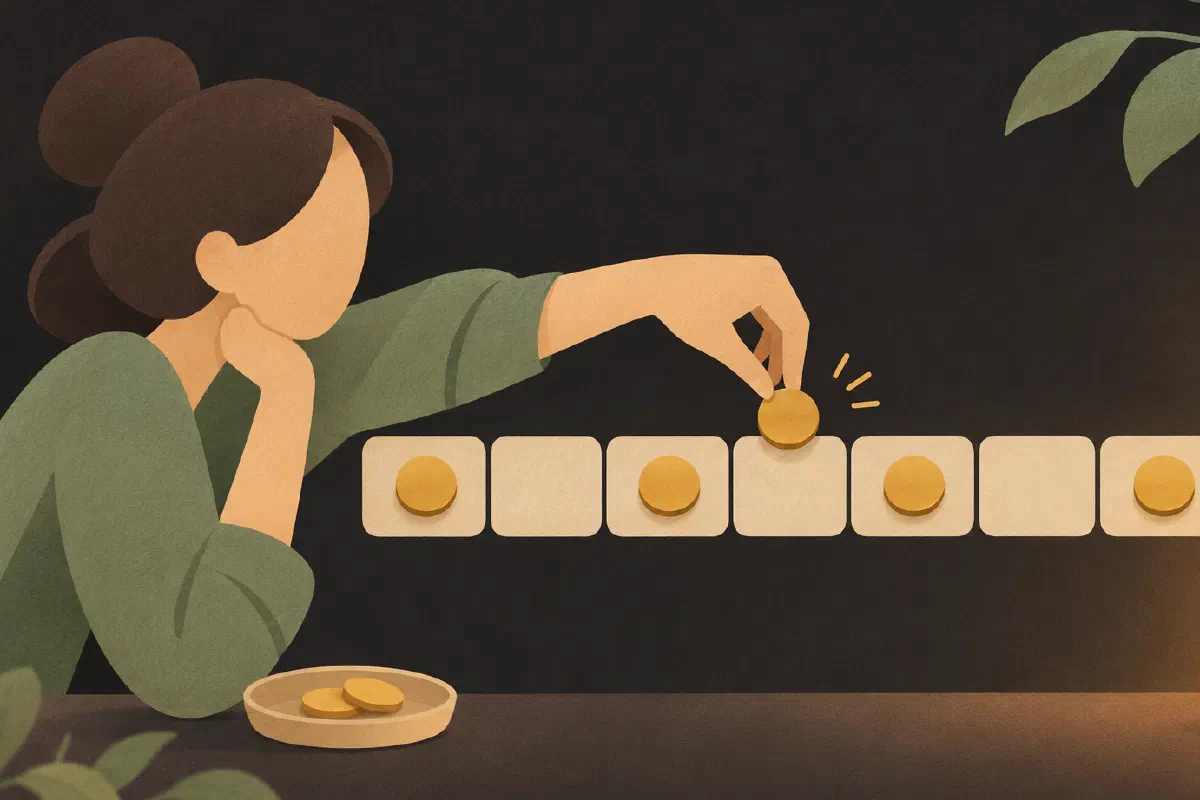
A minimal version is not lowering your standards forever. It keeps the link between the cue and the action alive on days when the full version is out of reach, so you are not starting from zero next time.
Stack hygiene onto things you already do
Habit research gives a clear, practical message. In a review for GPs, Gardner, Lally and Wardle explain that repeating a simple action in the same context builds an association so that, over time, the context starts the behaviour with less effort. They advise choosing a daily cue such as a time or an event, anchoring the new action to an existing routine and keeping it consistent.
Three findings from that review are especially reassuring:
- Simple actions become automatic sooner than elaborate ones, so “brush teeth after switching off the TV” beats “complete evening routine”.
- Missing one day did not seriously derail habit formation in the study they describe; progress resumed after the next repetition.
- It takes longer than the popular 21 days. Automaticity levelled off at about 66 days on average, with wide variation between people, and the authors suggest expecting roughly ten weeks.
Routine stacking means writing the anchor and the action as a single if-then line:
- Pick an anchor you already do every day without thinking: making coffee, the kettle boiling, getting home and dropping your keys, plugging in your phone at night.
- Pick one minimal hygiene action from the table above.
- Write it as: “After I [anchor], I [action].” For example: “After I plug in my phone, I brush my teeth.”
- Put the supplies within reach of the anchor if possible.
- Run it for a couple of weeks before adding a second stack.
Planning like this has some research support, though modest. A 2021 meta-analysis of 21 studies found that combining if-then plans with thinking through likely obstacles had a small-to-moderate effect on reaching goals, and the authors note that publication bias means the true effect may be smaller. Treat stacking as a helpful structure, not a guarantee. For longer chains of linked tasks, see task stacking with ADHD.
Put cues and supplies where the task happens
Relying on memory is the weak point, so move the reminder into the room. These are common practical strategies; they are not tested treatments, but they reduce the number of steps between deciding and doing.
- Duplicate kits. A spare toothbrush and toothpaste in the kitchen or next to your bed, deodorant in your work bag, face wipes by the sofa.
- Lay out the next step. Put a towel and clean clothes on the bathroom stool before you need them, so the shower starts with fewer decisions.
- Lower the friction. Pump bottles instead of caps, a shower caddy at hand height, a robe on the door if getting cold is what puts you off.
- Visible cues. A sticky note on the mirror with only the minimal version, or the toothbrush standing next to the kettle.
- A finish line. A short playlist or a visual timer turns “a shower” into “three songs”. Visual timers for ADHD explains the options.
- Company. Some people find it easier to start while someone else is around or on a call, a popular informal strategy usually called body doubling.
- Sensory fixes. If a texture, smell or temperature is the real barrier, change that thing (unscented products, a softer towel, warmer bathroom) instead of pushing through it.
A shame-free hygiene checklist
A checklist helps because you no longer have to remember the chain, but a perfect daily list can turn into a record of failure. This version counts any level as a success. Copy it into your notes app or print it.
Today I did (tick any level):
- Teeth: ☐ floor ☐ minimal ☐ full
- Body: ☐ floor ☐ minimal ☐ full
- Hair: ☐ floor ☐ minimal ☐ full
- Clothes: ☐ floor ☐ minimal ☐ full
- Face and skin: ☐ floor ☐ minimal ☐ full
What made it easier today: ____________
One thing to set up for tomorrow (towel out, kit in bag): ____________
Rules for using it:
- Tick what happened. Do not mark what didn’t.
- A floor tick counts as a full tick for the day.
- Look back once a week only to spot what helped, not to grade yourself.
Worked example: a workday evening
Here is an illustrative composite, not a real person. Sam works in an office, gets home at 18:30 drained, and often goes to bed without brushing or showering, then feels bad the next morning.
- Anchor chosen: plugging in the phone charger by the bed at about 22:30.
- Stack written: “After I plug in my phone, I brush my teeth.” A second toothbrush and toothpaste now live in the bedside drawer, next to a glass and a small bowl.
- Shower redesigned: showering moves to the morning, straight after switching on the coffee machine. The towel and clothes are laid out the night before, and a three-song playlist marks the end.
- Floor defined: on very tired mornings, a cloth wash at the sink plus fresh underwear and deodorant.
- Tracking: the checklist sits on the fridge. In a typical week Sam ticks the floor on some days and the full version on others, and the night brush happens most nights because it costs almost no effort.
The routine did not become perfect. It became something that happens on most days, and the bad days stopped breaking it completely.
When it is more than executive dysfunction
Sometimes hygiene slips because of low mood or exhaustion, not only because starting is hard. The NHS lists symptoms of depression that include having no motivation or interest in things, lack of energy and neglecting hobbies and interests, and advises seeing a GP if you have symptoms for most of the day, every day, for more than 2 weeks. The strategies in this article are not a substitute for that conversation.
This article is educational and does not replace advice from a doctor. If you have thoughts of harming yourself, contact your local emergency number or a crisis line in your country right away. For the overlap between these states, read executive dysfunction, anxiety and depression, and if self-care collapsed after a long period of overload, see executive dysfunction and burnout.
Summary and one next step
Hygiene tasks are chains of small decisions, which is why they can stall when executive functions are stretched. Give each task a floor and a minimal version, attach one of them to an anchor you already do daily, put the supplies and cue where the task happens, and track any level as a win.
Your next step: pick one task and write a single stack today, such as “After I plug in my phone, I brush my teeth”, and put the toothbrush where you will see it. If a time limit makes starting easier, open the Cyklio Focus Timer and set a 10-minute reset for laying out tomorrow’s towel and clothes.