

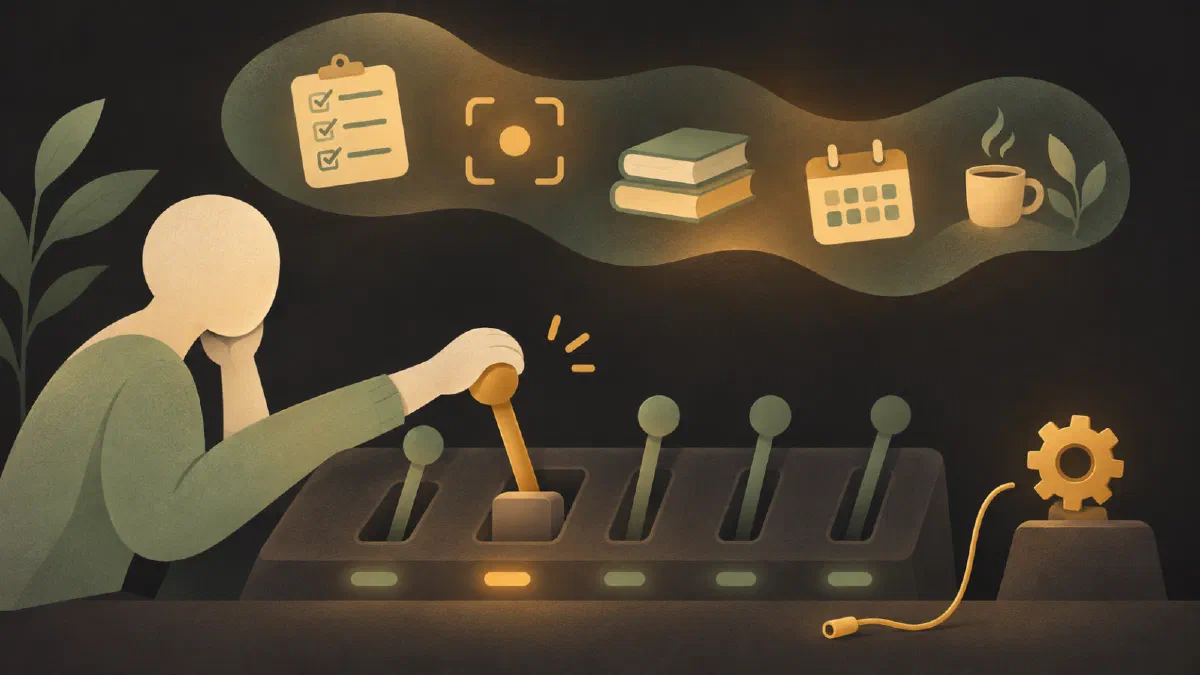
You know what you need to do, you may even want to do it, and still the task does not get planned, started or finished. “Executive dysfunction” is the name many people use for that gap. This guide explains what the term means, what it looks like in an adult’s day, what can cause it and when it is worth asking a doctor about it.
This article is educational and does not replace advice from a doctor.
What does executive dysfunction mean?
Executive functions are, in the words of one widely cited review, a family of top-down mental processes needed when you have to concentrate and pay attention. You need them most when running on habit or instinct would not get the job done: a new task, a change of plan, a temptation you want to resist.
Executive dysfunction simply means having persistent difficulty with these skills. Cleveland Clinic describes it as a symptom that happens with conditions that disrupt the brain’s ability to control thoughts, emotions and behavior. In other words, it describes what is hard, not why.
The three core executive functions
Researchers usually group executive functions into three core skills. The same review by Adele Diamond names them as inhibitory control, working memory and cognitive flexibility, and Harvard’s Center on the Developing Child uses plainer labels: working memory, mental flexibility and self-control.
| Core skill | What it does | Everyday adult example |
|---|---|---|
| Working memory | Holds information in mind while you use it | Remembering the three things your manager asked for while you open the right files |
| Mental flexibility | Lets you switch approach or adjust to new rules and priorities | Changing your plan when a meeting moves, without losing the whole afternoon |
| Self-control (inhibition) | Holds back an urge or tunes out a distraction so you can do what fits the goal | Not opening your inbox “just for a second” when you sat down to write a report |
Diamond’s review explains that higher-level skills such as reasoning, problem solving and planning are built from these three core skills. That is why a problem with one core skill can show up as a problem with something bigger, like planning a project.
The three skills are related but not identical. In a study of 137 college students that measured shifting, updating information in working memory and inhibition, the three functions were moderately correlated with one another but clearly separable. In practice this means one person may struggle mostly with holding information in mind, while another struggles mostly with switching or with resisting distractions.
A simple analogy: the control tower
Harvard’s Center on the Developing Child compares executive function to an airport having a highly effective air traffic control system. The analogy works well for adults too, so here is how it maps:
- The planes are your tasks, ideas and intentions: the email to answer, the report to write, the call to return.
- The radar screen is working memory: it shows which planes are in the air and where they are.
- Rerouting is mental flexibility: when a runway closes, the tower finds another way in.
- Holding a plane on the ground is self-control: not letting something take off just because it is ready and noisy.
Executive dysfunction is a tower having a bad stretch. The radar flickers, so planes drop off the screen. Rerouting takes far longer than it should. The loudest plane gets cleared first, even when it is not the most important one. Meanwhile some planes circle for hours because nobody gives them a landing slot.
Notice what the analogy does not say. The planes are fine, the pilots are skilled and the airport is not lazy. The problem is coordination. That is often how executive dysfunction feels from the inside: you have the ability and the intention, but turning them into action at the right moment is unreliable.
If you need a one-line version to explain this to a partner or colleague, try: “My brain’s control tower is unreliable. I can do the work; what’s hard is keeping track of it, switching between things and starting at the right time.”
Signs and everyday examples of executive dysfunction
Cleveland Clinic lists common signs of executive dysfunction, including:
- being very distractible, or fixating narrowly on one thing;
- zoning out during conversations, meetings or classes;
- trouble planning or finishing tasks;
- difficulty starting tasks that feel hard or dull;
- struggling to switch between tasks;
- acting impulsively, or saying things without thinking about the effect on others;
- difficulty explaining your thinking in words.
Everyone does some of these some of the time. What matters is how often, how much and in how many areas of life. A single forgotten appointment is not executive dysfunction; a long pattern of missed appointments, unfinished projects and lost afternoons that keeps causing real problems may be.
A worked example from a working day
Here is a composite example (not a real person) showing how the three core skills can trip up an ordinary Tuesday for an account manager we will call Maya.
| Time | What happened | Executive function involved |
|---|---|---|
| 8:50 | Opens her laptop to write a client proposal; checks one notification and is still in her inbox 40 minutes later | Self-control: holding back a distraction |
| 9:35 | Stares at the blank proposal, unsure what to do first; the task feels like one huge block | Planning and starting: breaking a goal into a first step |
| 10:15 | A colleague asks her to join an urgent call; afterwards she cannot remember where she was in the proposal | Working memory and switching back |
| 13:00 | Her manager mentions two changes in passing; by 14:00 she remembers one | Working memory: holding information until it is written down |
| 15:30 | The client moves the deadline forward; she freezes and reshuffles her to-do list three times | Mental flexibility: adapting to a new priority |
| 17:30 | Leaves with the proposal half done, feeling she “wasted” the day | All of the above, plus the emotional cost |
Maya is not short of skill or motivation. The problems cluster at moments of transition: starting, switching, holding new information and replanning. That pattern is typical of how people describe executive dysfunction. For more scenes like this, including home and admin tasks, see our collection of executive dysfunction examples in everyday life.

Executive dysfunction in ADHD
The link between ADHD and executive function is one of the most studied in this area. A meta-analysis of 83 studies, comparing 3,734 people with ADHD to 2,969 without, found that groups with ADHD showed significant impairment on all executive function tasks, with medium-sized effects. The strongest and most consistent differences were in response inhibition, vigilance, working memory and planning.
The same review adds an important caveat: the effects were moderate and not every person with ADHD had executive function weaknesses, so the authors concluded these weaknesses are neither necessary nor sufficient to cause all cases of ADHD. Put simply, executive dysfunction is common in ADHD, but ADHD is not the same thing as executive dysfunction, and you can have one without the other.
Many of the adult ADHD signs listed by the NHS overlap with everyday descriptions of executive dysfunction, such as being easily distracted or forgetful, finding it hard to organise your time, and finding it hard to follow instructions or finish tasks. If you want the wider picture of how adult ADHD can present, see our guide to ADHD symptoms in adults.
What about “executive dysfunction paralysis”?
Online, people often describe a frozen state where they cannot make themselves start anything, sometimes called “ADHD paralysis” or “executive dysfunction paralysis”. These are popular terms, not diagnostic categories. They overlap with executive dysfunction but are not the same thing; we explain the difference in ADHD paralysis vs executive dysfunction.
What causes executive dysfunction?
Because executive dysfunction is a description rather than a diagnosis, it can have many causes, and Cleveland Clinic notes that experts don’t fully understand why it happens. Diamond’s review links executive functions closely to the prefrontal cortex, especially its lateral regions, and describes them as among the first abilities to suffer when something is not right in your life.
Conditions associated with executive dysfunction
Cleveland Clinic lists a wide range of conditions where executive dysfunction can appear. They fall into two broad groups:
- Mental health and neurodevelopmental conditions: ADHD, autism, depression, OCD, schizophrenia and addictions, especially alcohol and drug use disorders.
- Brain injury or disease: concussion and traumatic brain injury, stroke, dementia including Alzheimer’s disease, epilepsy, multiple sclerosis, brain tumours, infections such as meningitis, and others.
Depression deserves a special mention because it is so common. A meta-analysis of 113 studies found that major depression is reliably associated with impaired performance on tests of executive function, with effect sizes from 0.32 to 0.97, although the author notes that the causal link still needs more research. The NHS also lists finding it difficult to make decisions and having no motivation among the psychological symptoms of depression. We look at this overlap in more depth in executive dysfunction with anxiety or depression.
Everyday factors: sleep, stress and strain
Executive functions are also sensitive to how your life is going. Diamond’s review says that stress, sadness, loneliness, lack of sleep and poor physical fitness all impair executive functions, and warns that these factors can make someone look as if they have an executive function disorder such as ADHD when they do not.
Two lines of research back this up:
- Sleep. A meta-analysis of 70 studies on short-term total sleep loss (under 48 hours) found effects ranging from large on lapses of simple attention to small and non-significant on reasoning accuracy, with working memory among the areas tested.
- Stress. A review of stress research concluded that even quite mild acute uncontrollable stress can cause a rapid and dramatic loss of prefrontal cognitive abilities, and that longer stress exposure can change prefrontal structure.
This is one reason executive dysfunction can vary from day to day and from one setting to another, and why a bad patch during a stressful period is not, on its own, a sign of a lifelong condition.
Popular use vs clinical use of the term
“Executive dysfunction” is used in two quite different ways, and mixing them up causes confusion.
| Popular use | Clinical use | |
|---|---|---|
| Where you hear it | Social media, forums, everyday conversation, especially in ADHD communities | Neurology, neuropsychology, psychiatry |
| What it usually means | “I can’t make myself start, plan or finish things, even when I want to” | Measurable difficulties with specific executive functions, as part of a wider assessment |
| Is it a diagnosis? | Often treated like one (“I have executive dysfunction”) | No: it is a symptom or finding that points to an underlying cause |
| How it is judged | Self-description | Clinical interview, history, rating scales and sometimes cognitive tests |
Terms such as “executive function disorder” or “executive dysfunction disorder” are widely used online, but clinicians treat executive dysfunction as a symptom of other conditions rather than a condition in its own right. That does not make the everyday experience less real; it means the label describes the problem without explaining it.
Why tests and real life can disagree
There is another twist. A review of 20 studies compared lab-style tests of executive function with questionnaires about everyday behaviour. Only 24% of 286 relevant correlations were statistically significant and the median correlation was only .19. The authors concluded the two types of measure capture different things: tests measure how efficiently your thinking works in a controlled setting, while questionnaires capture how well you pursue goals in real life.
For you, this has a practical meaning. Doing well on a short cognitive test does not prove your daily struggles are imaginary, and struggling day to day does not automatically mean a test will show a deficit. A good assessment looks at both, along with your history.
A self-reflection checklist (not a test)
This checklist cannot tell you whether you have ADHD or any other condition, and it is not a screening tool. Its job is to help you notice patterns and put them into words, which is useful if you decide to talk to a doctor. Copy it into a note and fill it in over a week or two.
- What is hardest? Starting / planning / remembering instructions / switching tasks / resisting distractions / finishing / something else: ________
- Where does it happen? Work / home / studies / relationships / admin and money tasks: ________
- Since when? As long as I can remember / since a specific time or event (when?): ________
- Did it start suddenly or gradually? ________
- What makes it worse? Poor sleep / stress / low mood / noise / boring tasks / time pressure: ________
- What makes it better? Deadlines / interest / another person nearby / timers / written lists: ________
- What has it cost me recently? For example a missed deadline, a late bill, a conflict: ________
- Sleep and mood check: How have my sleep, energy and mood been over the last two weeks? ________
- Health changes: Any recent head injury, illness, new medicine or change in alcohol or drug use? ________
If the answers point to a long-standing pattern across several areas of life, or to a recent clear change, that is useful information to share. If you are curious about formal tools, our guide to how adult ADHD is diagnosed explains what an assessment involves.
When to seek an assessment
Executive dysfunction is worth discussing with a doctor when it is persistent and causing real problems, not when you simply have an unproductive week. Public health guidance gives some clear markers:
- It affects your work, studies or relationships. The NHS advises adults whose ADHD-type symptoms affect these areas to make an appointment with a GP to find out what support is available. The GP may also consider other conditions that could explain the symptoms, such as autism or anxiety.
- It comes with low mood. If you have symptoms of depression, such as low mood, loss of interest or difficulty making decisions, for most of the day, every day, for more than 2 weeks, the NHS recommends seeing a GP.
- Memory problems keep happening. The NHS says to see a GP if you keep having problems with your memory or they affect your day-to-day life. It lists stress, anxiety, depression and sleeping problems among common causes.
- It started after a head injury. See a GP if symptoms of a head injury last more than 2 weeks. Problems with understanding, speaking or writing after a head injury need emergency help.
- It is new and getting worse. A clear change from how you used to function, especially if it keeps progressing, should be checked rather than explained away.
When it is urgent
Get emergency help straight away if thinking problems start suddenly, especially together with weakness, a drooping face or trouble speaking. The NHS lists confusion and memory loss among other possible stroke symptoms and advises calling 999 (the UK emergency number) straight away if you think someone is having a stroke. Elsewhere, call your local emergency number.
If you are struggling so much that you feel hopeless or think about harming yourself, please contact your local emergency number or a crisis line in your country now. Talking to someone you trust, or to your doctor, is a strong first step.
What helps (and where to go next)
Because executive dysfunction is a description rather than a diagnosis, what helps depends partly on the cause. If an underlying condition such as ADHD or depression is found, treatment for that condition is a matter to decide with your doctor. Alongside that, many people find practical changes to their setup useful, such as writing things down instead of holding them in mind, making the first step of a task tiny and concrete, and giving work blocks a clear start and end.
We cover these strategies step by step in how to work around executive dysfunction, so this guide does not repeat them. If you want to try one small thing today, a visible timer for a short block is an easy place to start: you can use the free focus timer.
Summary and one next step
Executive dysfunction is ongoing difficulty with the mental skills that let you hold information in mind, switch approach and hold back urges, and with the planning and starting that are built on them. It is a description, not a diagnosis. It is common in ADHD but not universal there, and it also appears with depression, brain injury and other conditions, and during periods of poor sleep and heavy stress. The popular use of the term is broader than the clinical one, and daily-life struggles do not always show up on tests.
Your next step: fill in the self-reflection checklist above over the next week. If the pattern is long-standing and affects your life, take it to a GP or doctor. If you want help with the starting part in the meantime, try one 10-minute block today with the focus timer, or try Cyklio, our own focus app, which runs sessions from 10 to 60 minutes towards a daily goal and lets you rate each one afterwards.