


You use executive function skills every time you keep a plan in your head, ignore a notification or change course when a meeting moves. This guide explains what those skills are, in plain language, and shows where each one turns up in an ordinary adult day.
This article is educational and does not replace advice from a doctor.
What are executive function skills?
Executive functions are a set of mental skills that let you direct your own behaviour towards a goal. The psychologist Adele Diamond, in a widely cited review, describes them as a family of top-down mental processes that you need when you have to concentrate and pay attention, and when going on autopilot or following your first impulse would be unwise or not enough.
The American Psychological Association’s dictionary gives a similar picture. It describes executive functions as higher-level cognitive processes of planning, making decisions, solving problems, ordering actions and keeping going towards a goal with effort and persistence, and of holding back urges that compete with that goal.
Three points help make sense of the term:
- It is a psychology concept. Executive function is a way researchers and clinicians group certain mental skills. It is not a body part you can point to, and it is not a diagnosis.
- It is an umbrella term. “Executive function” (singular) and “executive functions” (plural) are used for the whole family of skills. The APA dictionary notes that the same ideas are sometimes called “higher order processes”.
- It takes effort. Diamond points out that using executive functions is effortful and that it is easier to keep doing what you have been doing than to change. That is a useful thing to remember on days when switching tasks feels heavy.
A popular analogy comes from Harvard’s Center on the Developing Child, which compares executive function to an air traffic control system at a busy airport, managing many arrivals and departures on several runways at once. Your tasks, messages and intentions are the planes; executive function is the control tower.
Is executive functioning a cognitive skill?
Yes. “Cognitive function” is the broad term for thinking processes such as perception, memory, language, attention and reasoning. Executive functions are one part of that larger set: the APA dictionary describes them as higher-level cognitive processes. The Job Accommodation Network, a US workplace-disability resource, describes them as high-level mental processes that guide more basic abilities such as attention and memory.
A simple way to hold the difference:
| Cognitive function (broad) | Executive function (part of it) | |
|---|---|---|
| What it covers | All thinking processes | The skills that steer and coordinate the others |
| Examples | Recognising a face, recalling a word, reading | Holding a plan in mind, resisting a distraction, switching strategy |
| Effort | Many processes run automatically | Usually deliberate and effortful |
Which brain area is involved?
The APA dictionary links executive functions to brain networks centred in the frontal lobe, especially the prefrontal cortex, so it is more accurate to think of connected networks than of one single “executive” spot. Diamond’s review describes the prefrontal cortex and executive functions as the first to suffer when something is not right in your life, such as stress or lack of sleep. You do not need any neuroscience to use the rest of this guide; it simply explains why you will often see executive function described as “frontal lobe” skills.
The core executive function skills
Researchers do not all use the same list, but Diamond’s review notes general agreement on three core skills. In a well-known study, Akira Miyake and colleagues found that three skills, which they called shifting, updating and inhibition, were related to each other but still separable. Diamond’s review uses the same three core skills under slightly different names and describes planning, reasoning and problem solving as higher-order skills built from them.
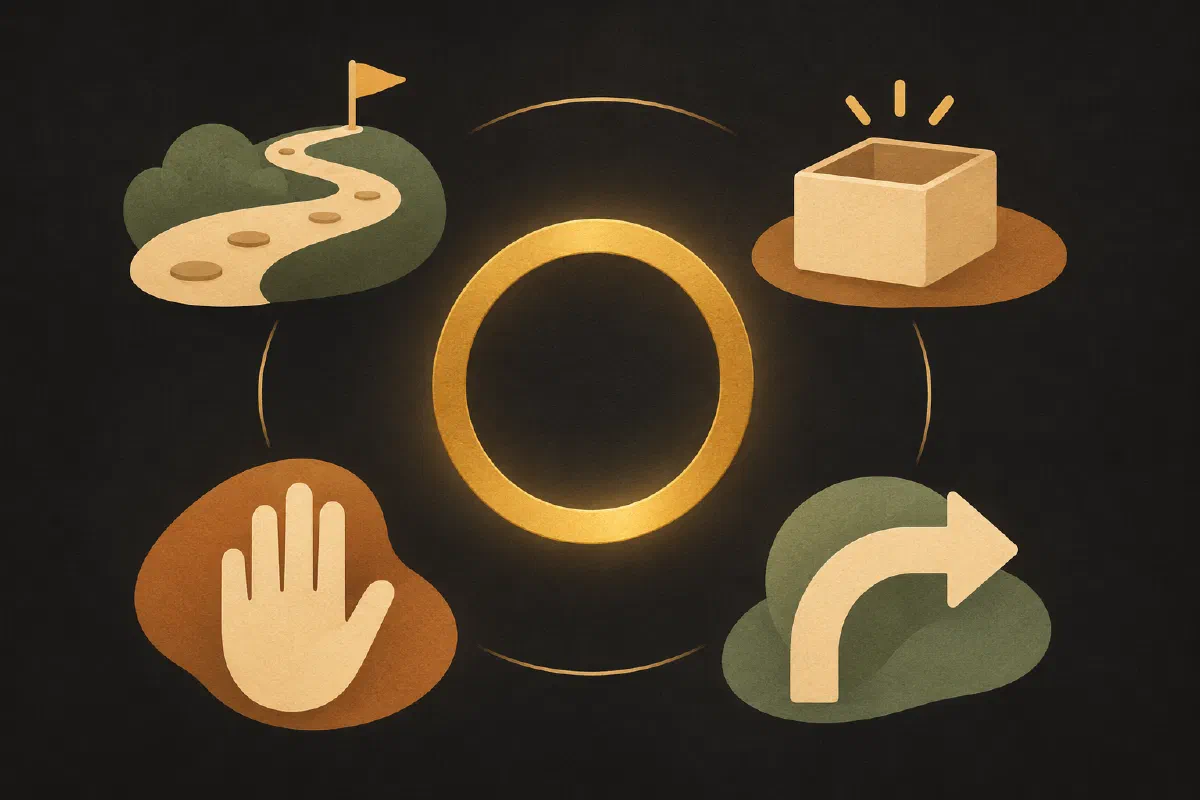
Here are the four skills most guides focus on, with examples from adult life.
1. Working memory
Working memory means holding information in mind and working with it at the same time. Diamond separates it from short-term memory, which is just holding information in mind; mentally reordering items on a to-do list or doing maths in your head uses working memory. She also notes that it is needed for turning instructions into an action plan and for making sense of anything that unfolds over time, such as a conversation.
Everyday examples:
- Keeping three requests from a colleague in mind while you finish the sentence you were typing.
- Following a recipe while also working out how to halve the quantities.
- Remembering why you walked into a room.
If working memory is the skill you notice most, our guide to working memory and ADHD goes deeper.
2. Inhibition (self-control and focus)
Inhibition is the ability to hold back an automatic response so you can do what you actually intend. Diamond describes two sides of it. Self-control means resisting temptations and not acting on impulse, such as not blurting out the first thing that comes to mind. Interference control means keeping your attention on what matters and screening out distractions, so you can stay on task.
Cleveland Clinic gives adult examples: concentrating on one conversation in a noisy office, or stopping yourself from losing your temper.
Everyday examples:
- Not opening the chat app every time it pings while you write a report.
- Waiting for someone to finish speaking in a meeting before you add your idea.
- Leaving the biscuits in the cupboard because you decided to eat lunch first.
3. Cognitive flexibility
Cognitive flexibility is the ability to switch approach, task or point of view. Diamond’s review describes it as being able to adjust to changed demands or priorities, see something from another person’s perspective, admit you were wrong and take advantage of unexpected opportunities. She calls it the opposite of rigidity.
Everyday examples:
- Rearranging your afternoon when a meeting is moved forward by two hours.
- Trying a different way to explain something when your first explanation lands badly.
- Switching from a detailed spreadsheet back to a big-picture planning call.
4. Planning (a higher-order skill)
Planning is not one of the three core skills in Miyake’s or Diamond’s models; it is built from them. You hold the goal and the steps in mind (working memory), keep yourself from jumping straight to the most interesting part (inhibition), and revise the plan when something changes (flexibility). The APA dictionary lists planning, organising and ordering actions among the things executive functions make possible.
Everyday examples:
- Working backwards from a Friday deadline to decide what has to happen on Tuesday.
- Ordering errands so you pass the pharmacy before it closes.
- Breaking “sort out the move” into packing, booking a van and changing your address.
How the skills work together
The skills rarely work alone. Diamond notes that working memory and inhibition support one another: keeping your goal in mind helps you ignore distractions, and ignoring distractions keeps your working memory free for the task. At the same time, Miyake’s results suggest the skills are separable, which fits a common experience: someone can be very flexible in conversation and still find it hard to keep a list in their head.
Longer executive function lists you may see
If you search for an “executive function list”, you will find lists of seven, ten or more skills: organisation, time management, task initiation, emotional control, self-monitoring and others. These are not wrong, but they mix two levels.
- Core skills (working memory, inhibition, flexibility) are what research models such as Miyake’s and Diamond’s measure.
- Everyday outcomes (getting organised, managing time, starting tasks) are things you achieve by combining the core skills with knowledge, habits and your environment.
Practical resources often use the longer, outcome-style list. The Job Accommodation Network, for example, includes the ability to plan, organise and strategise, pay attention to and remember details, and start and stop actions, as well as monitoring and changing your behaviour as needed and adapting to changing situations. Harvard’s Center on the Developing Child groups executive function together with self-regulation.
Here is how some popular list items map back to the core skills. This is our simplified illustration, not a research classification.
| Popular list item | Core skills it mostly draws on | What it looks like at work |
|---|---|---|
| Organisation | Working memory, planning | Knowing where the latest version of a file is |
| Time management | Planning, working memory, inhibition | Leaving the current task in time for the next meeting |
| Task initiation | Inhibition, planning | Opening the hard document instead of the easy inbox |
| Emotional control | Inhibition, flexibility | Replying calmly to a frustrating email |
| Self-monitoring | Working memory, flexibility | Noticing you have drifted off the brief and correcting course |
Starting tasks is such a common sticking point that we cover it separately in our guide to task initiation.
Executive function in one ordinary workday
Definitions are easier to remember when you can see them in action. Here is an illustrative morning for Sam, an invented project coordinator. Sam is not a real person; the point is to show which skill each moment calls on.
| Time | What happens | Skill in use |
|---|---|---|
| 08:45 | Sam opens the laptop and decides the budget summary comes before email | Planning, inhibition |
| 08:50 | A colleague messages: “Can you also check the venue, send the slides and call the printer?” | Working memory (holding three new requests) |
| 09:10 | Halfway through a paragraph, a social media notification appears; Sam ignores it | Inhibition (interference control) |
| 09:40 | The client moves the call from 14:00 to 10:30 | Cognitive flexibility |
| 09:45 | Sam reorders the morning: slides first, budget after the call | Planning, flexibility |
| 10:30 | During the call, the client changes a figure; Sam keeps it in mind while answering a question | Working memory |
| 11:15 | Sam feels irritated by a blunt comment and waits before replying | Inhibition (self-control) |
| 11:30 | Sam writes the three requests from 08:50 into a list instead of trying to remember them | Using an external support to free working memory |
Two things stand out. First, a “normal” morning asks for a lot of executive effort, often in small bursts that nobody notices. Second, the last row shows a choice many people make without thinking about it: moving information out of your head and onto paper, a calendar or a timer, so your executive skills have less to carry.
Why is executive function important?
Diamond’s review links executive functions with a wide range of life outcomes, including mental and physical health, quality of life, success at school and at work, and getting along with a partner. Cleveland Clinic similarly notes that strong executive functioning skills make a difference to mental and physical health.
These are associations, not guarantees. Many factors shape how life goes, and having a skill that is harder for you does not decide your future. What the research does suggest is that executive function is worth understanding, because it touches so many everyday tasks.
At work, executive skills show up in:
- holding the details of a project while answering questions about it;
- staying with a dull but necessary task;
- adapting when priorities change;
- breaking a large goal into steps and working through them.
What affects executive function day to day?
Executive function is not fixed from one hour to the next. Diamond’s review lists stress, sadness, loneliness, lack of sleep and poor physical fitness as things that impair executive functions, and notes they can produce difficulties that look like a disorder such as ADHD even when no such disorder is present. Cleveland Clinic names stress, loneliness, lack of sleep and lack of exercise as factors too.
Executive function also develops over a long time. Harvard’s Center on the Developing Child explains that children are not born with these skills but with the potential to develop them, and that they keep maturing through adolescence into early adulthood.
In practice, this means:
- A day after a bad night’s sleep is likely to feel harder to plan and focus on, for anyone.
- A stressful week can make you more forgetful and less flexible than usual.
- New or unfamiliar tasks need more executive effort than routine ones: Diamond notes these skills are needed when you are learning something new, and that well-learned tasks can come to rely on them much less.
None of this is a reason for self-blame. It is a reason to plan demanding work for times when you are rested, where you can.
Executive function and ADHD
Executive function comes up often in conversations about ADHD, and the research link is real but more nuanced than it is often presented.
A large meta-analysis of 83 studies found that groups with ADHD showed weaknesses on executive function tasks, with medium effect sizes, most consistently in response inhibition, vigilance, working memory and planning. The same authors concluded that executive function weaknesses are an important part of the picture but are neither necessary nor sufficient to cause all cases of ADHD. In other words, not everyone with ADHD has measurable executive function weaknesses, and having them does not mean someone has ADHD.
The NHS describes adult ADHD symptoms in everyday terms, such as being easily distracted or forgetful, finding it hard to organise your time and finding it hard to finish tasks. You can see how these overlap with the skills described above. Because stress, poor sleep and sadness can also make someone appear to have a disorder such as ADHD when they do not, a list of struggles is not enough to work out the cause yourself.
- If you think you may have ADHD symptoms and they affect your studies, work or relationships, the NHS advises adults to make an appointment with a GP to find out what support is available.
- When people talk about ongoing problems with these skills, they often use the term “executive dysfunction”; we explain it, and when to seek an assessment, in what executive dysfunction is.
- Online quizzes cannot diagnose anything. Our guide to the limits of executive dysfunction tests explains why.
If you are struggling so much that you feel hopeless or think about harming yourself, please contact your local emergency number or a crisis line in your country now.
Can executive function be taught?
To some extent, yes, but with an important limit. Diamond’s review states that executive functions are trainable and can be improved at any age. A later review by Diamond and Ling concluded that transfer tends to be narrow: people improve on what they practise, but only on what they practise. The skills need to be continually challenged, not just used, and benefits diminish once practice ends.
Research on commercial “brain training” is more sceptical still. A meta-analysis found that working memory training produces reliable short-term improvements on similar working memory tasks but no convincing improvement on broader abilities such as verbal and nonverbal ability, reading comprehension or arithmetic. A major review summarised by the Association for Psychological Science found very little evidence that brain-training programs improve everyday cognitive performance.
That is why many practical approaches focus on supporting executive skills from the outside. The Job Accommodation Network suggests workplace supports such as written instructions and checklists, timers or alarms, colour-coded calendars and breaking large assignments into smaller chunks. We go through the evidence in more detail in can executive function be improved, and collect practical tools in the executive function toolkit.
A one-week skill map (fill-in template)
This is not a test and cannot tell you whether you have a condition. It is a way to notice which skills your days lean on most, so you can decide where a small support would help. Copy it into a notebook or a document and fill in one row whenever you notice a moment that felt hard or went well.
| Day | Situation | Skill it called on (working memory / inhibition / flexibility / planning) | How it went | Support that helped or might help |
|---|---|---|---|---|
| Mon | ||||
| Tue | ||||
| Wed | ||||
| Thu | ||||
| Fri |
Example row: Wed, “Three requests in a hallway chat”, working memory, “Forgot one”, “Note them in my phone before walking back”.
At the end of the week, look for patterns:
- Which skill appears most often in the hard moments?
- Do the hard moments cluster at certain times of day or after poor sleep?
- Which supports (a list, a calendar alert, a timer, a quieter room) showed up in the moments that went well?
- Pick one support to keep using next week.
Summary and one next step
Executive function skills are the effortful mental skills that let you steer your behaviour towards a goal. The three core skills in most research models are working memory, inhibition and cognitive flexibility, and planning and problem solving are built from them. They are a psychology concept, not a diagnosis. They depend on brain networks centred in the frontal lobe, they vary with stress and sleep, and they are linked to ADHD without being the whole story. Practice tends to improve the specific skill you practise, so outside supports like lists, calendars and timers are a sensible everyday option.
Your next step: pick one task you have been putting off and give it a single short block with a visible end, using the free focus timer. If you would like to track blocks like this over days and weeks, Cyklio, our own focus app, runs sessions from 10 to 60 minutes towards a daily goal, lets you rate each session afterwards and has a 7-day free trial with no account or card needed.