

When work gets busy, snacks are usually decided by whatever is closest: the biscuit tin, the vending machine, or nothing at all until you are starving at 4 pm. This guide gives you a short list of easy snacks, a way to prep them once a week, and a few desk set-ups that make the better choice the easy one.
What makes a good snack for work
A workday snack has a practical job before it has a nutritional one. It has to be ready when you are, survive a few hours at your desk and be quick to eat between two tasks. Within that, public health guidance gives a clear direction.
- Mostly from the food groups health bodies favour. The NHS recommends at least 5 portions of a variety of fruit and vegetables a day and higher-fibre or wholegrain starchy foods. Harvard’s Healthy Eating Plate points to vegetables, fruit, whole grains, beans and nuts.
- Lower in sugar and salt. The WHO advises keeping free sugars below 10% of daily energy intake and limiting salty snacks. The NHS suggests that foods high in fat, salt and sugar are eaten less often and in small amounts, not banned.
- Low prep. If a snack needs a knife, a plate and five minutes, it will lose to the biscuit tin on a busy day.
- Easy to portion. Small tubs, single pieces of fruit or a pre-filled bag stop “a few” from becoming the whole pack.
A few details from NHS guidance are easy to miss. Unsalted nuts make a good snack, but they still contain high levels of fat, so eat them in moderation. For dairy, the NHS suggests lower-fat, lower-sugar yoghurt. And dried fruit, juice and smoothies are better kept for mealtimes: the NHS advises eating dried fruit at mealtimes rather than as a between-meal snack to reduce the risk of tooth decay, and limiting juice and smoothies to 150ml a day in total.
Healthy snacks for work: a decision table
Split your options by where they can live. The drawer list is your backup for days when you forget to bring anything; the fridge list is for days you plan ahead.
| Snack | Where it lives | Prep | Good to know |
|---|---|---|---|
| Whole fruit (apple, banana, pear, satsuma) | Desk or bag | None | 80g of fresh fruit counts as one portion of your 5 A Day |
| Unsalted nuts | Drawer, in small tubs | Portion once a week | High in fat, so eat in moderation |
| Wholegrain crackers or oatcakes | Drawer | None | Check the label for salt |
| Roasted chickpeas (plain or lightly spiced) | Drawer | Buy or roast in a batch | Pulses are low in fat and high in fibre and protein (NHS) |
| Vegetable sticks (carrot, cucumber, pepper) | Fridge or cool bag | Cut in a batch | Pairs well with a small tub of hummus |
| Hummus in a small tub | Fridge | Portion once a week | Keep it chilled |
| Lower-sugar yoghurt | Fridge | None | Plain yoghurt with fruit added is an easy swap for sweetened pots |
| Boiled egg | Fridge | Boil a batch | Eggs are a good source of protein (NHS) |
| Leftovers from dinner | Fridge | None | Refrigerate within two hours |
If you are standing in front of a shop shelf, the label is your quickest guide. Per 100g, the NHS treats more than 22.5g of sugars or more than 1.5g of salt as high, and 5g of sugars or 0.3g of salt or less as low. On traffic-light labels, the NHS says a product that is all or mostly green is generally a healthier choice, ambers are fine most of the time, and reds are worth limiting.
Prep ideas: one 20-minute block a week
A snack plan is easiest to keep when the daily step is as small as “grab one tub”. Here is a single prep session you can run once a week, for example on Sunday evening or Monday morning:
- Check the drawer (2 minutes). What is left of the nuts, crackers and chickpeas? Write down what to buy.
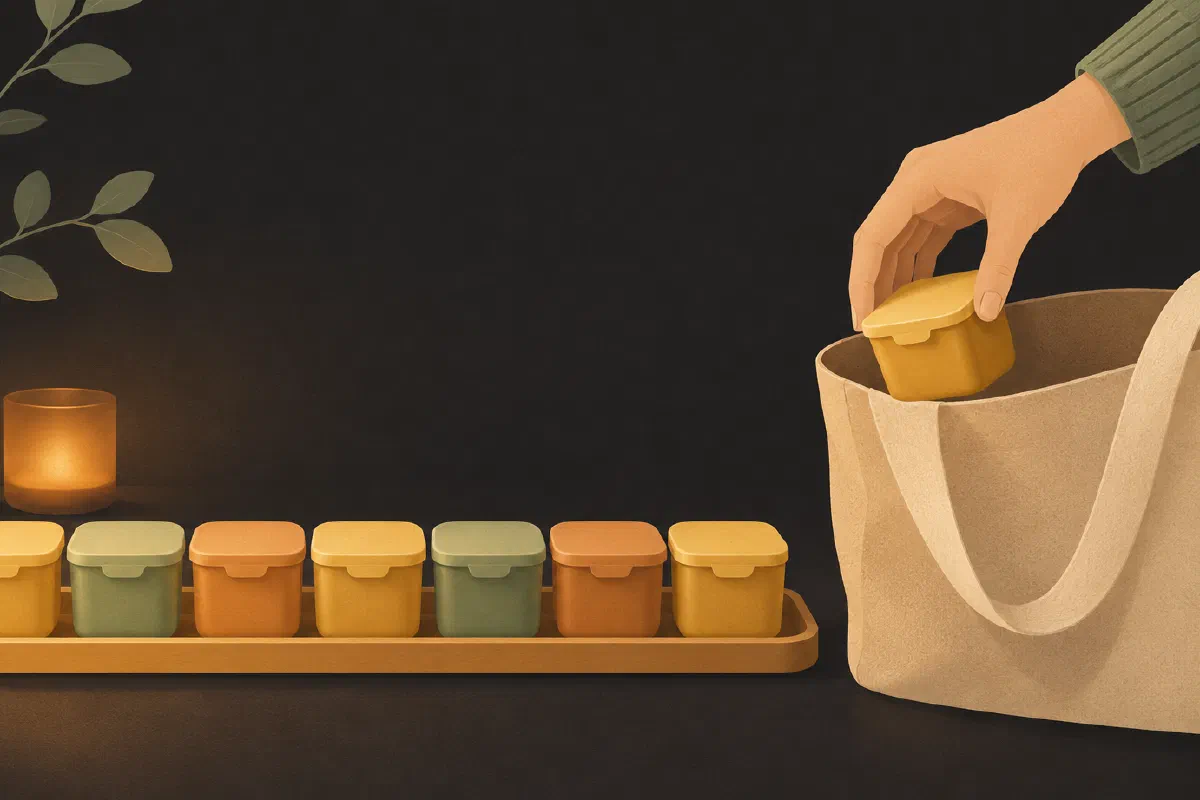
- Portion dry snacks (5 minutes). Split a bag of unsalted nuts or roasted chickpeas into five small tubs or bags, one per workday.
- Cut vegetables (8 minutes). Carrot, cucumber and pepper sticks into lidded boxes with a damp piece of kitchen paper.
- Boil eggs (runs in the background). Cook a few while you cut, cool them, and keep them in the fridge.
- Pack the first day (3 minutes). Put Monday’s tubs straight into your bag so the first day is already done.
- Set a place for them (2 minutes). Decide which shelf in the fridge and which drawer at work are “snack spots”, so you never have to think about it.
If you work at an office with a fridge, take two or three days of chilled snacks in on Monday. If you do not, a small cool bag with an ice pack works, and the drawer list carries the rest of the week.
Desk-friendly tips that do most of the work
Put the snack you want within reach. A Cochrane review found that placing snack foods farther away reduced how much people ate, and that offering fewer options reduced selection of the targeted foods. The authors rated the certainty of this evidence as low or very low, so treat it as a cheap experiment rather than a guarantee: fruit on the desk, biscuits in a cupboard you have to walk to.
Keep a water bottle next to the snack. The CDC’s first tip for drinking more water is to carry a reusable water bottle, and it suggests choosing water over sugary drinks. The NHS mentions 6 to 8 glasses of fluid a day, and Harvard’s guide lists water, tea or coffee with little or no sugar.
Mind the two-hour rule for chilled food. The CDC advises refrigerating perishable food, including dairy, cut fruit, some vegetables and cooked leftovers, within 2 hours, or within 1 hour above 90°F (32°C). Yoghurt and other foods sold chilled, such as hummus, belong in the fridge or cool bag, not the drawer.
Give the snack a time, not a mood. Decide when you eat it: after your second focus block, or at a fixed break mid-afternoon. A snack tied to a break happens even when you are absorbed in a task. If you want ideas for what else to do in that break, see these short break ideas between focus sessions.
Eat away from the keyboard for two minutes. Stepping back from the screen can turn the snack into a real pause instead of something you eat while reading email.
When appetite or focus gets in the way
Some days the problem is not choosing a snack but remembering to eat at all. Long stretches of hyperfocus, back-to-back meetings or medicine can all play a part.
If you take ADHD medicine, appetite changes are worth knowing about. The NHS lists loss of appetite among the side effects of methylphenidate for adults and notes that it may help to take the medicine with a meal; it also mentions that some weight loss can happen in the first months. If your appetite or weight changes, talk to your prescriber or doctor. Do not change how or when you take your medicine on your own.
For reminders, routines and the reasons meals slip past, see our guide on ADHD and forgetting to eat. For broader eating patterns at work, including impulsive snacking, read ADHD and food. This article stays with the practical side; it does not cover diets, supplements or claims that a food improves focus.
A worked example: one workday
This is an illustrative example, not a prescription. Imagine a project coordinator who starts at 8:30 and often works through lunch.
| Time | What happens | Snack plan |
|---|---|---|
| 8:30 | Arrives, puts the cool bag in the office fridge | Today’s tub of veg sticks, hummus and an egg go on the “snack shelf” |
| 10:15 | Ends a second focus block | Apple and a glass of water before the next task |
| 12:30 | Lunch, away from the desk | Leftovers from last night, refrigerated since morning |
| 15:00 | Planned break, usually the low point of the day | Veg sticks with hummus, refill water bottle |
| 16:30 | Late meeting runs over | Backup from the drawer: small tub of unsalted nuts |
Nothing here is clever. The plan works because every snack has a place and a time, and the drawer catches the day when something goes wrong. If mid-afternoon is your hardest time, our guide to the afternoon slump at work covers how to plan that part of the day.
Fill-in template: my work snack plan
Copy this into your notes and fill it in once:
- My snack spot at work: (drawer / shelf / fridge shelf) ____________
- Drawer backups (no fridge): 1. ________ 2. ________ 3. ________
- Fridge or cool-bag snacks: 1. ________ 2. ________
- My snack times: morning ______ afternoon ______
- Prep day and time: ____________ (20 minutes)
- Shopping list item that runs out first: ____________
- Drink: water bottle filled at ______ and ______
- One thing I move out of reach: ____________
Review it after two weeks. Keep what you actually ate, and swap out what came home untouched.
Summary and one next step
Healthy snacks for work do not need to be complicated. Choose mostly fruit, vegetables, pulses, whole grains, unsalted nuts and lower-sugar dairy; keep a no-fridge backup in a drawer; respect the two-hour rule for chilled food; and prep once a week so the daily step is just “grab a tub”. Put the snack you want within reach and give it a fixed time.
Your next step: pick two drawer snacks and one fridge snack from the table and put them on this week’s shopping list. Then tie your afternoon snack to a planned break. If you use a focus timer, a session followed by a short break is a natural slot. Cyklio, our app, lets you set focus sessions from 10 to 60 minutes and rate each one afterwards, so you can see how your afternoons go, and it comes with a 7-day free trial. If long stretches of concentrated work are what make you forget to eat, our guide to deep work with ADHD covers how to plan those blocks.