


If you have ADHD, you may have started the same habit many times: a week of daily walks or evening planning, then a busy Tuesday, then nothing. This guide explains why habits slip and walks you through a realistic way to build them: tiny starts, clear cues, habit stacking, light tracking, flexible streak rules and a plan for the day after you miss one.
Why habits slip with ADHD
A habit is built by doing the same small thing at the same moment, again and again, until it starts without a decision. ADHD makes several parts of that harder.
- Remembering the moment. The NHS lists being easily distracted or forgetful, and finding it hard to organise your time or finish tasks, among the symptoms of ADHD in adults. A habit that depends on remembering at the right moment is exposed to exactly those difficulties.
- Staying on track. The National Institute of Mental Health describes inattention as difficulty paying attention, keeping on task or staying organised, and notes that symptoms can make it hard to get things done.
- A payoff that is far away. A meta-analysis of 21 studies found that, on average, people with ADHD discount delayed money rewards more steeply than people without ADHD, a medium-sized difference. The benefits of most habits, like fitness or a tidy inbox, arrive weeks later.
- It takes longer than people say. In a study by Lally and colleagues, 96 volunteers repeated one new daily behaviour for 12 weeks. The estimated time for it to become close to fully automatic ranged from 18 to 254 days. A summary in the British Journal of General Practice puts the average at about 66 days and traces the popular “21 days” figure to anecdotal reports about plastic surgery patients, not to habit research.
One honest caveat: those habit studies were run with general adult volunteers, not specifically with people with ADHD. The methods below are well grounded in habit research, but treat them as experiments to adjust, not guarantees. And none of this is a character flaw. It is a design problem, and design problems can be worked on.
What actually makes a habit stick
Habit researchers define habits as actions triggered automatically by cues that have been linked to them through repetition. The BJGP paper explains that repeating one specific action in the same context builds that link, that simple actions such as drinking water become habitual faster than elaborate routines, and that the cue can be an event, such as arriving at work, or a time of day, such as after breakfast, that you meet regularly.
This shifts the work away from willpower and towards setup. Psychologists Duckworth, Gendler and Gross argue that changing your situation in advance is likely to work better than resisting impulses in the moment, while noting that this has not yet been tested head to head. For ADHD, that is good news: you can put more of the habit into your surroundings and less into your memory.
Step 1: Start with a version you could do on a bad day
Pick one habit, not five. Then shrink it until it feels almost too easy. The BJGP authors recommend choosing the behaviour yourself, aiming for small changes and adding a new action rather than trying to give up an old one.
| What you want | Tiny version to start with |
|---|---|
| Plan your workday | Write the first task for tomorrow on a sticky note |
| Exercise regularly | Put on trainers and walk to the end of the street |
| Keep your desk clear | Put three things away before you log off |
| Read more | Read one page before bed |
Once the tiny version runs on most days for a few weeks, you can grow it. The minimum version stays as your fallback.
Step 2: Choose a cue you already meet every day
Turn the habit into an if-then plan: “After I [cue], I will [tiny habit].” A meta-analysis of 94 tests found that these plans, called implementation intentions, had a medium-to-large effect on reaching goals. Evidence specific to ADHD is limited: in a lab study of children with ADHD, adding if-then plans improved response inhibition on a lab task, which is not the same as building a habit in adult life.
A good cue:
- happens every day, including on busy days
- is an event you notice, not just a time on the clock you might miss
- happens in the place where the habit will take place
- comes right before the habit, so there is no gap to forget in
Step 3: Stack the habit on an existing routine
Attaching a new habit to something you already do is widely called habit stacking. It is a popular term from self-help books rather than a research term, but the idea matches what habit researchers describe as repetition in a stable context.
There is a small piece of direct evidence on order. In an exploratory study with 50 participants, people told to floss after brushing their teeth tended to form stronger flossing habits than those told to floss before brushing, and at an eight-month follow-up they had stronger habits and flossed more often. The takeaway: put the new habit straight after a well-established one, not before it.
Make the link visible. Keep the sticky notes next to your laptop charger, the trainers by the door, the book on your pillow. If the object is in your path when the cue happens, you do not have to remember it.
If you want the broader framework behind cues and stacking, see our Atomic Habits ideas for focus and starting tasks.
Step 4: Add something pleasant right away
Because a distant payoff carries less weight, give the habit a small, immediate one. In a study of 226 participants, people who could only listen to gripping audiobooks at the gym initially visited 51% more often than a control group, although the effect declined over time. It was a single study, so expect a modest boost, not a fix.
Practical pairings: a favourite playlist only during your evening tidy-up, a good coffee only during morning planning, a short stretch or a tick on your tracker right after the habit is done.
Step 5: Track it lightly
A meta-analysis by Harkin and colleagues found that interventions that got people to monitor their progress more often improved goal attainment, with larger effects when progress was physically recorded or shared. The BJGP authors also suggest a simple daily tick-sheet.
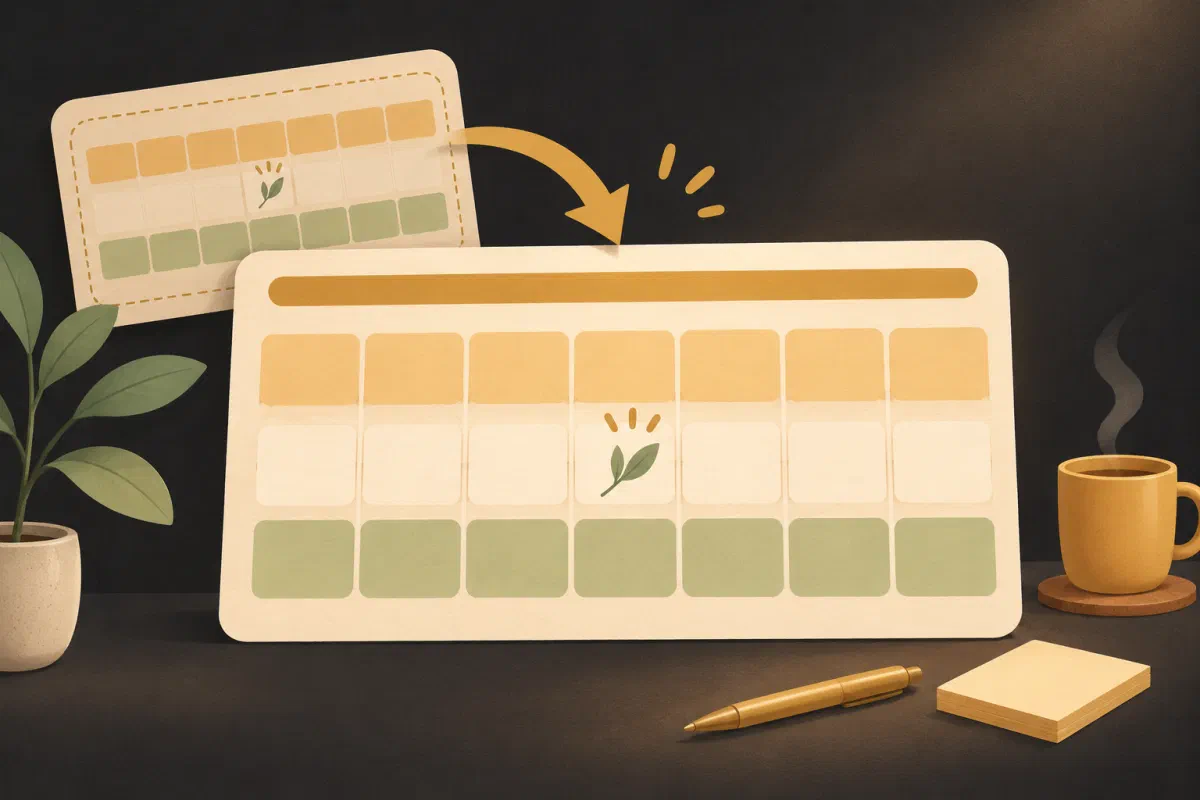
Keep it light: one habit, one tick per day, in a place you see at the moment of the cue. A complicated tracking system becomes a second habit to forget. If you like a visual grid, our guide to the habit tracker grid shows a simple layout.
Step 6: Use flexible streak rules
Strict streaks punish exactly the kind of irregular day ADHD tends to produce. The good news from the Lally study is that missing a single opportunity did not meaningfully disrupt habit formation. A gap is a pause, not a reset.
Rules that keep you going without making you quit:
- The minimum version counts. One page, one sticky note or one minute still earns the tick.
- Aim for most days, not every day, such as five out of seven, and decide that in advance.
- Try not to miss twice in a row. This is a popular rule of thumb, not a tested finding, but it fits the research on single misses.
- Plan different days. Decide now what the habit looks like on weekends, travel days or sick days, even if the answer is “minimum version only”.
How to recover after a missed day
- Notice it without a verdict. “I didn’t do it yesterday” is information, not proof you have failed.
- Ask what got in the way. Did the cue not happen, was the habit too big or was the object out of sight?
- Do the minimum version today, at the usual cue.
- Change one thing if the same problem shows up twice.
Be kind to yourself here. A missed day is a reason to adjust the plan, not a reason to judge yourself.
| What happened | Likely reason | Adjustment to try |
|---|---|---|
| Forgot completely | Cue not noticeable or not daily | Pick an event you never skip; put the object in your path |
| Remembered but didn’t start | Habit too big for that moment | Shrink to the minimum version |
| Did it, then stopped after two weeks | Novelty wore off, no near reward | Add a pleasant pairing; change the reward |
| Works on weekdays, fails on weekends | Different cues on different days | Write a separate weekend plan |
| Missed several days and gave up | All-or-nothing streak rule | Switch to “most days” and restart today |
Worked example: a 10-minute planning habit
This is an illustrative example, not a real case. Imagine a project coordinator with ADHD who wants to plan each next workday but keeps forgetting by the end of the day.
- Week 1. Plan: “After I close my last meeting, I will write tomorrow’s first task on a sticky note.” The note pad sits on the laptop. Done on 3 of 5 days; on the other two, the last meeting ran late and the cue was missed.
- Week 2. Adjustment: the cue moves to “when I plug in my laptop charger at home”, which happens every evening. Done on 4 of 5 days.
- Weeks 3 to 4. Added reward: a favourite podcast starts only after the note is written. The tick goes on a small grid next to the charger. Missed one Thursday, did the minimum version on Friday.
- Week 5 onward. The note grows into a 10-minute plan with a timer, three tasks for tomorrow and the first step of the hardest one. On low days, the sticky note alone still counts.
Nothing in this plan needs more willpower. Each change makes the habit easier to remember, easier to start or more pleasant to finish.
Your habit plan (fill-in template)
Copy this and fill it in for one habit:
- Habit, tiny version: ____________________
- If-then plan: After I ____________________, I will ____________________.
- Where the object lives: ____________________
- Right after, I get: ____________________
- Minimum version on bad days: ____________________
- My streak rule: ____ out of 7 days, minimum version counts.
- If I miss a day, I will: ____________________
- Review date (four weeks from today): ____________________
Habits, routines and when to get support
A habit is one action tied to one cue. A routine is a sequence of several habits. Once one habit holds, you can link others into a routine; our guides on building an ADHD daily routine and on how to stick to a routine with ADHD cover that next level. For general methods outside ADHD, see how to change habits, and for stopping an unwanted habit, see how to break bad habits.
If habits keep falling apart despite small, well-cued plans, and ADHD symptoms are affecting work, home or relationships, talk to your doctor. The NHS says talking therapies such as cognitive behavioural therapy (CBT) or mindfulness may be recommended for adults with ADHD. In a randomised trial of 86 adults who still had symptoms despite medication, CBT reduced symptoms more than relaxation with educational support. A clinician can help you decide what fits you; this article does not replace that advice.
Summary
- ADHD makes habits harder because of forgetfulness, organisation and the pull of immediate rewards, and new habits usually take far longer than the popular 21 days.
- Start tiny, attach the habit to a cue you meet every day and put the object in your path.
- Add a small immediate reward and track with one tick a day.
- Use flexible streak rules: the minimum version counts, and one missed day does not reset progress.
- When you miss, change one thing about the plan instead of judging yourself.
Your next step: choose one habit, write its if-then plan from the template and do the minimum version today. If the habit is a work one, such as a short daily focus block, you can run it with the free Cyklio Focus Timer. If you want those sessions to add up, Cyklio is the focus timer app we make at Mindly 360: sessions from 10 to 60 minutes, a daily goal in hours with a progress ring, a quick rating after each session (full focus, distractions, not today) and daily, weekly and monthly reports. It is on Android, with iPhone coming, and has a 7-day free trial with full access and no account or card needed. It does not diagnose or treat anything; it simply makes a daily habit easy to see.