

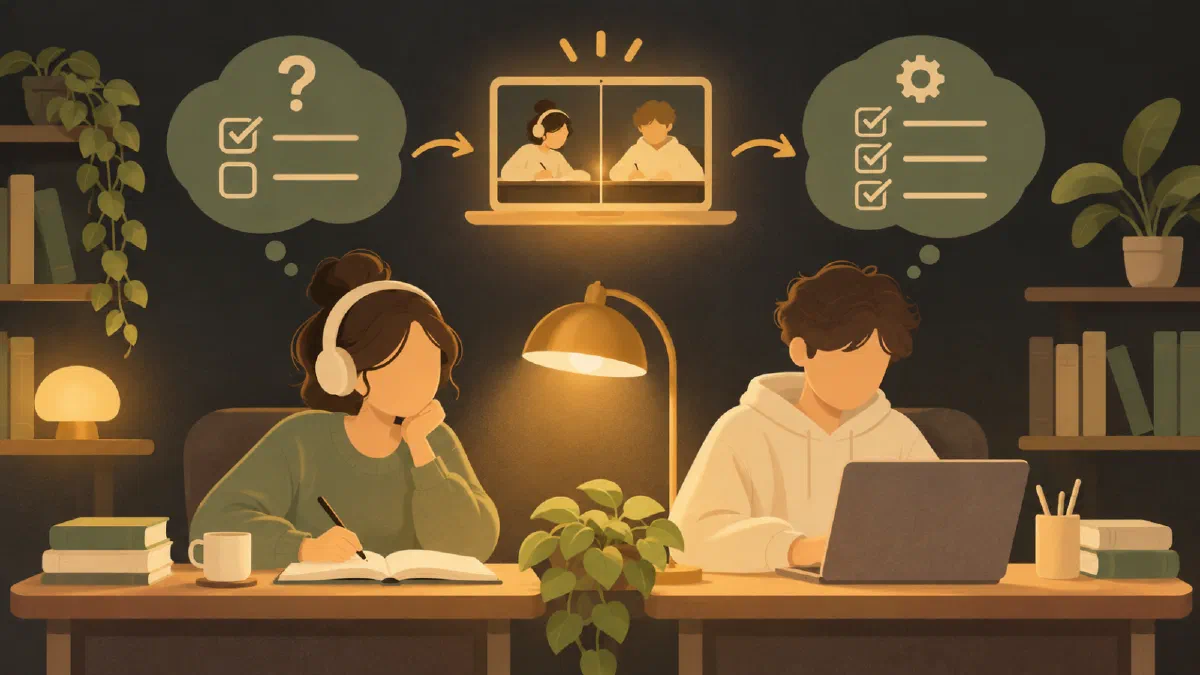
You know you should study, the books are right there, and you still don’t feel like it. That is normal. This guide gives you ten ways to get going today, a table to pick the right one, and a plan for your first session.
Why you don’t feel like studying
Not wanting to study is not a sign that you are lazy or bad at learning. Research on procrastination points to a few predictable forces. In Piers Steel’s widely cited meta-analytic review of procrastination, strong and consistent predictors included how unpleasant a task feels, how far away the reward or deadline is, low confidence that you can do it, and impulsiveness.
Studying often scores badly on all of them. The material may be dull or hard, the exam is weeks away, you are not sure you will understand the chapter, and your phone offers something easier every few seconds.
That is useful news. Each force can be nudged:
- The task feels unpleasant → make the start smaller and the session more pleasant.
- The payoff is far away → create a goal and a reward you can reach tonight.
- You doubt you can do it → pick a first step you are sure to manage.
- Distractions are strong → change your surroundings before you sit down.
Notice what is missing: “wait until you feel motivated”. For many people the feeling arrives after they start, not before. The ten ideas below are ways to start without it. For motivation at work or in general, see how to get motivated when you don’t feel like it.
10 ways to get motivated to study
1. Swap the big goal for a goal for tonight
“Pass the exam” or “finish the course” is too far away to pull you off the sofa. In a classic study, children who struggled with arithmetic made faster progress and developed more confidence and interest when they worked toward close subgoals for each session instead of one distant goal. It was a study of children and maths, so treat it as a principle rather than proof for every adult learner, but it fits everyday experience.
Write tonight’s goal as something you can see when it is done: “work through problems 1 to 5” or “make 15 flashcards for chapter 3”, not “do some biology”.
2. Give yourself a near reason, not only a distant one
Your long-term “why” (a new job, a degree, a certificate) is worth writing down once. But it may not carry you through an ordinary Tuesday. In studies of goals that included studying and exercise, immediate rewards such as enjoyment predicted persistence better than delayed rewards, even though people said they were pursuing the goal for the delayed rewards.
So ask two questions: “Why does this course matter?” and “What would make tonight’s session a bit more pleasant?” The second one often decides whether you start.
3. Make the first step almost too small to refuse
Newcastle University’s study-skills team suggests making the first step tiny, such as reading one paragraph, and to work for just ten minutes to begin with. A small start lowers the “this will be awful” feeling that keeps you away from the desk.
Good tiny starts:
- Open the file and read the first heading.
- Do one practice question, even badly.
- Copy tonight’s three goals onto paper.
- Set a timer for ten minutes and promise yourself you may stop when it ends.
If you keep going after ten minutes, great. If you stop, you still studied, and tomorrow’s start will feel less heavy.
4. Decide when and where with an if-then plan
“I’ll study tonight” leaves the decision open, and an open decision is easy to postpone. An if-then plan closes it: “If I finish dinner, then I sit at the kitchen table and open chapter 4.” Plans in this form are called implementation intentions, and a meta-analysis of 94 tests found they had a medium-to-large effect on reaching goals, including getting started (Gollwitzer and Sheeran, 2006). The research covered many kinds of goals, not studying alone, but it is one of the better-supported strategies here.
5. Get your study spot ready before you need it
The UNC Writing Center recommends choosing a place where you can focus, ideally offline, and keeping your materials out where you can see them. It also warns that preparing the space can turn into procrastination of its own: tidying the desk for an hour is not studying.
A practical version: before you stop each session, leave the book open at the next page, a pen on top and tomorrow’s first question written on a sticky note. Next time, starting means sitting down.
6. Put the phone out of sight
You may have heard that just having your phone nearby drains your brainpower. The evidence is more modest than the headlines: a recent meta-analysis found a small negative effect on working memory and no clear effect on other mental abilities. Still, moving the phone to another room costs nothing and removes the easiest exit from a hard paragraph. If you need it for a login or a timer, put it face down out of reach.
7. Pair studying with something you enjoy
“Temptation bundling” means allowing yourself a treat only while doing the thing you avoid. In a field experiment, people who could listen to gripping audiobooks only at the gym initially went 51% more often than a control group, though the effect faded over the following weeks (Milkman, Minson and Volpp, 2014). That study was about exercise, not studying, so test the idea for yourself: a favourite tea, a playlist without lyrics or a café table you only use for study sessions.
8. Use rewards wisely
Rewards can help, but not all rewards are equal. A meta-analysis of 128 experiments found that rewards tied to doing, finishing or doing well at a task reduced people’s later free-choice motivation for it, while positive feedback increased it (Deci, Koestner and Ryan, 1999). Both UNC and Newcastle still recommend rewarding yourself after study progress.
A sensible middle path:
- Use small, pleasant rewards for tasks you dislike, such as a walk or an episode after the session.
- Give yourself honest, specific feedback: “I finally understood how the formula works.”
- Avoid big “if I study all week I’ll buy…” deals for subjects you already enjoy.
9. Make your progress visible
Seeing progress makes the next start easier. A meta-analysis of 138 experiments found that interventions that got people to monitor their progress more often helped them reach their goals, with larger effects when progress was physically recorded or shared (Harkin et al., 2016). A tick on a wall calendar, a line in a notebook or a session log all count.
10. Forgive yesterday’s missed session
Harsh self-criticism feels responsible, but it can make the desk feel even worse. In a set of experiments, people guided to treat a failure with self-compassion spent more time studying for a retest (Breines and Chen, 2012).
If a fresh start helps, use a close one. Field studies found that gym visits and goal commitments rise after temporal landmarks such as a new week, month or semester (Dai, Milkman and Riis, 2014). Pick a landmark that is days away, such as Monday evening, rather than waiting weeks for a bigger one.
Which way should you try first?
You don’t need all ten at once. Pick the line that sounds most like you today.
| What you notice | Likely cause | Try first |
|---|---|---|
| “The exam is ages away, I’ll study later.” | Payoff feels distant | 1. Goal for tonight, 9. Visible progress |
| “I open the book and immediately feel heavy.” | Task feels unpleasant | 3. Tiny first step, 7. Pair with something you enjoy |
| “I don’t even know where to begin.” | Unclear task, low confidence | 1. Goal for tonight, 3. Tiny first step |
| “I sit down and end up on my phone.” | Strong distractions | 5. Study spot, 6. Phone out of sight |
| “I always mean to study but the evening disappears.” | No fixed start | 4. If-then plan |
| “I skipped three days, so what’s the point?” | Guilt and all-or-nothing thinking | 10. Forgive and restart |
Your first study session plan
Use this plan when you sit down today. It takes about 30 minutes, and the first 10 are the only ones you have to commit to.
- Two minutes: write tonight’s goal. One visible outcome, such as “summarise section 2.1 in five bullet points”.
- One minute: write your if-then plan for next time. “If ___ happens, then I start ___ at ___.”
- One minute: clear the exits. Phone in another room, unneeded tabs closed, water within reach.
- Ten minutes: study with a timer. Start with the easiest useful part. When the timer ends, you may stop.
- Decide: stop or continue. If you want to continue, set another 10 to 20 minutes.
- Three minutes: leave a starting point. Open the next page and write the first question for tomorrow.
- One minute: record and reward. Tick the calendar, note one thing you understood, then take your reward.
A fill-in card you can copy:
- Tonight’s goal: ______
- My first tiny step: ______
- If ______, then I start studying at ______ (place: ______).
- My reward after the session: ______
- Tomorrow’s first question: ______
What happens during longer sessions, such as active recall, breaks and keeping attention steady, is covered in how to concentrate on your studies.
Worked example: studying after a long workday
Marta (an illustrative example) is preparing for a project-management certificate while working full time. Every evening she plans to study for two hours, and most evenings she studies for none.
Here is how she rebuilds the start:
- Goal for tonight: instead of “study risk management”, she writes “answer the 8 review questions at the end of chapter 5”.
- If-then plan: “If I’ve finished washing up, then I sit at the desk in the spare room.” Not the sofa.
- Prepared spot: the previous night she left the book open at the questions with a pen on top.
- Tiny start: ten minutes on the timer, permission to stop after one question.
- Pleasant pairing: her favourite tea only during study sessions.
On the first evening she stops after 10 minutes and two questions. On the second she does 25 minutes. By the end of the week she has studied on five evenings, around 20 to 40 minutes each, far more than her two-hour plan ever produced. When she misses Thursday, she writes “missed, restart Friday” and moves on instead of writing off the week.
When motivation stays out of reach
Sometimes low motivation is more than a dull subject. The NHS lists having no motivation or interest in things among the symptoms of depression, and advises seeing a GP if symptoms last most of the day, every day, for more than two weeks. If that sounds like you, read how to study when you’re depressed and speak to a doctor.
If you have ADHD, or getting started is a constant struggle for you, see study tips for ADHD for strategies adapted to that. For setting-specific advice, see study tips for high school students and study tips for nursing school.
Summary and your next step
You rarely need to feel motivated before you study. You need a start that is easy enough to take:
- Set a goal for tonight, not for the exam.
- Make the first step ten minutes or less.
- Decide when and where with an if-then plan.
- Prepare your spot and move the phone away.
- Add a small pleasure, track progress and forgive missed days.
Your next step: pick one line from the table, write tonight’s goal, and run a 10-minute session now with the focus timer. If you’d like a daily goal and session history, Cyklio, our app from Mindly 360, offers sessions from 10 to 60 minutes and a 7-day free trial without an account.