

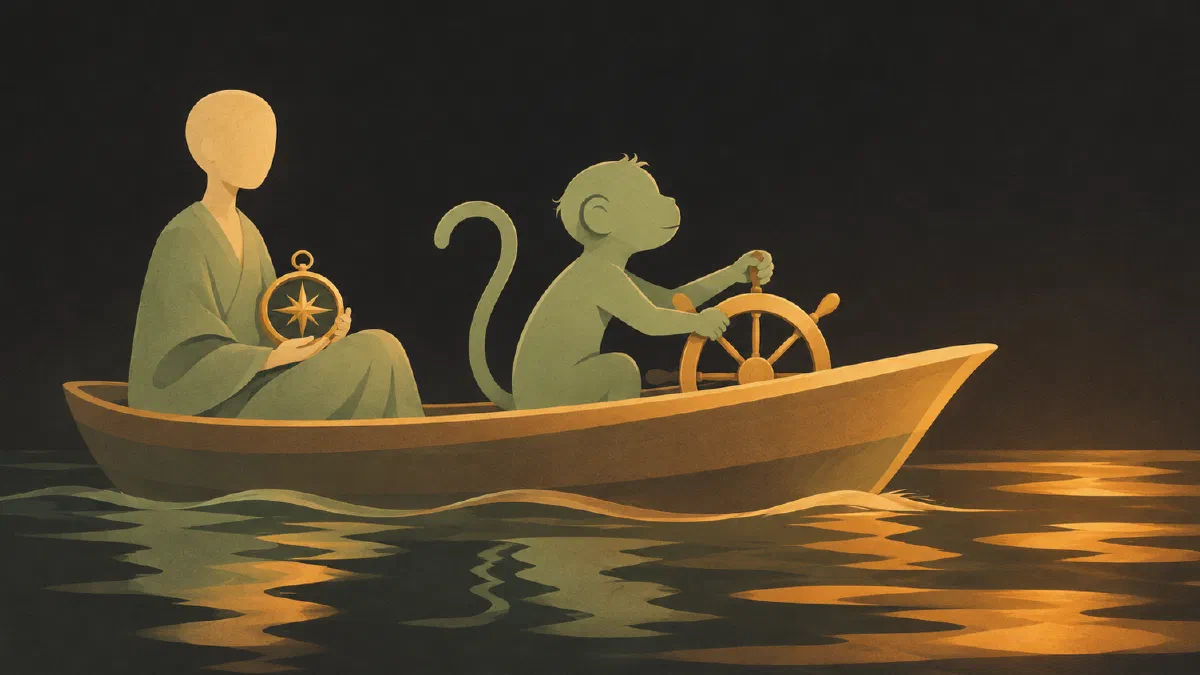
You sit down to write the report, and ten minutes later you are reading about deep-sea fish. The writer Tim Urban has a name for the thing that took the wheel: the Instant Gratification Monkey. This article explains where the procrastination monkey comes from, what it captures, where it misleads, and how to use it to actually start work.
Where the procrastination monkey comes from
The monkey is the invention of writer Tim Urban. He introduced it in a Wait But Why essay published on 30 October 2013, followed a week later by a second part on how to beat procrastination. He later presented the same cast of characters at TED2016 in his talk “Inside the mind of a master procrastinator”, which helped the idea spread far beyond his blog.
Urban’s essay uses stick-figure drawings and humour. It does not cite research or present itself as a scientific model; it is a way of describing what procrastination feels like from the inside. The main characters, as described in the original essay and its follow-up:
| Character | What it stands for in Urban’s story |
|---|---|
| Rational Decision-Maker | The part of you that makes sensible plans and knows the report matters. |
| Instant Gratification Monkey | A creature that only cares about what is easy and pleasant right now, and finds the plans pointless. |
| Dark Playground | Leisure at the wrong time: the fun is “unearned”, so it comes with guilt and dread. |
| Panic Monster | Wakes up when a deadline gets close or embarrassment looms, and scares the monkey away. |
| Happy Playground | Leisure you enjoy after you have done the work (from part two). |
The essay also separates casual “I procrastinated on Facebook today” talk from real, recurring procrastination, which Urban describes as something that does not feel optional. That distinction is part of why the metaphor resonates: it takes the experience seriously instead of saying “just do it”.
What the metaphor captures well
The monkey is a cartoon, but several things it dramatises line up with what procrastination research describes. The research does not test the monkey itself; these are parallels, not proof.
- Unpleasant tasks with distant payoffs lose. A large meta-analysis by Piers Steel, based on 691 correlations, found that some of the most consistent predictors of procrastination were task aversiveness, a long delay before the reward, impulsiveness and distractibility. That is the monkey’s territory: boring now, rewarding later.
- Feeling better now beats feeling better later. A review by Fuschia Sirois and Timothy Pychyl describes procrastination as a self-regulation failure driven largely by short-term mood repair, with the costs passed on to the “future self”. Urban’s monkey, which ignores past lessons and future consequences, is a vivid picture of that trade.
- Deadlines change the game, but only for some goals. Urban notes that the Panic Monster mostly shows up for deadlines and public consequences, while goals like getting fit or learning an instrument rarely wake it up at all. Many people recognise this pattern: work with a due date gets done in a rush; personal projects with no date drift for years.
- The leisure is not restful. The idea of the Dark Playground names something people often report: hours of scrolling that feel neither productive nor relaxing. The guilt side of this is covered in our piece on why procrastination feels so bad.
Where the metaphor falls short
A good metaphor can still mislead. Before you rely on the monkey, keep these limits in mind.
- It is not a map of the brain. Urban talks about characters “in the brain”, but these are story figures, not anatomy. If you want to know what neuroscience actually says, see what happens in the brain when you procrastinate, where the claims are sourced.
- The monkey chases fun; real avoidance often escapes discomfort. The research above puts weight on repairing your mood in the short term when a task feels aversive, which often means escaping feelings such as anxiety, boredom or self-doubt. If you picture only a pleasure-seeking monkey, you may miss that the real job is to make the task feel less threatening, not to remove all the fun from your life.
- It can become an excuse. “The monkey did it” is funny once. Used every day, it can shift responsibility away from the choices you can still make, such as changing the setup of your work.
- It can become a source of shame. The opposite risk is treating the monkey as proof that you are broken. In a study of first-year students summarised by the British Psychological Society, those who forgave themselves for procrastinating before one exam procrastinated less before the next one. It was one observational study with self-reported measures, but it suggests contempt for your monkey is not a good strategy.
- The Panic Monster is an expensive manager. Relying on last-minute fear can get things done, but it does nothing for goals without a deadline and tends to make work stressful. The official description of Urban’s TED talk says he encourages people to think harder about what they are really procrastinating on, not just how to survive deadlines.
- One monkey does not explain everyone. Procrastination has several possible drivers. If delay is constant and comes with long-standing problems with attention and organisation, the picture may be different; we cover that in ADHD and procrastination. For a broad set of strategies beyond this metaphor, see the general guide how to stop procrastinating.
How to use the monkey to start work
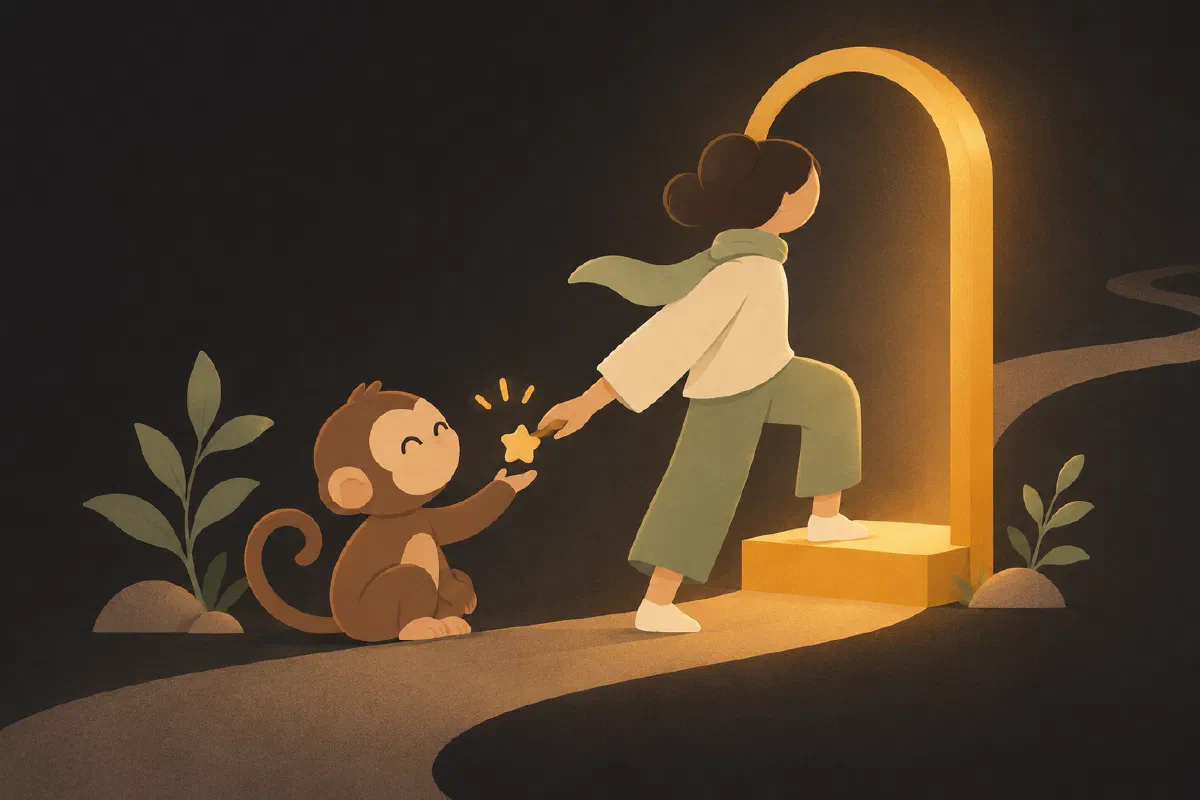
The most useful moment for the metaphor is the start, when the monkey is loudest. Urban calls this the “Critical Entrance” and notes it is usually the hardest part of the work. These five moves are built around it.
- Name it, without contempt. When you notice the pull toward another tab, say (silently or on paper): “That’s the monkey. It wants out of this because the task feels unclear.” Naming the urge creates a pause. Keep the tone friendly; the self-forgiveness finding above is a reason not to turn this into self-criticism.
- Make the entrance tiny. Urban’s own advice is to break big goals into small “bricks” and schedule them as fixed slots. For starting, go smaller still: “open the file and write the heading” is an entrance the monkey can tolerate. More techniques for the first step are in our guide to task initiation.
- Write an if-then start plan. Psychologists call these implementation intentions: “If situation X happens, then I will do Y.” A meta-analysis of 94 studies found a medium-to-large effect on overcoming failures to get started with a goal. Results differ between people and situations, so treat this as a helpful nudge, not a guarantee. Example: “If I close my lunch tab at 13:30, then I open the report draft and set a timer.”
- Give the monkey a planned treat. In a field experiment, gym members who could only listen to gripping audiobooks at the gym went 51% more often than controls early in the study, though the effect faded over time. The researchers called this temptation bundling. At work, that might mean a favourite playlist or a good coffee that you only have during the dull task.
- Close the doors to the Dark Playground. Urban suggests minimising distractions, for example with airplane mode. Put the phone in another room and close chat before the session, not during it, when the monkey is already negotiating.
A short, fixed session also helps, because it gives the monkey a clear end point. Our guide to using a short timer to start a task you are avoiding walks through that approach step by step.
Worked example: a Tuesday afternoon report
Maya is a project coordinator. Her quarterly summary is due Friday, and on Tuesday at 13:30 she has two free hours. Here is how the monkey shows up and how she answers it.
| Moment | What the monkey says | What Maya does |
|---|---|---|
| 13:30, opening the laptop | “Check messages first, just quickly.” | Notices it (“monkey”), leaves chat closed and puts her phone in her bag. |
| 13:32, looking at the blank file | “This is huge. Start tomorrow when you’re fresh.” | Shrinks the entrance: write the four section headings only. |
| 13:35, headings done | “Good enough, reward time.” | Uses her if-then plan: “If the headings are done, I fill in the numbers table.” |
| 13:35 to 14:00, first session | “Bored. One video?” | Has her coffee, which she saves for report work, and keeps going until the timer ends. |
| 14:00, break | “We’ve earned the rest of the afternoon.” | Takes ten minutes away from the screen, then sets one more session for the summary paragraph. |
Nothing here relies on panic. Maya does not wait for Thursday night to frighten the monkey; she makes each step small enough that the monkey has less to object to.
A fill-in plan for your monkey
Copy this into a note before your next hard task. It takes about two minutes.
- The task: ______________________
- What my monkey will probably say: ______________________
- The feeling behind it (unclear, boring, worried, tired): ______________________
- My tiny entrance (under five minutes): ______________________
- My if-then plan: If ______________________, then I will ______________________.
- The monkey’s treat, only during this task: ______________________
- Doors I close before starting: ______________________
- Session length: ______ minutes, then a short break.
- After the session: Did I start? Yes / Partly / Not today. What would make the entrance smaller next time?
The “feeling behind it” line matters most. It reminds you that the monkey is often running from a feeling, which points you to a better fix: clarify the task, make it shorter, or ask a question you have been avoiding.
Summary
- The Instant Gratification Monkey is Tim Urban’s cartoon from Wait But Why (2013) and TED2016, not a scientific model.
- It captures real patterns: people delay unpleasant tasks with distant rewards and pick short-term relief.
- Its limits: it is not brain science, it can become an excuse or a reason for shame, and fear-based deadlines are a costly fix.
- It works best at the start: name the urge kindly, make the entrance tiny, plan “if-then”, bundle a small treat and close distractions in advance.
Your next step: pick one task you have been avoiding, fill in the plan above, and run a single short session. You can use our free focus timer, or Cyklio, our own app, which offers focus sessions from 10 to 60 minutes and lets you rate each one as full focus, distractions or not today, so you can see over a week when your monkey tends to win.