


Some mornings you wake up and everything feels heavy: the shower looks like a mountain, and the idea of a full routine makes you want to pull the covers back up. Online, this is often called a “low dopamine morning”. This guide explains what that label can and cannot tell you, then gives you a gentle, low-demand morning you can actually do on those days, with a template to fill in tonight.
What people mean by a “low dopamine morning”
“Low dopamine morning” is a popular, informal phrase, not a medical term or a diagnosis. People use it to describe a morning when they feel flat, slow and unmotivated, and when nothing seems rewarding enough to get them moving. The feeling is real. The label is a shorthand.
There is genuine research on dopamine and ADHD, but it does not translate into “your dopamine is low today”. For example, a brain-imaging study of 53 adults with ADHD who had never taken medication found lower availability of dopamine receptors and transporters in parts of the brain’s reward pathway than in 44 adults without ADHD (Volkow and colleagues, 2009). The Cleveland Clinic lists ADHD among conditions associated with low dopamine, but also points out that it is unclear whether a change in dopamine causes a condition or the condition changes dopamine.
Two more points are worth knowing before you build a routine around the word:
- ADHD is not diagnosed from brain chemistry. The CDC states that there is no single test to diagnose ADHD. How you feel at 7 a.m. is not a reading of your dopamine level.
- “Dopamine” is often used as a catchy label. Writing about the “dopamine fasting” trend, Harvard Health Publishing notes that people are creating snappy titles for age-old concepts, and that a dopamine “fast” does not actually lower your dopamine levels.
So in this article, “low dopamine morning” simply means a low-energy, low-motivation morning. The routine below does not claim to raise dopamine or treat ADHD. It is designed to make the first hour possible when your energy is low. If you want the science itself, our guide to what research says about ADHD and dopamine covers it in depth.
Why low-energy mornings are common with ADHD
There is rarely one cause, but three well-documented factors often pile up in the first hour of the day:
- A later body clock. A systematic review of 62 studies by Coogan and McGowan found consistent evidence that ADHD is linked with a later chronotype (a natural lean towards later sleep and wake times) and with delayed body-clock markers.
- Short sleep. The CDC recommends 7 or more hours of sleep for adults aged 18 to 60. A late body clock plus a fixed work alarm can easily leave you short.
- Normal grogginess. Everyone feels slow after waking. A review of this “sleep inertia” says full recovery does not appear complete until at least an hour after waking, so the moment you judge your energy is when your brain is least able to judge it.
If the main problem is getting out of bed at all, start with our guide to why getting out of bed is so hard with ADHD. If you are up but foggy, see morning brain fog. This article is about what to do once you are up and your energy is low.
The idea: lower the demand, keep the routine
A common reason routines collapse on bad days is that they only have one setting: all or nothing. A gentle routine has three levels of the same morning:
- Floor version (5 to 10 minutes). The smallest morning that still counts as “I did my routine”. You do this on the worst days.
- Standard version (20 to 40 minutes). What you do on an ordinary day.
- Bonus (optional). Extras you add only when you have energy left. Skipping them is not failure.
The floor version matters because of how habits form. Habits are actions that start automatically in response to cues, and the advice for building one is to repeat an action consistently in the same context (Gardner, Lally and Wardle, 2012). In the habit study they describe, automaticity levelled off after about 66 days on average, with wide variation between people, and missing the occasional opportunity did not seriously impair habit formation. A floor version lets you keep repeating the same steps in the same place on low days, instead of skipping the routine entirely. This research was about habits in general, not ADHD, so treat it as a sensible principle rather than an ADHD treatment.
Low-demand steps that still count
A low-demand step is one that is short, physical, already prepared and needs no decisions. Use this table to pick two or three steps for your floor version. The “demand” column is a practical judgement, not a scientific score.
| Step | What it asks of you | Demand | How to make it easier |
|---|---|---|---|
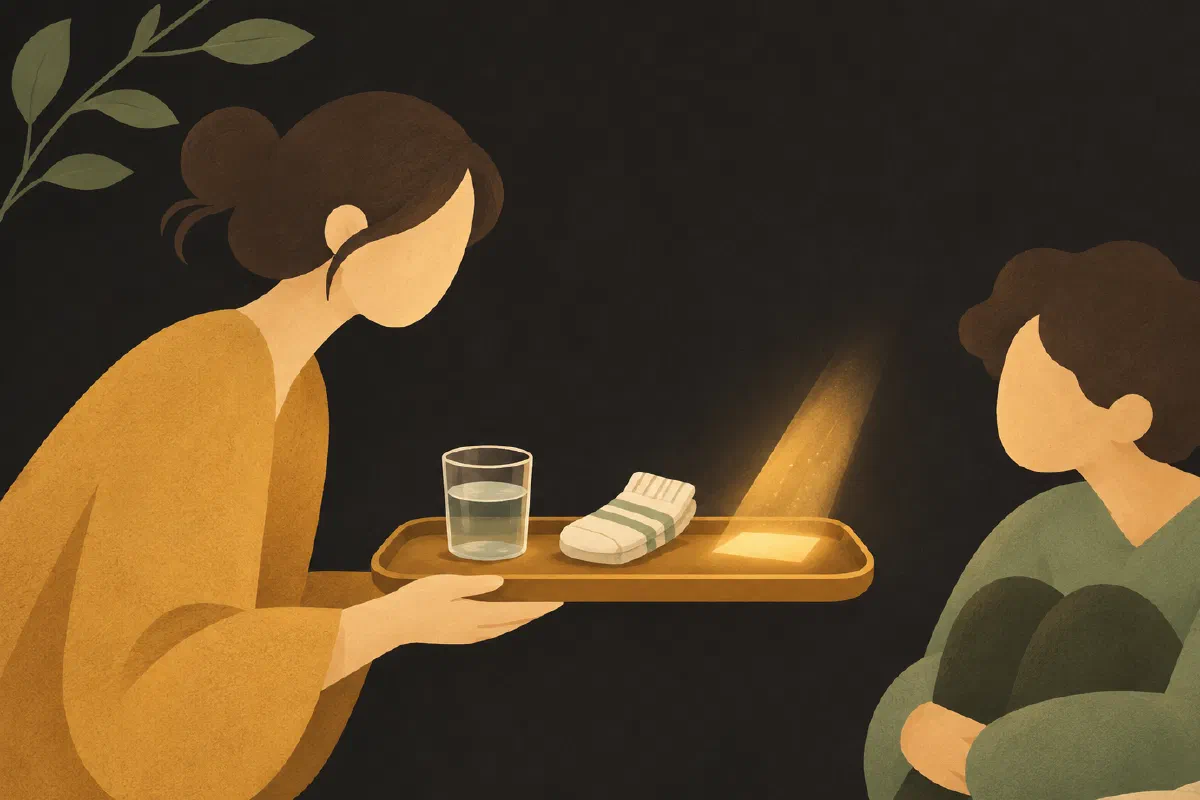
| Drink a glass of water | Reach and swallow | Very low | Fill it and leave it by the bed the night before |
| Open the curtains or switch on the main light | Two steps and one movement | Very low | Leave the curtains half open |
| Put on clothes laid out the night before | Dressing, no choosing | Low | One pile, socks on top |
| Brush your teeth | Two minutes, familiar | Low | Toothbrush and paste already out |
| Eat something you do not need to cook | Opening a packet or a fridge | Low | Keep one easy option at eye level |
| Wash your face instead of a full shower | One minute at the sink | Low | Towel already on the hook |
| Step outside for two minutes | Shoes and a door | Low to medium | Shoes by the door |
| Short walk or stretching | Several minutes of movement | Medium | Keep it as a bonus, not a rule |
| Checking email or news | Decisions, worry, endless scrolling | High | Leave it until after the floor version |
The pattern: the best low-energy steps remove choices. Every decision you make the night before is one you do not have to make while groggy.
On movement, the evidence is promising but limited. A 2025 meta-analysis found that both single sessions and longer programmes of physical activity were linked with better inhibitory control in adults with ADHD, but it included only a small number of studies and the authors say the conclusion still needs to be confirmed. That is a reason to keep a walk in your bonus level if you enjoy it, not a reason to force a workout on your worst mornings.
A gentle morning template to fill in tonight
Copy this into your notes app or onto paper and fill in the blanks. Keep each level short. If the floor version takes more than ten minutes, it is not a floor version yet.
My floor version (worst days, 5 to 10 minutes)
- Step 1: ____________ (example: drink the water by the bed)
- Step 2: ____________ (example: put on the clothes on the chair)
- Step 3: ____________ (example: brush teeth)
- Done means: “I did my morning.” Nothing else is required.
My standard version (ordinary days, 20 to 40 minutes)
- Floor version, then:
- ____________ (example: shower)
- ____________ (example: breakfast)
- ____________ (example: write the first work task on a sticky note)
My bonus (only if I have energy left)
- ____________ (example: ten-minute walk)
- ____________ (example: tidy the kitchen counter)
My if-then plans
- When I switch off the alarm, then I ____________.
- When I walk into the kitchen, then I ____________.
- When I notice I am scrolling, then I ____________.
Evening setup (5 minutes)
- Water by the bed
- Clothes in one pile
- Floor version written where I will see it
The if-then lines are worth the effort. Plans in this form are called implementation intentions, and a meta-analysis of 94 independent tests by Gollwitzer and Sheeran found a medium-to-large effect on reaching goals, including helping people get started. Again, this was research on goal pursuit in general, not specifically on ADHD. For the evening side of this, see our guide to building a night routine, and if you want a complete standard-day routine rather than a low-energy one, use our ADHD morning routine template or browse morning routine examples for working adults.
Worked example: Tom’s low Tuesday
This is an illustrative example, not a real case. Tom is a payroll specialist with ADHD who starts work from home at 8:30. His usual standard routine takes about 35 minutes: shower, breakfast, a short walk and writing the day’s first task on a sticky note.
On Tuesday he wakes up at 7:15 feeling flat and heavy, and the full routine feels impossible. Instead of skipping it, he switches to his floor version:
- 7:20. He drinks the water he left by the bed. His if-then plan says that comes straight after the alarm.
- 7:25. He opens the curtains and puts on the clothes from the chair.
- 7:30. He brushes his teeth and washes his face instead of showering.
- 7:35. He ticks “floor version done” on the note on his fridge. The routine counts.
- 7:45. With some grogginess gone, he eats a yoghurt from the front of the fridge. He skips the walk.
- 8:30. He sits down, reads his sticky note from last night and starts a 10-minute focus session on the first task.
Tom did not feel more motivated at 7:15. The difference was that the morning asked very little of him, every choice had been made the evening before, and a smaller version still counted.
When low energy is more than a routine problem
A gentler routine can make low mornings easier, but it cannot fix everything. Talk to a GP or doctor if:
- you have been feeling tired for a few weeks and you are not sure why, or tiredness affects your daily life;
- you feel tired and have other symptoms, such as weight loss or mood changes;
- you have had a lack of energy or no motivation or interest in things for most of the day, every day, for more than two weeks, which the NHS lists among symptoms of depression.
The NHS also notes that anxiety and depression can make ADHD symptoms worse, so it is worth mentioning both if you speak to a doctor. If you take ADHD medication and think it affects your mornings, raise it with your prescriber rather than changing anything yourself. If you ever have thoughts of harming yourself, contact your local emergency number or a crisis line in your country straight away.
This article is educational and does not replace advice from a doctor.
Summary and one next step
A “low dopamine morning” is a popular way of describing a flat, low-energy start to the day, not a measurement of brain chemistry. What helps on those mornings is lowering the demand rather than dropping the routine: a floor version that still counts, steps that remove decisions, if-then plans and an evening setup that does the thinking for you.
Your next step tonight: write your three-step floor version and put a glass of water by the bed. Tomorrow, once the floor version is done, start your first task with a 10-minute session in our free Cyklio Focus Timer.