


You finish work, blink, and it is 11 pm. The evening went somewhere, but it did not feel like rest. This guide shows how to plan free time after work and on weekends so it restores you, without turning your evenings into another to-do list.
Why free time disappears
Free time rarely vanishes because people are lazy. It usually leaks away for two simple reasons.
Work has no clear end. If you answer one more message at 19:30 and keep thinking about tomorrow’s meeting, your body is at home but your mind is still at work. A meta-analysis of 86 publications with more than 38,000 employees found that doing work-related things in non-work time was linked to less mental detachment from work, and that more detachment went with less exhaustion, better sleep and higher well-being. A review of recovery research by Sonnentag and Fritz also found that high workload is linked to lower detachment, and lower detachment to more strain and poorer well-being. These studies are mostly correlational, so they show a consistent pattern rather than proof of cause, but the practical message is clear: free time starts with a boundary.
Nothing is chosen in advance. When you arrive home tired with no plan, the easiest option wins, which is often scrolling or half-watching something while doing chores. That is not wrong, but if it happens every evening, it rarely feels like the time was yours.
If the leak starts during the workday itself, see our guide to managing your time at work. This article is about what happens after you stop.
What makes free time feel like rest
“Rest” does not only mean lying on the sofa. Work psychologists Sabine Sonnentag and Charlotte Fritz identified four distinct recovery experiences people have in their leisure time: psychological detachment from work, relaxation, mastery and control, and found them moderately related to psychological well-being.
| Recovery experience | What it means | Evening example | Weekend example |
|---|---|---|---|
| Detachment | Not thinking about or doing work | Work apps closed, phone notifications for work off | No email check until Monday morning |
| Relaxation | Low effort, calm, pleasant | Bath, slow walk, music, easy reading | Lazy breakfast, a nap, time outside |
| Mastery | Learning or practising something that stretches you a little | Twenty minutes of guitar, a language lesson, a new recipe | A class, a longer hike, a small DIY project |
| Control | Deciding for yourself what you do and when | Choosing tonight’s activity rather than drifting into one | One block of the weekend that answers to nobody |
A useful way to read this table: an evening that restores you usually has detachment plus at least one of the other three. A night of chores with work email open has none of them, which is why it can feel like a second shift.
Enjoyable activities themselves also seem to matter. In four studies with 1,399 participants, people who took part in more kinds of enjoyable leisure activities had more positive psychological states, less depression and better measures of physical health. Again, this is an association, not proof that hobbies cause better health, but it supports treating leisure as something worth protecting rather than as leftover time.
If you have ADHD and rest tends to either never start or slide into hours of scrolling, our guide on how to rest with ADHD goes deeper into that specific problem.
How much free time do you need?
There is no magic number, and more is not always better. Across two large datasets covering 35,375 Americans and two experiments, researchers found that having too little discretionary time was linked to lower well-being, mainly through stress, while having a great deal of it was sometimes linked to lower well-being because people felt less productive. That downside shrank when people spent the extra time on activities they saw as productive.
For a working adult, the first half of that finding is the usual problem: too little free time, poorly protected. The second half is a useful reminder for weekends and holidays. Large open stretches feel better when at least part of them goes to something you find worthwhile, such as a project, a skill, time with people or helping someone.
Plan loosely: anchors, not time slots
Here is the trap: once you decide to “manage” free time, it is tempting to schedule it like work. Research suggests that can backfire.
Across 13 studies, Tonietto and Malkoc found that scheduling a leisure activity made it feel less free-flowing and more like work, and reduced both anticipation and enjoyment. Scheduling it only roughly, without fixed start and end times, removed that negative effect.
So use anchors instead of time slots:
- “Swim sometime Tuesday evening” rather than “Swim 19:00–19:45”.
- “Saturday morning: farmers’ market, no rush” rather than “09:00 market, 10:15 coffee”.
- “After dinner: one chapter of my book” rather than “20:30–21:00 reading”.
An anchor tells you what and roughly when. It gives you something to look forward to without a start time to be late for.
Looking forward is part of the value. In a Dutch study of 1,530 people, vacationers reported higher happiness than non-vacationers before their trip, which the authors suggest may reflect anticipation, while most were not happier after it. A small anchor planned on Monday for Thursday gives you a little of that anticipation during the week.
Time blocking can still be useful for the boundary itself, such as blocking “finish work by 18:00”. For how blocks work in detail, see time blocking best practices; just keep the inside of your free time loose.
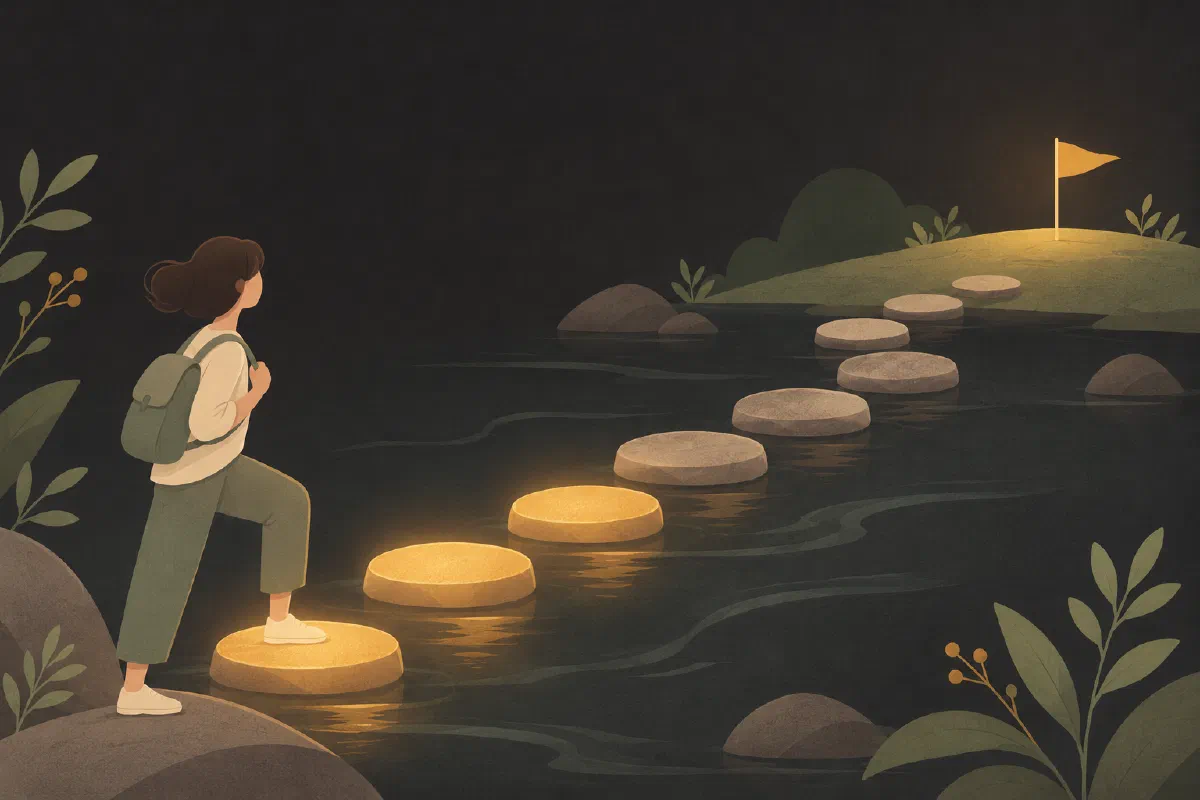
A five-step plan for your free time
- Set the boundary first. Pick a realistic end time for work on most days and a short closing action: write tomorrow’s first task, close work apps, turn off work notifications. For the full wind-down after that, see our night routine guide.
- Count your real free hours. Subtract commuting, cooking, chores, caring for others and sleep. You may find you have only one or two genuinely free hours on a weekday evening. Plan for the number you actually have, not an imaginary four.
- Choose one anchor per evening and one or two per weekend. Check them against the four recovery experiences. If the whole week is relaxation, add one small mastery activity. If everything is mastery, add something easy.
- Protect the anchor like an appointment with yourself. When something else comes up, ask whether it truly cannot move before giving up your anchor. Keep a small buffer before it, so a late meeting does not cancel it automatically.
- Leave unplanned space. Keep at least one evening a week and a large part of the weekend with no anchor at all. That is where control lives, and it keeps your plan from turning into a schedule.
Once a week, take two minutes to look back: which anchor actually helped, which one felt like a duty? Keep the first kind and swap the second.
Evening and weekend examples
The following is an illustrative example, not a real person.
Weekday evening. Ana works as a project coordinator and gets home at 18:30. Before, her evenings looked like this: laptop open “for a minute”, dinner while answering messages, then scrolling until midnight. She now does the following:
- Boundary: at 18:00 she writes tomorrow’s first task on a sticky note and closes her laptop. Work notifications are off until 08:30.
- Anchor: Tuesday and Thursday “a walk after dinner”, Wednesday “pottery class”, Monday “one episode of a series with my partner”.
- Unplanned: Friday evening has nothing on it by design.
On a bad day she shrinks the anchor instead of skipping it: a ten-minute walk around the block still counts.
Weekend. Ana uses two anchors and leaves the rest open:
- Saturday morning: “market and coffee, no rush” (relaxation and control).
- Sunday afternoon: “a longer bike ride somewhere new” (mastery and detachment).
Chores fit into the gaps rather than filling the whole weekend.
There is also a simple mindset trick worth trying. In three preregistered experiments, people who were asked to treat their weekend like a vacation reported more positive feelings, fewer negative feelings and more satisfaction when back at work on Monday. Exploratory analyses pointed to greater attention to the present moment, and the authors note they could not fully rule out participants guessing the study’s aim. A low-cost version: on Saturday morning, ask yourself what you would do today if you were on holiday in your own town.
A simple free-time template
Copy this into a notebook or notes app on Sunday evening or Monday morning. Fill it in within five minutes; if it takes longer, you are over-planning.
| Anchor (what, roughly when) | Recovery type | Smaller backup version | |
|---|---|---|---|
| Work end time this week | ____ | Detachment | Close apps, write first task |
| Monday evening | ____ | ____ | ____ |
| Tuesday evening | ____ | ____ | ____ |
| Wednesday evening | ____ | ____ | ____ |
| Thursday evening | ____ | ____ | ____ |
| Friday evening | Unplanned | Control | — |
| Saturday | ____ | ____ | ____ |
| Sunday | ____ | ____ | ____ |
| One thing I am looking forward to | ____ |
Rules of thumb for filling it in:
- No more than one anchor per weekday evening.
- At least one empty evening and one empty half-day at the weekend.
- Every anchor gets a smaller backup version for tired days.
- Use at least three of the four recovery types across the week.
Common problems and fixes
| Problem | Likely cause | Fix |
|---|---|---|
| Work keeps leaking into the evening | No clear end point | Fixed end time and a two-minute closing action |
| Evenings vanish into scrolling | No chosen activity, very tired | One small, easy anchor with a natural end |
| Planned hobbies feel like homework | Free time scheduled to the minute | Turn time slots into rough anchors |
| Weekends fill with chores and errands | Chores expand into all open time | Put one anchor in first, then fit chores around it |
| A long free weekend feels flat | Lots of time, nothing that feels worthwhile | Add one mastery or social anchor |
| You feel guilty resting | Rest seen as wasted time | Write rest into the template as a deliberate choice |
If your problem is less about free time and more about too many competing demands, choosing what matters first is covered in our guide to prioritization and time management, and broader methods are collected in time management techniques.
Summary and next step
Managing free time is mostly about two things: giving work a clear end and choosing a few loose anchors that give you detachment, relaxation, mastery or control. Research suggests rough plans keep leisure enjoyable, while rigid scheduling can make it feel like work, and that both too little time and large unstructured stretches can leave you feeling worse.
Your next step: pick one anchor for this evening and write it down with a rough time, such as “walk after dinner”. If ending work is the hard part, try finishing your last tasks in timed sessions with the Cyklio Focus Timer. Cyklio, our own app, also lets you set a daily goal in hours with a progress ring, so you can see when your work for the day is done.