


Hyperfocus can give you three brilliant hours on a project, or three lost hours on the wrong thing and a missed dinner. You do not have to choose between switching it off and letting it run your day. This guide shows how to aim hyperfocus, put a timer around it and build exit cues that work when your attention will not.
Hyperfocus: the popular word and what research says
“Hyperfocus” is an everyday term, not a diagnosis. The diagnostic manual used for ADHD does not explicitly refer to any symptom as hyperfocus, and the review that points this out also notes that there is no single agreed definition. The NHS list of adult ADHD signs includes finding it hard to organise your time and to finish tasks, but does not mention hyperfocus.
What research does say, mostly from self-report questionnaires:
- Adults with higher ADHD symptom scores report more hyperfocus across settings such as school, hobbies and screen time.
- It is not unique to ADHD: one study found that adults with diagnosed ADHD did not differ from matched controls in how often they experienced it.
- Researchers who built a hyperfocus questionnaire describe features such as timelessness, ignoring personal needs and difficulty stopping and switching tasks, and see it, together with mind wandering, as a facet of poor attentional control.
- A clinical study described hyperfocusing as difficulty shifting attention away from events that trigger interest.
That last point shapes everything below. If hyperfocus is, at least in part, a problem of steering and stopping, then the useful work happens before and around the session, not inside it. For a fuller explanation of the state itself, read what hyperfocus is and how it relates to ADHD. Hyperfocus is not a reason to self-diagnose, either way.
Step 1: Choose your targets before hyperfocus does
The questionnaire researchers note that hyperfocus can lead to positive outcomes, such as completing a creative project, or neutral and negative ones, such as hours of television. The state is roughly the same. The difference is the target. Since absorption tends to follow whatever grabs you (see why ADHD motivation depends on interest, urgency and novelty), the practical move is to decide in advance what it is allowed to land on.
Use this table to sort your usual pulls:
| Target type | Examples | How to handle it |
|---|---|---|
| Green: chosen, valuable, bounded | The report you need, a design draft, studying for a set exam | Give it your best hours, with a session timer |
| Amber: useful but endless | Formatting, research tabs, inbox cleanup, refactoring, tidying files | Allow only with a fixed time box and a stop alarm |
| Red: open-ended and costly at the wrong time | Feeds, video series, games, news, late-night “quick” projects | Keep out of risky slots, such as before deadlines or bedtime |
| Unknown: a new idea pops up mid-task | A new app idea, a side question | Write it on a “later list” and return to the green task |
Four ways to put this into practice:
- Name one green target per day. Write it down in the morning so you are not deciding while already absorbed.
- Put the green task where you usually sink in. If you tend to get absorbed in the late morning, start the important task then, not the inbox.
- Make the target concrete. “Draft the first two sections” gives you a natural end. “Work on the report” does not.
- Keep a later list. A side quest written down is easier to leave than one still open in a tab.
Step 2: Put a timer on every session you expect to sink into
Once you are absorbed, your own sense of time is not much help: researchers describe hyperfocus as involving diminished awareness of time and the environment. The popular term time blindness describes a similar everyday experience. An external timer does the noticing for you. In a qualitative study of 32 adults with ADHD, participants described using checklists and electronic devices to plan or remind them of tasks and appointments as one of their self-developed compensation strategies.
Use two kinds of timer, because they do different jobs:
- Session timer. Start it before you start the task. It is a check-in, not a punishment: at the end you decide to continue, take a break or switch. Try 25 to 50 minutes to start. Our free Cyklio Focus Timer lets you choose 10 to 60 minutes.
- Hard-stop alarm. Set it for anything you must not miss: a meeting, a pickup, a train, a bedtime. Set it early enough to leave in time (for example 15 minutes before you must go), and never snooze it in the moment.
If you want the full start, work and stop routine around a timer, see the ADHD timer method.
Step 3: Build exit cues that actually reach you
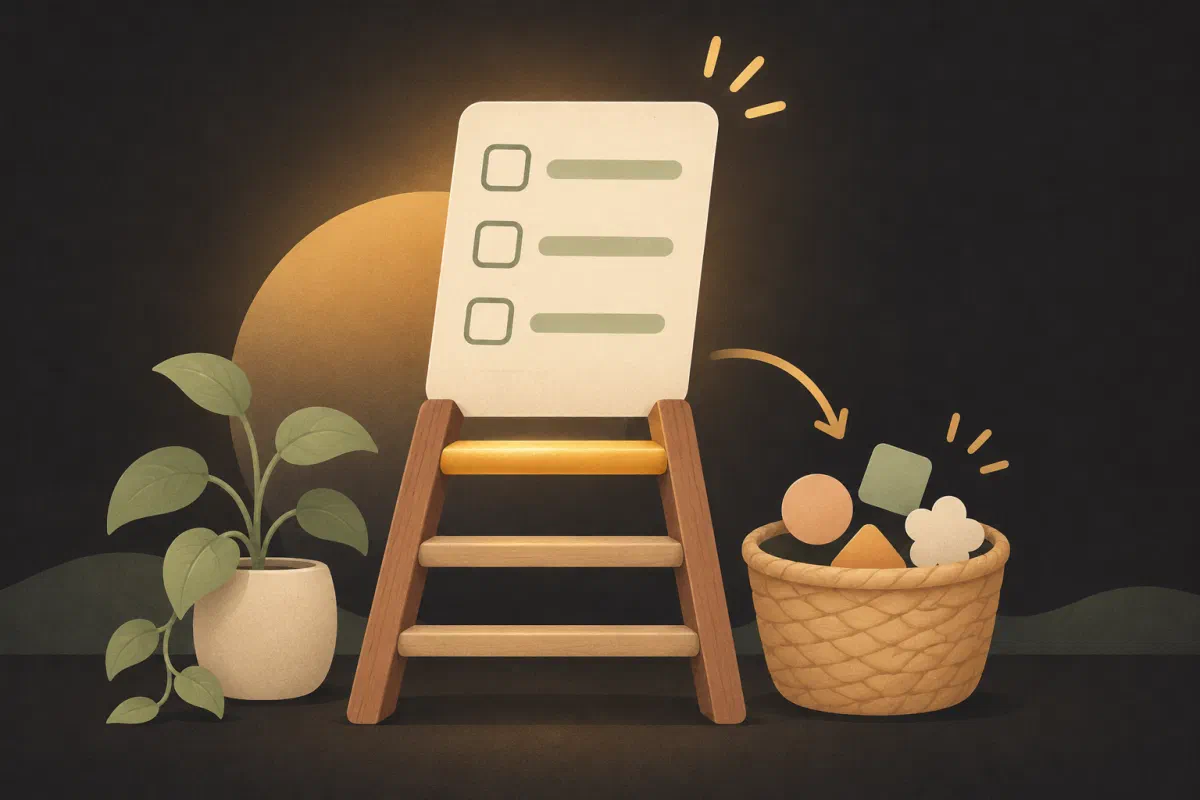
A beep you dismiss without looking is not an exit cue. Pick a cue strong enough for the situation, using this ladder from weakest to strongest:
- Silent on-screen notification: fine for low-stakes check-ins.
- Sound or vibration: for ordinary session ends.
- Alarm placed across the room: you have to stand up to stop it, which breaks the posture of the session.
- A change in your environment: a smart light that dims, a scheduled call, a laptop charger left in another room.
- A person: a colleague, partner or friend who checks in at a set time. A person can be harder to ignore than a beep.
Match the rung to the cost of missing it. A water check-in can be rung 1 or 2. A school pickup deserves rung 3 or higher, plus a backup.
Then attach a plan to the cue in if-then form: “If the alarm rings, then I save, write my resume note and stand up.” These plans are called implementation intentions. A meta-analysis of 94 tests found they improved goal attainment with a medium-to-large effect, and a 2024 meta-analysis of 642 tests found effects were larger when plans used an if-then format. That review also classified cue types, including reaching a point within a task. You can use that as a seam cue: “If the timer has rung, then I stop at the end of the current paragraph, test or slide.” This is general research on planning, not studies of hyperfocus, so treat it as a promising tool rather than a proven fix.
Step 4: Make stopping cheap with a resume note
Part of what makes stopping hard is the fear of losing your place. Remove that fear with a 60-second note before you leave the task:
- Where I stopped: …
- The very next step: …
- Anything I must not forget: …
There is research behind this habit. In four studies on interrupted work, briefly planning how to return to the interrupted task reduced attention residue and protected performance on the next task. Another set of experiments found that unfinished goals caused intrusive thoughts, and that making a specific plan for them eliminated those effects. In plain terms: a written plan for coming back may help your mind let go of the unfinished task. If the switch to the next task is still the hard part, see ADHD and task switching for transition rituals.
Step 5: Protect the non-negotiables: people, body, sleep
Hyperfocus does not check whether you have eaten. Decide your protections before you start:
- Body breaks. A meta-analysis of 22 study samples found that breaks of 10 minutes or less had small effects on boosting vigour and reducing fatigue; their overall effect on performance was not significant, though longer breaks were linked to bigger performance boosts. Put water within reach and plan one real break every one or two sessions.
- People. Put shared commitments into alarms, not memory. Tell the people around you what your exit cue is, so a check-in is expected rather than an intrusion.
- Sleep. The CDC recommends 7 or more hours of sleep for adults aged 18 to 60. If late evenings are your risky time, set a “screens down” alarm and keep red targets out of the last hour before bed.
If long sessions often leave you drained, the guide on hyperfocus and burnout covers stop signals and recovery in more depth.
Worked example: a hyperfocus-proof Thursday
Dev (a made-up example) is a software developer who often gets absorbed in tooling instead of the feature that is due. He has a client call at 15:00 and picks up his daughter at 17:15. This is how he plans the day in five minutes at 9:00:
| Time | Plan | Timer and exit cue |
|---|---|---|
| 9:00 | Names the green target: “Finish the login form validation” | Writes it on a sticky note |
| 9:15–11:45 | Three 45-minute sessions on the green target, short breaks between | Session timer (sound); if-then note: “If it rings, I stop at the next passing test” |
| 11:45 | Lunch | Alarm across the room |
| 13:00–14:00 | Amber slot: build-script cleanup, time-boxed | 50-minute timer; later list for new ideas |
| 14:40 | Prepares for the call | Hard-stop alarm at 14:40 (rung 3) |
| 15:00–15:45 | Client call | Fixed commitment |
| 16:00–16:50 | One more green session | Session timer, then resume note |
| 16:55 | Leaves for pickup | Hard-stop alarm at 16:55 plus a calendar alert on his watch |
| 21:30 | Screens down | Alarm; no new projects after 21:00 |
At 10:45 he notices a slow test runner and feels the pull to fix it. He writes “speed up test runner” on the later list and returns to validation. In the 13:00 amber slot, the runner gets its 50 minutes. Nothing here asks him to resist hyperfocus mid-session. Every decision was made at 9:00, outside it.
Your daily hyperfocus plan (template)
Copy this into your notes each morning. It takes about five minutes.
- Today’s green target: …
- My usual absorption window, and what I will put in it: …
- Amber tasks allowed today, with time boxes: …
- Red targets to keep out of risky slots: …
- Session length: 25 / 45 / 50 / other …
- Hard stops (time, what, cue rung): …
- My if-then exit: If … then I will …
- Seam I will stop at: …
- Break and food plan: …
- Screens-down time tonight: …
- End of day check: Did hyperfocus serve today’s green target? Yes / Partly / No
After a week, read the last line back. You will see which targets, times and cue rungs work for you.
When it keeps eating your days
These strategies help many people, but they have limits. The NHS advises that if possible ADHD symptoms, such as finding it hard to organise your time or finish tasks, are affecting your studies, work or relationships, you should make an appointment with a GP to find out what support is available. Outside the UK, start with your family doctor or local health service. If you already have an ADHD diagnosis, talk to your clinician about hyperfocus that is causing problems. This article does not give medication or treatment advice.
Summary
- Hyperfocus is a popular term, not a diagnostic criterion. Several research groups frame it as difficulty steering and shifting attention.
- Choose targets in advance: one green task per day, time-boxed amber tasks, and red targets kept out of risky slots.
- Use a session timer for check-ins and separate hard-stop alarms for fixed commitments.
- Match exit cues to the stakes, attach an if-then plan and stop at a seam.
- Write a resume note, and protect people, food, water and sleep before the session starts.
Your next step: tomorrow morning, fill in the daily plan and start your first green session with a timer: our free Cyklio Focus Timer, or Cyklio, our app, where you can rate each session and see in weekly reports which ones served you well.