


If you have a certification exam, a licence test or a pile of terms to learn while also holding down a job, you do not need more hours as much as better ones. This guide covers the four memorization techniques that research supports best, shows which one fits which kind of material, and ends with a one-week plan you can start today.
Why rereading feels productive but fades fast
Rereading and highlighting feel like work, and the material looks familiar the second time through. Familiar is not the same as remembered. A large review of ten learning techniques by Dunlosky and colleagues (2013) rated rereading and highlighting as low utility: most students report using them, but they do not consistently improve performance. The same review gave its only two “high utility” ratings to practice testing and distributed practice, because they helped learners of different ages and abilities across many kinds of tests.
So the core of memorizing is simple to state: pull the information out of your head, and do it more than once, on different days. The rest of this article is about doing that well.
Retrieval practice: test yourself instead of reviewing
Retrieval practice means closing your notes and trying to recall the answer before you check it. Flashcards, blank-page recall, practice questions and explaining a topic out loud all count.
The evidence is strong and consistent:
- In a classic experiment, students who read a passage and then took recall tests remembered more of it two days and one week later than students who restudied it the same number of times, even though restudying looked better on a test five minutes later.
- When students learned foreign-language vocabulary, repeated study after they could recall a word had no effect on later recall, while repeated testing on those words produced a large improvement.
- A meta-analysis found that practice tests were more beneficial for learning than restudying and all other comparison conditions, although the average benefit varied with the features of the tests, the learners and the studies.
The five-minute result explains why so many people stick with rereading: it feels better in the moment, and in the 2006 study repeated studying also made students more confident they would remember. Recall feels harder; that does not mean it is working less well.
How to do it
- Turn each fact or term into a question with one clear answer (“What does RAID 1 do?” rather than “RAID”).
- Try to answer from memory. Say or write the answer before you look.
- Check immediately and mark it: got it, shaky, or missed.
- Return to the shaky and missed items later in the same session, then again on another day.
- Keep testing items you already know, just less often. Dropping them the first time you get them right is what the 2008 study suggests not to do.
For a full walkthrough of card design and review piles, see our guide on how to study with flashcards.
Spacing: the same hours, spread out
Spacing (also called distributed practice) means splitting your reviews across days instead of massing them into one session. It is one of the two techniques the Dunlosky review rated as high utility. A quantitative review of 317 experiments added an important detail: the gap between sessions that gave the best retention grew as the time until the final test grew.
How far apart should reviews be? A large study with over 1,350 participants tested this directly. The best gap between study sessions depended on how long you need to remember: for a test one week away, the best gap was about 20 to 40 percent of that week, and for a test a year away it fell to about 5 to 10 percent of the year. In practical terms:
| When is your exam? | Rough gap between reviews |
|---|---|
| In about a week | 1–3 days |
| In about a month | Several days to a week |
| A year away, or you need it long-term | A few weeks (about 5–10% of the time until you need it) |
Treat these as rough guides, not exact rules; the month row is an estimate between the study’s one-week and one-year results. In that study, lengthening the gap first improved final test scores and then slowly lowered them, so going back too soon wastes some of the benefit, and waiting far too long does too.
Spacing also suits a working week. Twenty-five minutes on four different days fits around work more easily than one tired two-hour block on Sunday night, and it builds in the gaps described above. If you want to see how many hours that adds up to, our study plan guide walks through scheduling.
Chunking: fewer, bigger pieces
Your short-term memory can hold only a small amount at once. A widely cited review by Cowan (2001) argued that the limit averages about four “chunks”, not the often-quoted seven. The useful part is the word chunk: chunking means recoding smaller units of information into larger, familiar units, so one chunk can stand for several items.
Chunking means grouping items into meaningful units so that each group takes up one slot. Experiments suggest this frees up capacity: when people could chunk part of a list, they also remembered the other, unchunked items better, which is consistent with chunks reducing load on working memory.
How to chunk material for an exam:
- Group by meaning. Twenty-four project management terms become six groups of four (planning, risk, cost, quality, and so on).
- Group by pattern. A long number or code splits into familiar segments, the way you already read a phone number.
- Name each group. A short label (“the four risk responses”) becomes a retrieval cue for everything inside it.
- Learn the groups, then the items. Recall the group names first, then fill in each group from memory.
If holding several things in mind is especially hard for you, you are not alone; our article on working memory and ADHD explains why and what helps.
Mnemonics: when the material has no built-in logic
Some things you just have to learn by heart: ordered steps, lists, names, arbitrary codes. Here a mnemonic gives your memory something to hold on to.
The best-studied one is the method of loci, also called the memory palace. You picture a familiar route, such as your flat or your commute, and “place” each item at a spot along it. To recall, you walk the route in your mind.
- A meta-analysis of 13 randomized trials found a medium-sized benefit for the method of loci, mostly in university settings, while noting a high risk of bias in many of the studies.
- A 2025 systematic review found strong evidence for a large effect on immediate recall of lists in order in adults compared with rehearsal, but rated the evidence as low to very low quality and called for more rigorous studies.
Other mnemonics have weaker records. The Dunlosky review rated the keyword mnemonic (linking a new word to a similar-sounding word and an image) as low utility: it is hard to apply in some contexts and seems to help only with a limited range of material and over short retention intervals.
So use mnemonics as a tool for specific items, not as your whole method. A memory palace gets the seven steps of a process into your head; retrieval practice and spacing keep them there.
Which technique for which material
| What you need to learn | Main technique | Add |
|---|---|---|
| Definitions, terms, vocabulary | Retrieval practice with flashcards | Spacing across days |
| An ordered list or process | Memory palace | Recall the route on several days |
| Long lists of related items | Chunking into named groups | Retrieval practice by group |
| Formulas, codes, numbers | Chunking into patterns | Practice questions that use them |
| Concepts you need to explain or apply | Practice questions and explaining in your own words | Spacing |
Understanding-heavy topics are better served by broader methods; our overview of evidence-based study techniques covers elaboration and self-explanation, and mind mapping for studying covers visual structure.
A one-week memorization plan
Here is how the techniques fit together in an illustrative example: Marta, a project coordinator, has a certification exam in seven days and about 120 terms and processes to learn. She has 30 to 45 minutes on weekdays, usually after work.
- Day 1: build and first recall (45 min). Sort the material into named chunks. Write questions for each item. Build a memory palace for the two ordered processes. End with one full recall pass and mark shaky items.
- Day 2: first spaced review (30 min). Recall everything before looking. Spend most of the time on yesterday’s shaky and missed items.
- Day 3: rest from this material. Leave a gap. Do something else or nothing; this gap is part of spacing.
- Day 4: second review (30 min). Full recall pass, mixed order. Walk each memory palace route from memory.
- Day 5: practice questions (30 min). Answer exam-style questions that make you use the terms, not just define them.
- Day 6: mixed self-test (45 min). A full mock test from memory, then fix only what you missed.
- Day 7: light review (20 min). Recall the chunk names and memory palace routes, review the few items still shaky, and stop early.
Each session follows the same shape: two minutes to choose the cards or questions, recall work in a timed block, a short break, and a quick check of how it went. A timer helps with the start, because “one 25-minute recall block” is easier to begin than “study”. You can use our free focus timer for this.
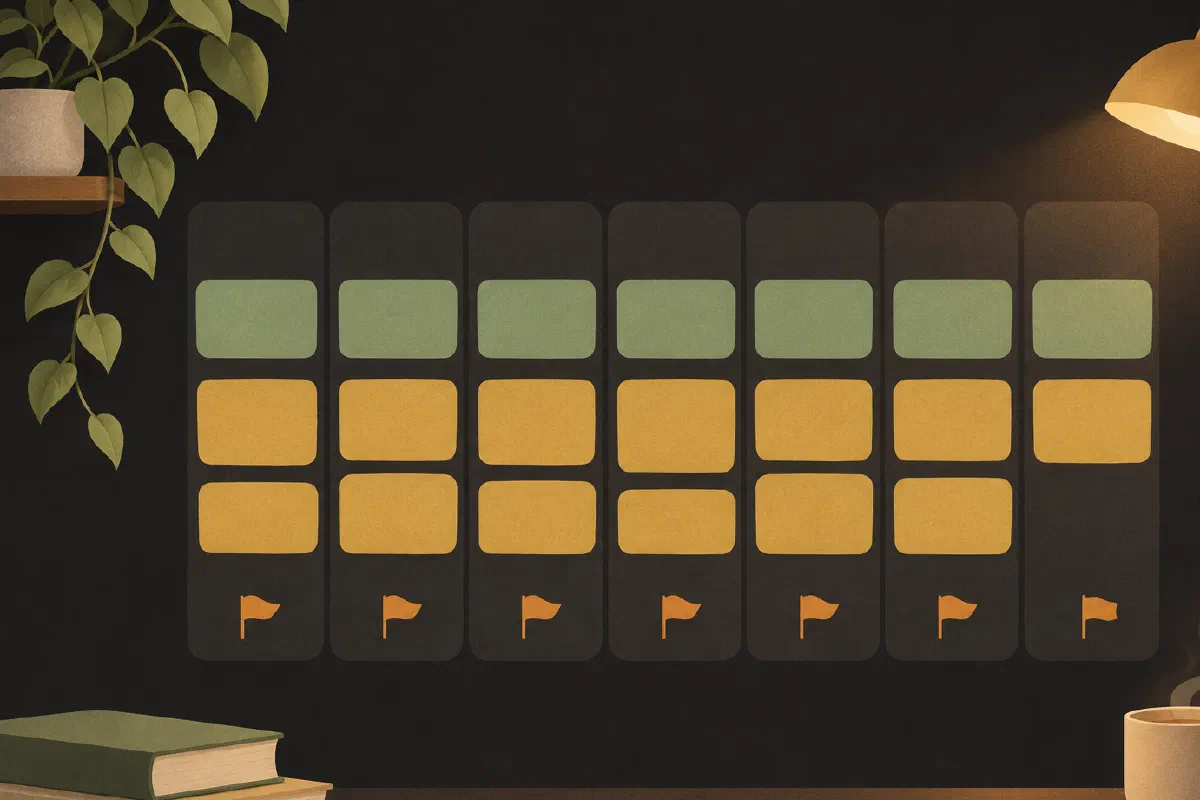
Fill-in session template
Copy this for each session:
- Today’s chunk(s): ______
- Recall first, then check: yes / no
- Got it / shaky / missed: __ / __ / __
- Next review of the shaky items: day ______
- How the session went: full focus / distractions / not today
Protect your sleep between sessions
Sleep is not a break from memorizing. A major review of the research concluded that sleep is a brain state that supports the consolidation of newly learned memories. In practice, that is one more reason to spread learning over several nights instead of staying up late before the exam.
If you notice that your memory feels much worse than usual, or it is affecting daily life, that is worth raising with a doctor. For memory difficulties linked to ADHD, see our article on ADHD and memory.
Summary and your next step
- Test yourself instead of rereading. Recall first, check second.
- Space your reviews. For an exam in a week, return every one to three days.
- Chunk long lists into a few named groups.
- Use a memory palace for ordered lists and arbitrary facts.
- Sleep between sessions.
Your next step: pick the material for your next exam, write ten recall questions, and run one short recall session today. If you want a timer that also lets you rate each session, Cyklio, our focus timer app, runs sessions from 10 to 60 minutes and shows daily and weekly reports, so you can see whether your spaced reviews are actually happening.