

School mornings rarely go wrong because of one big problem. They go wrong because of five small ones: a missing charger, a shirt that needs ironing, a bus that leaves two minutes early. This guide gives you a short checklist, a way to build in time buffers and sample schedules for teens and for adults who study alongside work.
Why school mornings feel rushed
Most rushed mornings come from two things: decisions left for the morning, and time estimates that are too hopeful.
The second one has a name. Psychologists call it the planning fallacy: an optimistic bias in which people underestimate how long their own tasks will take. Roger Buehler, one of the researchers who studied it, notes that students who usually finished past assignments close to the deadline still insist they will finish the next one well ahead of it. He also describes the same bias in small tasks such as household chores, not just big projects, and getting out of the door is exactly that kind of task. “Shower takes five minutes” is usually a hope, not a measurement.
The fix is not more willpower. It is fewer morning decisions, a checklist you can follow half-awake and a buffer that absorbs the small surprises.
Step 1: Evening prep (10 minutes)
Anything you can decide the night before should not be waiting for you in the morning. A short evening “launch pad” routine covers most of it:
- Pack the bag completely: books, laptop, charger, pencil case, student card, keys. Put it by the door.
- Choose clothes and lay them out, including shoes and a jacket that suits tomorrow’s forecast.
- Prepare food: lunch in the fridge, breakfast items in one spot.
- Check tomorrow: timetable, deadlines, anything to sign or hand in, and the time you must leave.
- Write the first task for your first study block on a sticky note, so the day has a clear start.
- Set the alarm for the same time you set it yesterday.
If your evenings are the harder part, our guide to a night routine that sets up the next day goes deeper. Here we keep it to the ten minutes that make mornings easier.
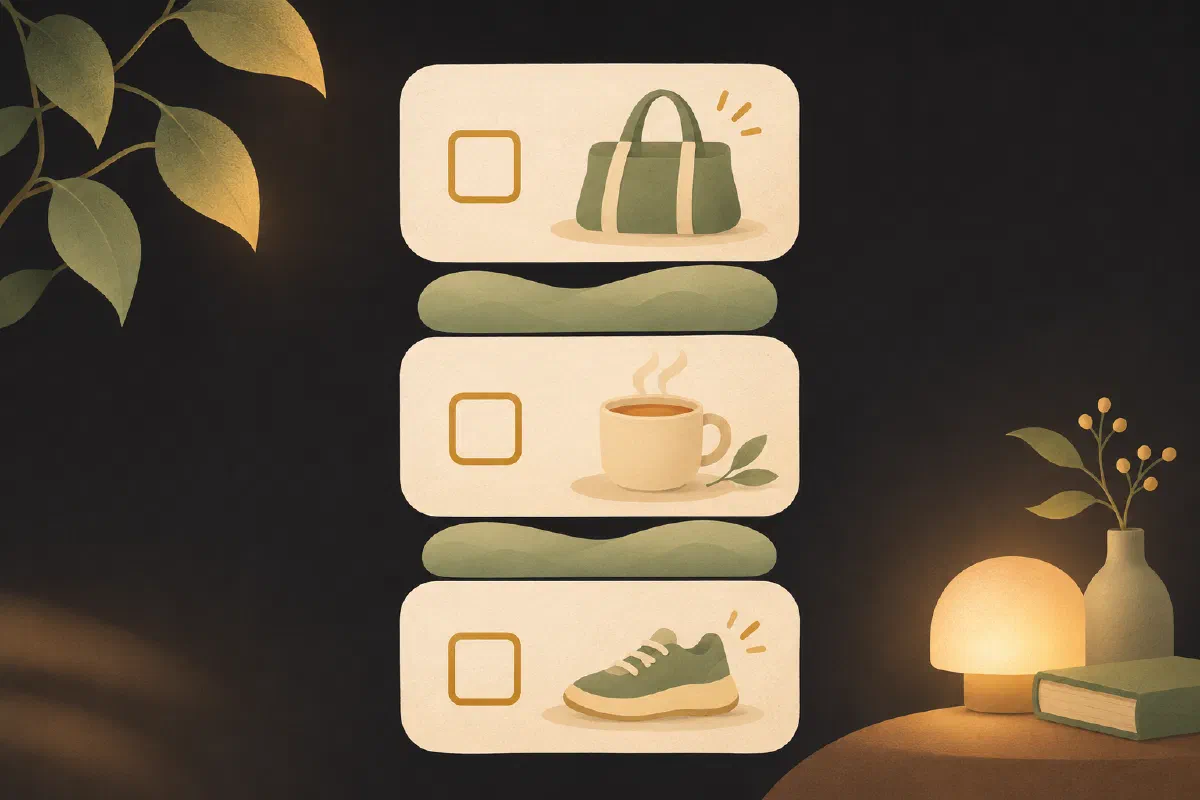
The morning checklist: eight steps
Keep the morning list short and in the order you actually do things. Write it down and put it where you will see it: on the bathroom mirror, the fridge or inside the front door.
- Get up at the alarm. Put the alarm across the room if snoozing is a habit.
- Water and light. Drink a glass of water, open the curtains or turn on the main light.
- Wash and get dressed in the clothes you laid out.
- Eat breakfast, even a small one you can take with you.
- Teeth, hair, medication or anything else personal you do every day.
- Final check: keys, phone, wallet or travel card, charger, lunch.
- Buffer time. Nothing is scheduled here. It is there for surprises.
- Leave (or log in) at the planned time.
Notice what is missing: scrolling, email and social media. One option is to keep the phone out of the routine until step 6, when it goes into the bag.
How to add time buffers that actually work
Because people tend to underestimate their own task times, a buffer is not a luxury. Here is a simple way to set one up.
- Time each step once. For one normal morning, note the time when you start and finish each step. Do not change anything, just measure.
- Use the real numbers. If dressing took 14 minutes, write 14, not the 5 you hoped for.
- Add a general buffer of 10 to 15 minutes before your leave time. This is a common rule of thumb, not a scientific number. Adjust it to how often your mornings get disrupted.
- Add a travel buffer if your bus, train or traffic is unreliable: plan for the later option, not the best case.
Buehler’s suggestions for countering the planning fallacy include breaking a plan into smaller steps and planning backwards from the deadline. Both fit school mornings well.
Plan backwards from your leave time
Start with the fixed point, the moment you must walk out of the door or join the first online class, and work back.
| Step | Measured time | Must start by |
|---|---|---|
| Leave the house | — | 7:50 |
| Buffer | 10 min | 7:40 |
| Final check (bag, keys, card) | 3 min | 7:37 |
| Teeth and hair | 8 min | 7:29 |
| Breakfast | 12 min | 7:17 |
| Wash and dress | 15 min | 7:02 |
| Water and light | 2 min | 7:00 |
| Alarm | — | 7:00 |
If the plan says your alarm should be at 6:40 and you currently set it for 7:15, you know the real problem before the morning starts. Then you can either move bedtime earlier or move tasks into the evening.
Sample schedules
These schedules are examples to adapt, not rules. The times assume the evening prep is done.
Teen at school (school starts 8:30)
| Time | Step |
|---|---|
| 6:55 | Alarm, get up, water, lights on |
| 7:00 | Shower and get dressed |
| 7:20 | Breakfast |
| 7:35 | Teeth, hair, final bag check |
| 7:45 | Buffer |
| 7:55 | Leave for the bus |
| 8:20 | Arrive, ten minutes before the bell |
Adult student with a job (morning lecture or online class at 9:00)
| Time | Step |
|---|---|
| 6:45 | Alarm, get up, water, lights on |
| 6:50 | Wash and get dressed |
| 7:10 | Breakfast, check today’s timetable and deadlines |
| 7:25 | One 25-minute review of yesterday’s notes |
| 7:50 | Pack lunch from the fridge, final check |
| 8:00 | Buffer |
| 8:15 | Leave, or log in at 8:50 for an online class |
Adult student studying before work
| Time | Step |
|---|---|
| 6:00 | Alarm, water, lights on |
| 6:05 | Get dressed, quick breakfast |
| 6:20 | First focus block on the task written last night |
| 7:05 | Short break, then get ready for work |
| 7:30 | Buffer |
| 7:45 | Leave for work |
A study block before work only helps if it does not cost you sleep. If you need more structure for fitting study around a job, see our guide to time management for students. For more morning formats beyond school days, there are more morning routine examples.
If-then plans for the usual snags
Most mornings break in the same few places. Instead of hoping they will not happen, write down what you will do when they do. This is what psychologists call an implementation intention: a plan in the form “if situation X happens, I will do Y”. A meta-analysis of 94 tests found that forming implementation intentions had a medium-to-large positive effect on reaching goals compared with simply intending to act. It is a planning aid, not a guarantee, but it costs almost nothing to try.
| If… | Then I will… |
|---|---|
| I snooze the alarm | Get up at the second alarm and skip the shower plan for a quick wash |
| I cannot find my keys or card | Check the bag spot by the door first, then use the spare |
| The bus is late or cancelled | Take the next option I already looked up last night |
| I run 10 minutes behind | Eat breakfast on the way and skip anything that is not on the list |
| I wake up with no energy | Do only steps 1, 3, 6 and 8 and leave on time |
If getting going is the hardest part for you, our guide to getting motivated in the morning covers that side in more depth.
Your routine starts with your wake-up time
No checklist fixes a morning that starts with too little sleep. The CDC recommends 8 to 10 hours of sleep for teenagers and 7 or more for adults aged 18 to 60. Many students do not get there: the CDC reports that, according to 2025 data, 75% of students are not getting adequate sleep.
Part of this is biology. During puberty, adolescents become sleepy later at night and need to sleep later in the morning, which clashes with early school days. A CDC report on the 2011–12 school year found that the average start time of US public middle and high schools was 8:03 a.m., and that only 17.7% started at 8:30 or later, the time recommended by the American Academy of Pediatrics.
You cannot change when school starts, but you can protect the routine around it. The CDC advises setting a regular bedtime and wake-up time, including on weekends. In practice, that means keeping your weekend alarm close to your school-day one, so Monday morning does not feel like jet lag.
Making the routine stick
A routine feels effortful at first and easier with repetition. In a well-known study, it took participants on average 66 days for a new daily behaviour to become automatic, with a wide range from 18 days to an estimated 254. In the same study, a single missed day had little impact on later progress, so one bad morning does not undo your work, although frequent misses did add up.
Three things help:
- Keep the list in the same place and follow it in the same order every day.
- Review it every Sunday. Cross out steps you never do and fix times that are always wrong.
- Have a minimum version (wake, dress, check, leave) for days when everything goes wrong.
If you live with ADHD and mornings are a daily struggle, the ADHD morning routine template adapts these steps to that situation.
Fill-in template
Copy this onto paper or into your notes app and fill it in after one timed morning.
| My morning | Answer |
|---|---|
| I must leave (or log in) at | ___ |
| My buffer is | ___ minutes |
| Final check list | keys / card / phone / charger / lunch / ___ |
| Breakfast takes me | ___ minutes |
| Washing and dressing takes me | ___ minutes |
| So my alarm is at | ___ |
| So my bedtime is at | ___ (7+ hours earlier for adults, 8–10 for teens) |
| Evening prep happens at | ___ |
| If ___ happens, I will ___ | ___ |
| My minimum version on bad days | ___ |
Summary
A calm morning routine for school is mostly decided the night before. Pack the bag and choose clothes in the evening, follow a short written checklist in the morning, time your steps once and plan backwards from your leave time with a real buffer. Add if-then plans for your most common snags and keep your wake-up time steady, weekends included.
Your next step: tonight, write your leave time and work backwards to an alarm time using the template above. If you plan a study block before school or work, try one short session with the Cyklio Focus Timer on the task you wrote down the evening before.