


Some days you wake up already empty, and the to-do list looks the same size as on a good day. This guide is for those days: how to tell whether you need rest or are avoiding something, how to shrink the day to a version you can actually do, and how to get moving with ten minutes at a time.
Why motivation disappears when energy is low
Motivation is not a fuel you either have or lack. A lot of it depends on how a task feels right now, and low energy makes almost everything feel heavier.
Two research findings help explain this:
- Hard thinking feels bad for most people. A 2024 meta-analysis of 170 studies with 4,670 participants found a strong link between mental effort and negative feelings across many tasks, populations and countries. If effort already feels unpleasant on a normal day, it is no surprise that it feels worse when you are drained.
- Putting things off is often about mood, not laziness. Procrastination researchers Fuschia Sirois and Timothy Pychyl argue that procrastination is closely tied to short-term mood repair: we delay an unpleasant task to feel better now, and our future self pays for it.
Put together, a low-energy day is a day when the gap between “how bad starting feels” and “how good it feels to escape” is unusually wide. Waiting for motivation to close that gap tends to fail. A self-help resource from Western Australia’s Centre for Clinical Interventions, written for people with low mood, puts the alternative simply: action is the first step, not motivation, and it warns that the big mistake is trying to do too much too soon. That resource is about depression, but the practical idea of starting small before you feel ready applies to ordinary tired days too.
If you have ADHD, the NHS lists finding it hard to organise your time and to finish tasks among adult ADHD symptoms, so low-energy days can stack on top of a starting problem you already know well. The steps below are general strategies, not ADHD treatment, but they are built to need as little planning as possible.
Rest or avoidance? How to tell the difference
Not every low-energy day should be pushed through. Sometimes rest is the productive choice. The trouble is that rest and avoidance can look identical from the sofa. A quick check:
| Question | Points to rest | Points to avoidance |
|---|---|---|
| Is the tiredness about everything, or one task? | Everything feels heavy, even things you enjoy | You feel fine about other things; one task makes you sink |
| What happened before today? | Short sleep, illness, a long or intense week | Nothing unusual; the task has been waiting for days |
| How do you feel after an hour off? | Somewhat better, calmer | The same or worse; the dread is still there |
| What are you doing instead? | Something restful: a walk, a nap, quiet time | Busy-but-easy tasks, scrolling, tidying the desk |
| What happens if you start for two minutes? | You still feel exhausted | The resistance drops once you have begun |
If most answers point to rest, rest on purpose: pick a time to stop, do something restoring and come back later or tomorrow. A meta-analysis of recovery after work found that psychologically detaching from work after hours was more strongly linked with lower fatigue than relaxation or a sense of control, so “resting” while half-reading work messages is unlikely to do much. For ideas on resting without guilt, see how to rest with ADHD without guilt.
If most answers point to avoidance, the task itself is the problem, not your battery. That is good news, because the next two steps are designed for exactly that.
Build a minimum-viable task list
On a low-energy day, your normal list is the wrong tool. It was written for a version of you with more fuel. Instead, write a separate, deliberately small list with three slots.
Fill-in template: minimum-viable day
- One must-do: the single task that causes real trouble if it slips today. Minimum version: ____________
- One small should-do: something that moves a bigger project forward. Minimum version: ____________
- One maintenance task: something that keeps life from piling up (dishes, one email, paying one bill). Minimum version: ____________
- Moved to another day: everything else, written down so you do not have to hold it in your head. ____________
The “minimum version” is the important part. Cut each task to the smallest step that still counts as progress:
- “Write the quarterly report” becomes “write the three headings and one sentence under each”.
- “Answer my inbox” becomes “reply to the two emails that are blocking someone else”.
- “Clean the kitchen” becomes “load the dishwasher”.
Rules for the list:
- Three items is the maximum, not the target. One finished item is a reasonable day.
- If a minimum version still feels impossible, cut it again.
- Anything you finish beyond the list is a bonus, not the new standard.
- Moving tasks to another day is part of the plan, not a failure.
Work in ten-minute sessions
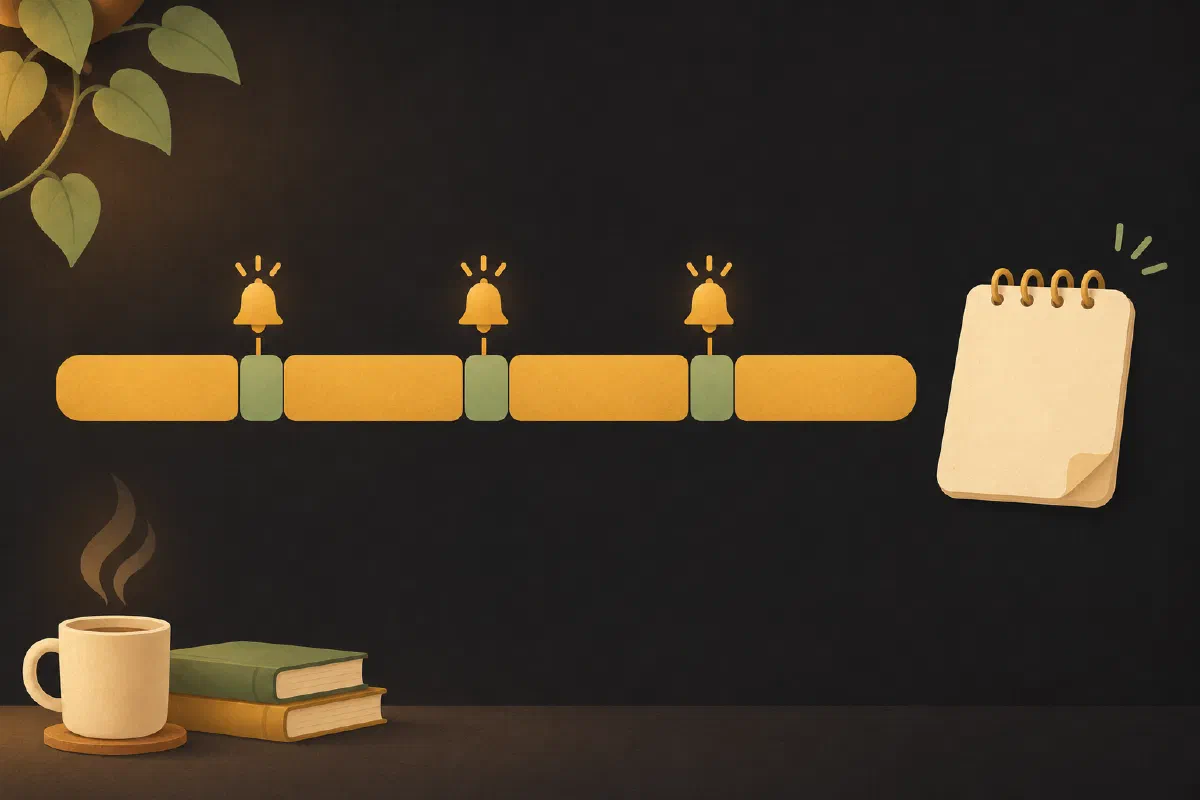
Once the list exists, the next obstacle is starting. A ten-minute session makes starting cheaper because the commitment is small and the end is visible. For more on picking very short timers, see using a short timer to start tasks.
A step-by-step plan for one session:
- Pick the minimum version of one task. Not the whole task, only the cut-down step.
- Make an if-then plan. “When I finish my tea, then I open the report file and set a ten-minute timer.” Plans in this form are called implementation intentions, and a meta-analysis of 94 independent tests by Gollwitzer and Sheeran found they had a medium-to-large positive effect on reaching goals. That research covered goals in general, not low-energy days specifically.
- Set the timer and give yourself permission to stop. When it ends, you really may stop. That permission is what makes starting possible.
- When the timer ends, choose: stop, take a short break, or do one more ten minutes.
- Take a real short break. Stand up, drink water, look out of a window. A meta-analysis of breaks lasting 10 minutes or less found a small increase in vigour and a small reduction in fatigue. The same review found no clear performance boost on demanding cognitive tasks, so breaks are a way to feel a little better, not a trick to get more output.
- Stop after a set number of sessions. Decide in advance, for example two or three. Stopping before you are completely spent leaves something for tomorrow.
You can run these sessions with any timer, including our free focus timer.
A worked example: Thursday at 3 pm
Marta is a project coordinator. She slept badly two nights in a row, and by Thursday afternoon she is staring at a list of nine tasks without starting any of them.
The check. Everything feels heavy, but when she thinks about the budget update she feels a specific jolt of dread. Her answer: partly tired, partly avoiding the budget.
The minimum-viable list:
| Slot | Full task | Minimum version |
|---|---|---|
| Must-do | Budget update for Friday’s meeting | Paste in this month’s numbers and flag the two that look wrong |
| Should-do | Draft the supplier comparison | List the three suppliers and one line on each |
| Maintenance | Inbox | Reply to the facilities email someone is waiting on |
| Moved | Six other tasks | Copied to Monday’s list |
The sessions. She sets a ten-minute timer for the budget. After ten minutes the numbers are in and one error is flagged. She takes a five-minute walk to the kitchen, then does one more ten-minute session and finishes the flags. She sends the facilities reply in two minutes and decides the supplier comparison can wait.
Result: about 25 minutes of focused work, the one task that mattered done, and no evening spent feeling guilty about a list she never had the energy for.
Small things that may lift energy a little
These do not replace sleep or rest, and the effects are modest:
- Move. A 2022 review in Frontiers in Psychology summarises earlier research showing that a single bout of exercise of about 20 to 40 minutes consistently increases feelings of energy. Evidence for very short movement breaks is thinner, but a walk at lunch or between sessions is a reasonable thing to try.
- Use the evening to detach. Given the recovery research above, a real break from work in the evening may do more for tomorrow’s energy than squeezing in one more task.
- Protect sleep. The NHS suggests keeping to the same sleep times and avoiding caffeine in the couple of hours before bed. If the problem today is mostly a short night, see how to focus when you are tired, and if mornings are the hardest part, how to get motivated in the morning.
Track what you actually did
On low-energy days it is easy to remember only what you did not do. A short record counters that. A meta-analysis of 138 experiments found that monitoring progress toward a goal helped people reach it, and the effect was larger when progress was physically recorded or shared. The studies covered many kinds of goals, so treat this as a sensible principle rather than a promise.
Keep it to one line per session: “Budget numbers, 10 min, done.” Over a few weeks, the record also shows you how much a realistic low-energy day holds, which makes the next minimum-viable list easier to write.
When to talk to a doctor
Ordinary tiredness after a hard week is common. Ongoing exhaustion is worth checking. The NHS advises seeing a GP if:
- you have been feeling tired for a few weeks and you are not sure why,
- your tiredness affects your daily life, or
- you feel tired and also have other symptoms, such as weight loss or mood changes, or you have been told you make gasping, snorting or choking noises when asleep.
According to the same NHS page, a GP may arrange blood tests to check for problems such as anaemia, diabetes or an overactive thyroid, and the causes of tiredness range from stress and poor sleep to hormonal changes and illness.
Low energy can also be part of depression. The NHS lists lack of energy and having no motivation or interest in things among its symptoms and advises seeing a GP if you have symptoms of depression for most of the day, every day, for more than two weeks. The NHS also notes that depression can occur alongside ADHD. Treating depression is beyond the scope of this guide; for motivation strategies alongside low mood, see how to get motivated when depressed, and if therapy itself feels hard to start, how to get motivated for therapy.
This article is educational and does not replace advice from a doctor. If you have thoughts of harming yourself or feel unsafe, contact your local emergency number or a crisis line now. In the European Union, 112 is the free emergency number in every member state.
Summary
- On low-energy days, waiting to feel motivated rarely works; start small first.
- Check whether you need rest or are avoiding one task, and rest on purpose when you need it.
- Write a minimum-viable list: one must-do, one small should-do, one maintenance task, each cut to its smallest version.
- Work in ten-minute sessions with real breaks and a planned stopping point.
- See a GP if tiredness lasts weeks, affects daily life or comes with other symptoms.
Your next step: write the minimum version of one task on a piece of paper, then start a ten-minute session for it. If you want to keep a record of low-energy days, Cyklio, our focus timer app, offers sessions from 10 minutes and lets you rate each one as full focus, distractions or not today. It has a 7-day free trial with no account or card needed.