

Some people with ADHD can’t start a spreadsheet without a playlist; others lose the thread the moment a song with words begins. Both can be right. This guide explains what research actually says about music and attention, which kinds of music fit which kinds of work, and how to run a short test to find what works for you.
Does music help you focus if you have ADHD?
Sometimes, for some people, on some tasks. That is not a dodge; it is what the evidence shows.
- For adults in general, music has no single effect. A meta-analysis of background music studies in adults found an overall effect of zero. The authors argue that this hides specific effects pulling in opposite directions: compared with silence, background music tended to disrupt reading and had small negative effects on memory, while it improved emotional reactions and sports performance.
- For people with ADHD, responses vary widely. In a classroom study of boys with ADHD, some did worse with music than without it, while others did better. Video, by contrast, was clearly distracting, especially for the boys with ADHD.
- The research base is small. Much of the ADHD-specific work involves children or students in short laboratory or classroom tasks, as in the studies above and the 2024 meta-analysis on noise, which included children and college-age young adults. We found few studies of adults with ADHD doing real work.
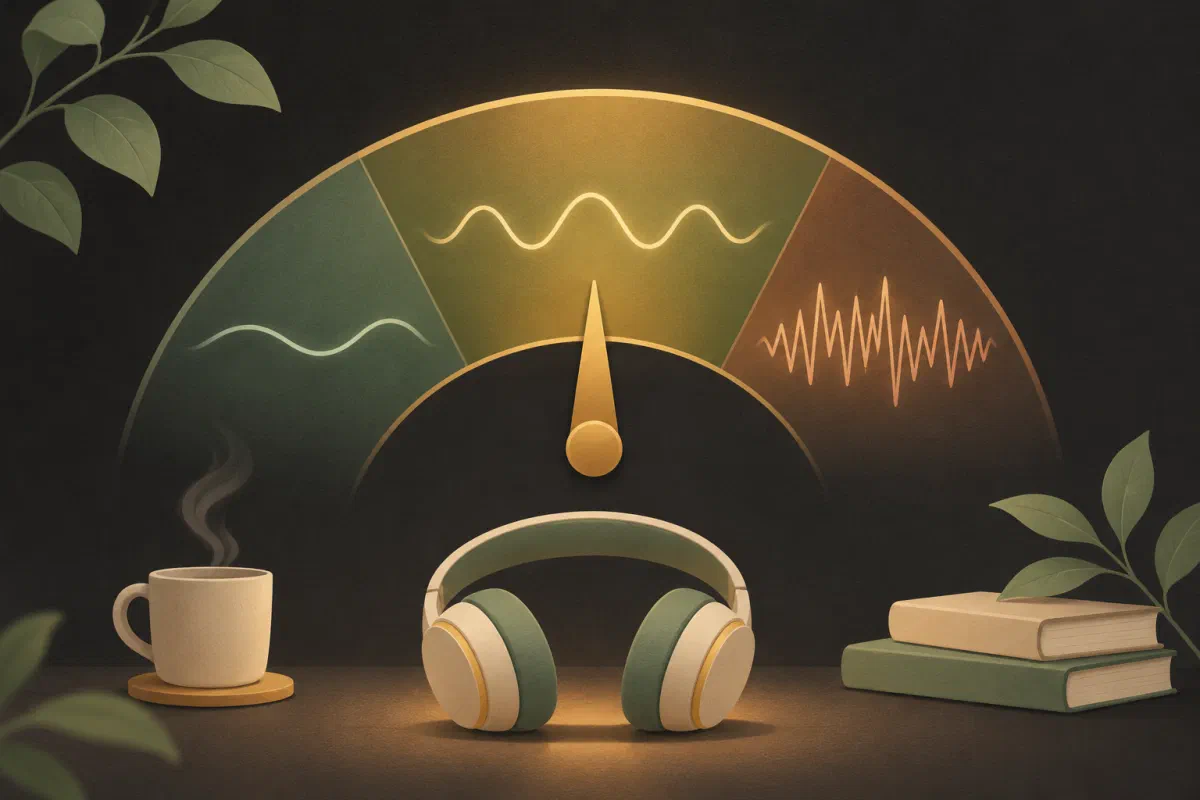
So a “best music for ADHD” list that applies to everyone does not exist. What research does offer is a set of patterns: which features of music tend to get in the way, and which situations make music more likely to help. You can use those to narrow your options, then test.
What research says about music and attention
Lyrics compete with words in your head
The most consistent finding concerns words. A Bayesian meta-analysis of 65 studies on auditory distraction during reading found that noise, speech and music all caused a small but reliable drop in reading performance, and that intelligible speech and music with lyrics caused the biggest distraction. The level of disruption to comprehension did not generally differ between adults and children.
The same pattern appeared in an attention test. In a randomised controlled trial with 102 people aged 20 to 24 that compared background music with and without lyrics, music with lyrics had significant negative effects on concentration and attention, and the authors concluded that music without lyrics is preferable if music is played at work.
In practice: if your task involves reading, writing, editing or anything verbal, lyrics are the first thing to drop.
Fast and loud is harder than calm and quiet
Speed and volume matter too. In one experiment, researchers varied the tempo and loudness of instrumental music while people read a passage. Comprehension fell significantly below the silent baseline only when the music was both fast and loud. Slow music, or fast music at a lower volume, did not cause a significant drop. The authors concluded that instrumental music is most likely to disrupt reading when it is fast and loud at the same time.
The task and the person change the result
Music does not affect every task the same way. In a laboratory study, music generally impaired performance on complex tasks, while complex music helped performance on simple tasks. How much a person liked external stimulation changed these effects. The authors’ summary: the effect depends on the music, the task and the person.
Another study looked at mind-wandering during a long, dull attention task. Forty students who normally listen to background music during attention-demanding tasks did the task once in silence and once with their own preferred music. Music increased the share of moments they reported being focused on the task, by reducing mind-wandering, though it did not make their reactions significantly faster. The task was easy, the participants were already music listeners, and ADHD was not measured, so this is a hint rather than proof. It fits the idea that music may help most when the work itself is under-stimulating.
Why music can feel like it helps
Part of music’s effect is on mood and alertness. When researchers re-examined the so-called “Mozart effect” (better spatial test scores after listening to Mozart), they found it disappeared once differences in arousal and mood were taken into account: a lively piece helped, a slow sad piece did not. In other words, music that lifts your arousal and mood may help you perform; there is nothing special about a particular composer.
Music you enjoy also engages the brain’s reward system. A brain imaging study found that dopamine is released in the striatum at moments of peak emotional pleasure in music, and also while people anticipate those moments. This was a study of musical pleasure in general, not of ADHD or focus, so it does not show that music “fixes” anything in ADHD. It does help explain why the right playlist can make starting a dull task feel less heavy.
Mood matters at work too. In a five-week field study of 56 software developers, positive mood and quality of work were lowest when music was removed, although time on task was longest without music, and participants described the music as improving their mood. It was a small study without an ADHD focus, but it reflects real working conditions rather than a laboratory.
What ADHD-specific studies show
A handful of studies look at people with ADHD directly. Their results point in the same direction: music is not automatically a distraction for ADHD, but the effect differs from person to person.
| Study | Who took part | What it found | Limits |
|---|---|---|---|
| Pelham and others, 2011 | Boys with and without ADHD in a classroom setting | Video was clearly distracting; music helped some boys and hurt others | Children; classroom tasks |
| Madjar and others, 2020 | 25 preadolescents with ADHD and 25 without | Reading comprehension improved with music in the ADHD group and declined in the group without ADHD | Small sample; children |
| Martin-Moratinos and others, 2023 | Systematic review of 17 studies | Passive listening was linked to better attention and academic skills in several studies; effects varied with genre, tempo and task difficulty | Mixed study types, including music therapy |
Two details stand out. First, the Madjar study included calm music with and without lyrics as well as rhythmic music with lyrics, yet music overall helped the children with ADHD read. That sits uneasily with the general finding that lyrics hurt reading, which is a reminder that group averages may not describe you. Second, the systematic review explicitly notes that effects depended on genre, tempo and task difficulty, not on music as such.
The “need for stimulation” idea
One explanation researchers have tested is that people with ADHD may need more background stimulation to perform at their best. A 2007 study built on this idea, called the moderate brain arousal model, found that white noise improved memory performance in children with ADHD but worsened it in children without ADHD. A 2024 meta-analysis of 13 studies found a small benefit of white and pink noise on laboratory attention tasks for young people with ADHD or high ADHD symptoms, and a small negative effect for those without ADHD.
These are studies of noise, not music, and the benefit was small. They are worth knowing because they suggest that a steady, low-information sound can sometimes work where music does not. If you want to compare brown, white and pink noise with music and silence, see our guide to the best noise for ADHD focus.
Best music for ADHD focus, by task
Researchers have not compared genres head to head for ADHD, so no study can tell you that lo-fi beats classical. What you can do is choose music with the features research links to less distraction (no lyrics for verbal work, not fast and loud at once) and match the stimulation level to the task.
| Your task | Try first | Approach with care | Why |
|---|---|---|---|
| Reading, writing, editing, studying | Calm instrumental music at low volume, or silence | Songs with lyrics, podcasts, fast and loud tracks | Lyrics and speech are the strongest reading distractors; fast plus loud disrupts comprehension |
| Complex problem-solving, planning, coding something new | Quiet instrumental music you know well, or silence | Complex or attention-grabbing music | Music generally impaired complex tasks in the lab |
| Repetitive or low-demand work (data entry, filing, inbox sorting, cleaning up files) | Livelier music you like; familiar songs, even with lyrics, if words are not involved in the task | Anything that makes you stop and pick tracks | Complex music helped simple tasks; preferred music reduced mind-wandering on a dull task |
| Getting started on a task you are avoiding | One upbeat track you enjoy as a start ritual, then switch to your task music | Long searches for the “perfect” playlist | Lively music can lift arousal and mood |
What about specific genres?
Use the table’s logic to judge any genre:
- Classical, ambient and piano: often instrumental and calm, which makes them a reasonable first test for reading or writing. Busy, dramatic pieces with sudden changes in volume may be harder to tune out.
- Lo-fi and chill electronic: usually instrumental, steady and quiet, so they suit the “calm, no lyrics” profile. Some mixes add speech samples; skip those for word-heavy work.
- Video game and film soundtracks: many are instrumental. Pick tracks without sudden swells if you need to read.
- Techno and fast electronic music: steady and energetic, which some people find helps with repetitive work. For reading, keep the volume low, because fast and loud together is the combination linked to poorer comprehension.
- Songs you know by heart: familiar lyrics may pull less attention than new ones, but this is a common experience rather than a tested finding. Save them for tasks that do not involve words.
“ADHD focus frequency” and other popular searches
You may see tracks sold as an “ADHD focus frequency”, or playlists built on binaural beats. These are a separate question from ordinary music, with their own small body of research. We cover them in binaural beats and music for ADHD focus. Here, the safest approach is to treat any such track like any other sound: test it against silence and keep it only if it helps.
How to set up music for a focus session
Most of the trouble with focus music is not the music itself but the decisions around it. Here is a simple setup for one session:
- Name the task first. Decide what you will work on, then pick the sound to match, using the table above.
- Choose the music before you start. Make two or three playlists in advance: one calm instrumental, one livelier, one “start ritual” track. Picking songs mid-session is its own distraction.
- Prefer long, predictable playlists. Fewer gaps and surprises mean fewer reasons to reach for your phone.
- Set a moderate volume. The WHO advises keeping personal devices at no more than 60% of maximum volume and notes that 80 dB is safe for up to 40 hours a week, with much shorter limits at louder levels (four hours a week at 90 dB). A lower volume also avoids the fast-and-loud combination that disrupts reading.
- Consider noise-cancelling headphones in noisy places. The WHO recommends well-fitted, noise-cancelling headphones to reduce the need to raise the volume in noisy situations. If open-plan noise is the main problem, our guide on how to concentrate in a noisy office has more options.
- Pair the music with a timed session. Start a focus session of a length you can actually begin, for example 15 to 25 minutes, with the free Cyklio Focus Timer. When the session ends, the music can stop too, which gives you a natural break.
- Have a switch rule. If you notice you are listening instead of working, switch to a calmer playlist or to silence for the rest of the session, without judging yourself.
A two-week test to find your own focus music
Because people with ADHD respond so differently to music, the most useful evidence is your own. Run a simple comparison over two weeks:
- Pick one type of task you do often, such as writing reports or processing email.
- Choose three conditions: silence, calm instrumental music, and your livelier playlist.
- Rotate the conditions across sessions so each one gets at least three or four tries at similar times of day.
- After each session, rate it in a few seconds and note anything unusual (poor sleep, lots of interruptions).
- At the end, compare. Keep the condition that most often gave you a focused session, and drop the rest.
You can copy this log into a notebook or a spreadsheet:
| Date | Task | Sound | Session length | Rating (focused / distracted / not today) | Notes |
|---|---|---|---|---|---|
| Mon | Weekly report | Silence | 25 min | ||
| Tue | Weekly report | Calm instrumental | 25 min | ||
| Wed | Weekly report | Livelier playlist | 25 min | ||
| … |
Two tips make the test fairer. Compare the same kind of task each time, because the effect of music depends on the task. And rate the session, not the music: the question is whether you got the work done, not whether you enjoyed the songs.
Worked example: music across one working day
Here is an illustrative example of how someone might apply this, not a real case.
Marta is a project coordinator with ADHD. After her two-week test, her day looks like this:
- 9:00, inbox and status updates. Her livelier playlist, songs she knows well, because the task is repetitive and silence makes her drift to other tabs.
- 10:00, writing a project proposal. Calm piano at low volume through noise-cancelling headphones. In her test, lyrical music during writing sessions usually ended with a “distracted” rating.
- 11:30, avoided task: updating the budget sheet. One upbeat song as a start ritual, then a 15-minute timed session with lo-fi in the background. Often she continues after the timer ends.
- 14:00, reviewing a contract. Silence. Dense legal reading was the one task where every kind of music made her reread paragraphs.
- 16:00, sorting files and tidying her task list. Back to the livelier playlist as energy dips.
Notice that Marta does not have one “focus playlist”. She has a small set of sound settings and a rule for which one goes with which task.
When silence or noise may work better
Music is one option, not a requirement. Consider silence or steady noise when:
- The task is dense and verbal. Reading contracts or studying for an exam are the situations where background noise, speech and music reliably cost some reading performance.
- You keep changing tracks. If music becomes something to manage, it has turned into a distraction.
- Sound feels overwhelming. Some people with ADHD find many sounds tiring or irritating. Our guide to ADHD and sound sensitivity covers coping strategies for work.
- You need steady masking rather than stimulation. Steady noise carries no melody or words, and the studies above suggest it may help some people with ADHD. Compare it with music using the same two-week test.
If concentration problems are new, severe, or affecting your work or relationships despite changes like these, talk to a doctor or another qualified professional. Music can make focus easier to reach; it does not replace assessment or treatment. For a wider set of strategies, see how to focus when you have ADHD.
Common mistakes with focus music
- Using one playlist for every task. Writing and data entry make very different demands on attention.
- Choosing music with lyrics for word-heavy work because it feels energising. Energy is useful; competing words are not.
- Turning the volume up to drown out the office. Louder music is more distracting for reading and harder on your hearing. Use headphones that block sound instead.
- Judging by enjoyment. A playlist you love can still produce weaker sessions. Your session ratings are better evidence than your taste.
- Expecting music to do all the work. Music can help you start and stay on task, but a clear task and a defined session length do much of the heavy lifting.
Summary
There is no universal best music for ADHD focus. Research suggests a few reliable patterns: lyrics and speech get in the way of reading and writing, fast and loud music is harder to work with than calm and quiet music, and music is more likely to help with simple, under-stimulating tasks than with complex ones. Studies of people with ADHD show that music helps some and hurts others, so your own results matter most.
Your next step: pick one recurring task and run three short sessions this week, one in silence, one with calm instrumental music and one with your livelier playlist. You can time them with the free Cyklio Focus Timer, or in Cyklio, our own focus timer app, where you can rate each session afterwards and see your weekly report.