

A night routine is not about a perfect evening. It is a short, repeatable sequence that closes today, sets up tomorrow and gives your mind a quieter runway into sleep. This guide gives you the three parts, a sample 30-minute routine and a checklist you can copy.
What a night routine is for
Most evening routines fail because they try to do too much: skincare, journaling, stretching, reading, meal prep, a tidy house. A useful night routine has two jobs:
- Close the day. Stop open tasks from following you to bed.
- Set up tomorrow. Remove the small decisions and searches that make mornings feel rushed.
Everything else is optional. The third ingredient, winding down, is where health guidance comes in. The CDC lists regular habits such as going to bed and getting up at the same time every day, turning off electronic devices at least 30 minutes before bedtime, and avoiding caffeine in the afternoon or evening. NHS Every Mind Matters recommends keeping a regular sleep schedule, including on days off, and a relaxing wind-down routine such as reading, breathing exercises or calm music.
So the order in this guide is simple: shut down, prep, wind down.
Part 1: Shutdown tasks that close the day
The shutdown is the “office closing” part of the evening, whether you work from home or just carry work in your head. Keep it to about 10 minutes.
- Capture every open loop. Write down anything still on your mind: replies you owe, half-finished tasks, things to buy, worries. One list, one place, no sorting yet.
- Pick tomorrow’s first task. Choose one task and make it concrete: “draft the first two slides” rather than “presentation”.
- Write a short to-do list for tomorrow. Three to five items is enough. Put the first task at the top.
- Close what is open. Shut the laptop, close browser tabs you will not need, put work papers in one spot.
- Say a closing phrase. Some people use a fixed phrase or action (“done for today”, switching off the desk lamp) as a signal that work has ended. This is a common habit strategy, not a researched technique, but it gives the routine a clear end point.
There is some research behind steps 1 to 3. In a sleep-lab study by Scullin and colleagues (2018), 57 healthy young adults spent five minutes before bed either writing a to-do list for the coming days or writing about tasks they had already completed. Those who wrote a to-do list fell asleep faster, and the more specific their list, the faster they fell asleep. It was one small study of a single night in healthy young adults, and the authors called for further trials, including people with sleep-onset insomnia, so treat it as a promising sign, not a guarantee.
A related idea comes from Masicampo and Baumeister (2011): in their experiments, unfinished goals produced intrusive thoughts during an unrelated reading task and hurt performance on other unrelated tasks, and letting people make specific plans for those goals eliminated those effects. You do not have to finish everything tonight. Writing down when and how you will deal with it seems to help the mind let go. The NHS also suggests that if you often lie in bed worrying, writing a list of what you need to do the next day can help clear your mind.
If you want a fuller system for turning that list into a day plan, see our guide on how to plan your day with ADHD.
Part 2: The prep list for tomorrow
Prep is about friction. Look at your last few mornings and ask: where did I lose time, search for something or make a decision I could have made the night before? Prep only those things.
| Prep item | Do it tonight if… | Leave it for the morning if… |
|---|---|---|
| Clothes | You often change outfits or hunt for clean items | You wear the same type of outfit every day |
| Bag, keys, badge, wallet | You have ever left without one of them | They live in one fixed spot already |
| Lunch or breakfast | Mornings are tight or you skip meals when rushed | Making it is part of a morning you enjoy |
| Calendar check | Tomorrow has an early meeting or an unusual start | Your days look the same every week |
| First task of the day | You lose the first hour deciding where to start | You already start with a fixed task |
| Phone and laptop charging | Low battery has derailed a morning before | Devices charge at your desk overnight anyway |
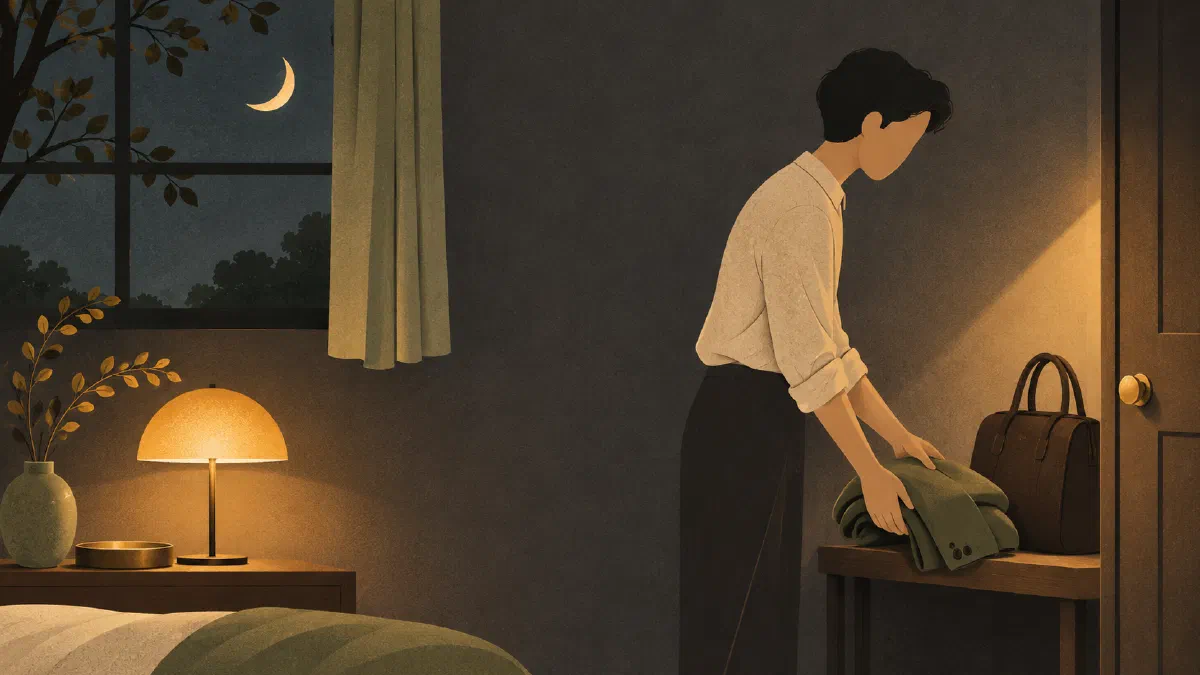
A practical trick is a launch spot: one place by the door where tomorrow’s bag, keys and anything you must take sit together. If it does not fit in the launch spot, write it on a sticky note and put it on the door handle.
Keep the prep list short. Five items is plenty. A longer list turns into another evening chore you will skip.

Part 3: Screen boundaries you can actually keep
Screens are the hardest part of most night routines, and the guidance differs a little between sources. The CDC suggests turning off electronic devices at least 30 minutes before bedtime. The NHS advises avoiding phones, tablets and computers for an hour before bed, because the blue light from screens can make it harder to fall asleep.
The research on device light is still limited. In a lab study by Chang and colleagues (2015), 12 healthy young adults read on a light-emitting eReader or a printed book for about four hours before bed on five evenings in a row for each condition. With the eReader, they took longer to fall asleep, felt less sleepy in the evening, released less melatonin and were less alert the next morning. It was a small, controlled study, so the size of the effect in normal life is uncertain, but it supports the common advice to give screens a cut-off time.
Ways to make the boundary realistic:
- Choose a “last check” time. One planned final look at messages, then the phone goes to charge.
- Charge the phone away from the bed. If you use it as an alarm, a cheap alarm clock removes the excuse to keep it close.
- Do screen tasks first. Put anything that needs a screen (calendar check, messages, tomorrow’s list in an app) at the start of the routine, not the end.
- Replace, do not just remove. Have a book, a podcast or a stretch ready so the gap is not empty.
- Start with 30 minutes. If that works for two weeks, try extending towards an hour.
If screens regularly stretch late into the night, our guide to reducing screen time covers the daytime habits behind that.
A sample 30-minute night routine
Here is an illustrative routine for a working adult who wants to be asleep around 11 pm. Shift the times to fit your own schedule; what matters is that the order and start time stay mostly the same.
| Time | Minutes | Step | What it looks like |
|---|---|---|---|
| 22:00 | 10 | Shutdown | Capture open loops, write tomorrow’s 3 to 5 tasks, pick the first one, close the laptop |
| 22:10 | 5 | Last screen check | Look at tomorrow’s calendar, reply to anything urgent, set the alarm, phone goes on the charger |
| 22:15 | 5 | Prep | Lay out clothes, put bag and keys in the launch spot, fill a water bottle |
| 22:20 | 5 | Reset the space | Clear the kitchen counter or desk enough that the morning starts clean |
| 22:25 | 5+ | Wind down | Wash up, dim the lights, read a few pages of a paper book or listen to something calm |
A few notes on this example:
- The shutdown and prep take 20 minutes. If you only have 10, keep the to-do list and the launch spot and drop the rest.
- The phone leaves your hands at 22:15, which gives roughly 45 minutes before 23:00. That meets the CDC’s 30-minute suggestion; to reach the NHS’s hour, move the last screen check to 22:00 or earlier.
- If you notice that the routine keeps starting later and later because you want “time for yourself”, that is a different problem. Our guide to revenge bedtime procrastination covers it.
You can time the shutdown itself with a 10-minute session in the free Cyklio Focus Timer, so it has a clear start and finish.
Fill-in night routine checklist
Copy this into a note or print it. Fill in the blanks once, then reuse it every night.
Start time: ____ (same on most nights)
Shutdown (about 10 minutes)
- Open loops written down
- Tomorrow’s first task: ______________________
- Tomorrow’s other tasks (2 to 4): ______________________
- Laptop closed, work things in one place
Prep (about 5 to 10 minutes)
- Clothes ready: yes / not needed
- Launch spot: bag, keys, wallet, badge, ______
- Food for tomorrow: ______
- Devices charging
Screens
- Last check done at ____
- Phone charging at ____ (away from the bed)
Wind down (5 minutes or more)
- Calm activity: ______________________
- Lights dimmed
After a week, cross out anything you never do and keep what made the next morning easier.
How a morning and night routine fit together
Your night routine is the first half of your morning routine. Every item you prep tonight is a step you skip tomorrow, and the first task you wrote down tonight is where your morning work begins. When the two are designed together, the morning can be short and calm instead of a rush of searching and deciding.
A good test: pick one thing that went wrong this morning and ask whether a two-minute step last night would have prevented it. If yes, add it to the prep list. For ideas on the other half, see our morning routine examples. If you are setting up evenings for school-age children or for your own classes, our morning routine for school guide covers that version.
When the routine is not the problem
A night routine helps with closing the day and winding down. It is not a treatment for sleep problems. The NHS advises seeing a GP if changing your sleeping habits has not helped, if you have had trouble sleeping for months, or if poor sleep makes daily life hard to cope with.
If you have ADHD and evenings feel especially hard to wrap up, our ADHD bedtime routine guide looks at that situation specifically.
Summary
- Build the routine in three parts: shut down, prep, wind down.
- Write tomorrow’s to-do list with a concrete first task; a small study linked specific lists with falling asleep faster.
- Prep only what slows your morning down and keep it in one launch spot.
- Set a screen cut-off you can keep, starting with 30 minutes.
- Keep the start time steady on most nights and trim the routine after a week.
Your next step: tonight, set a 10-minute timer, write tomorrow’s first task and put your keys and bag in one spot. Tomorrow, start that first task with a short focus session, for example in Cyklio, our focus timer app, which offers a 7-day free trial with no account and no card needed.