


The vegetables you forgot in the bottom drawer, the bill under a pile of post, the friend you meant to text back: if things you cannot see seem to stop existing for you, you have probably met the phrase “object permanence ADHD”. This guide explains what the term really means, what people mean when they use it online, and the visible-cue systems that help.
What does object permanence mean in psychology?
Object permanence is a term from developmental psychology. The American Psychological Association defines it as knowing that objects keep existing even when you cannot perceive them (APA Dictionary of Psychology).
The idea comes from Jean Piaget, who placed it in the sensorimotor stage of infant development. According to the APA Dictionary of Psychology, Piaget’s milestones run roughly like this:
- Around 8 months, a baby reaches for an object hidden under a cover.
- Around 12 months, a baby searches in a new hiding place, even after the object was hidden several times in a different spot.
- Around 18 months, a baby removes a series of covers to find an object it only saw being hidden under the outermost one.
The same entry notes that later research using tasks without reaching suggests babies understand some of this earlier than Piaget proposed (APA Dictionary of Psychology).
So in the strict sense, object permanence is a skill nearly every adult has. If your keys are in a drawer, you know they still exist. You simply did not think of them when you needed them.
What people mean by “object permanence ADHD”
When people use “object permanence” online in connection with ADHD, they usually mean “out of sight, out of mind”. The forgetting is about attention and reminders, not about believing hidden objects vanish. Typical examples:
- Food spoils because it went into an opaque container at the back of the fridge.
- A task disappears once its browser tab, email or paper is closed or filed away.
- Clean clothes put away in drawers stop being worn, while the ones on the chair get worn again.
- Friends you do not see for a while fall out of mind, even though you care about them.
It is important to be clear about the evidence. “Object permanence” does not appear in the adult ADHD symptom descriptions published by the NHS or in the CDC’s overview of ADHD symptoms. It is a popular description, not a diagnostic term, and it cannot tell you whether you have ADHD.
What the phrase describes does overlap with symptoms those bodies list. The NHS includes being easily distracted or forgetful, difficulty organising time, and frequently losing items such as a wallet, phone or keys among the inattentive symptoms of ADHD in adults (NHS). The CDC lists forgetting or losing things a lot among the signs of ADHD in children, and says that people with the predominantly inattentive presentation are easily distracted or forget details of daily routines (CDC).
If you want the theory behind why ADHD affects holding information in mind, that is a separate topic covered in working memory and ADHD. This article stays with the practical side.
Developmental meaning vs popular meaning
| Developmental psychology | Popular “object permanence ADHD” | |
|---|---|---|
| Who it is about | Infants in their first two years | Adults and teens, often with ADHD |
| What it means | Understanding that hidden objects still exist | Things out of sight are not thought about |
| Is it lost in adults? | No, nearly all adults have it | Nothing is lost; reminders are missing |
| Clinical status | Established research concept | Informal phrase, not a diagnostic term |
| What helps | Normal development | Visible cues and simple systems |
Why visible cues help
If the problem is that hidden things do not prompt you, the solution is to make the right things prompt you. Two lines of research support this approach, although neither was designed specifically to test “object permanence” in ADHD.
The first is cognitive offloading. Psychologists Risko and Gilbert describe it as using physical action to reduce the mental demands of a task, for example writing something down instead of holding it in your head (Risko and Gilbert, 2016). A visible item on a hook by the door does the remembering for you.
The second is self-control research. Duckworth, Gendler and Gross argue that self-control can be easier when people change or choose their situation ahead of time, and that strategies which act early may be especially effective because impulses tend to grow stronger over time (Duckworth, Gendler and Gross, 2016). Arranging your space so the important things are in view is a situational strategy of this kind.
Adults with ADHD also build such systems themselves. In a qualitative interview study of 32 adult outpatients with ADHD in Switzerland, organisational skills, such as checklists, reminder apps and rigid routines, were the most often reported group of coping strategies (Canela and colleagues, 2017). One participant said they kept losing paper notes and switched to an electronic device instead, which is a useful warning: a reminder only works if it stays where you will see it.
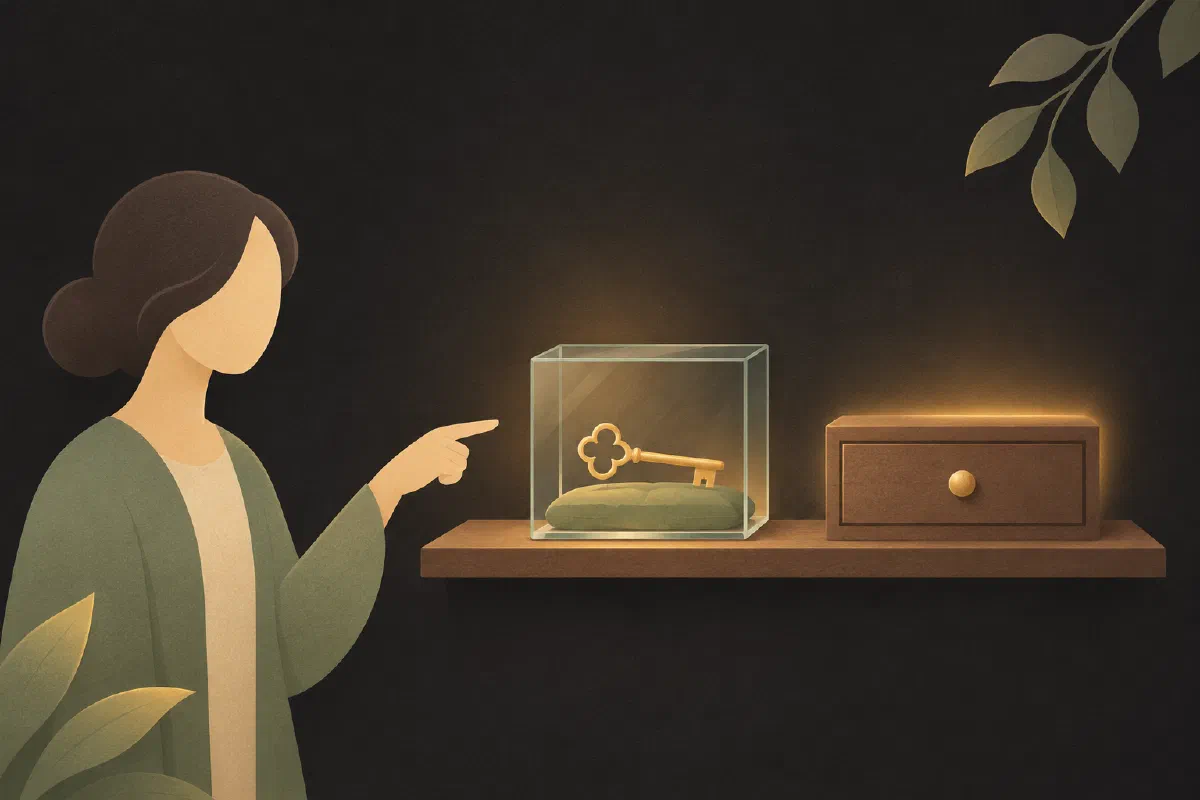
CHADD, a US nonprofit that runs the National Resource Center on ADHD, gives practical advice in the same direction: use clear containers so you can see what is inside, keep dated folders for upcoming paperwork “in plain sight”, and set up a table by the front door with a basket for keys, glasses and wallets (CHADD).
Systems that keep important things in sight
You do not need to put everything on display. Pick the areas where out-of-sight forgetting costs you most, and start there.
- A launch pad by the door. A small table, shelf or basket for keys, wallet, glasses, badge and anything that must leave with you tomorrow. Following CHADD’s suggestion, bags can sit there too.
- Clear containers and open storage. Use see-through boxes for items you often forget you own, and open shelves or labelled bins instead of closed cupboards where possible.
- An eat-first shelf. Put leftovers and food close to its date at eye level in a clear container. Put long-life items at the back.
- One visible task surface. A whiteboard, a single sheet on the desk or one pinned list with today’s three tasks. One surface is easier to check than notes spread across apps and paper. For deeper systems, see ADHD organisation strategies.
- A bills and post spot. One tray or folder in plain sight for anything that needs action, checked at the same time each week.
- Pinned digital cues. Pin the one document you are working on, keep one task widget on your phone’s home screen, and close tabs you are not using so the one that matters stands out.
- A people list. If friends drift out of mind, a short list of people you want to contact, placed where you see it weekly, turns good intentions into a visible cue.
Decision table: match the cue to the problem
| If this keeps happening… | Try this visible cue |
|---|---|
| You leave without keys, badge or charger | Launch pad by the door, checked before you open it |
| Food goes off unseen | Clear containers and an eat-first shelf at eye level |
| Tasks vanish when the email is filed | Copy the task to your one visible task surface first |
| Bills are found after the due date | One action tray in plain sight, weekly check |
| You forget you already own something | Clear, labelled bins in one place |
| Projects stall once the folder is closed | Leave the next step written on top of the open folder |
| You lose track of time in a task | A visible timer that shows time passing |
Time is the least visible thing of all. If you often lose track of it, read about time blindness and how visual timers for ADHD make time easier to see.
A worked example: one workday with visible cues
Here is a hypothetical example of how this can look for a working adult with an office job.
- 7:40. Keys, badge and laptop charger are in the basket by the door because they went there last night. Nothing to search for.
- 8:50. At the desk, the day’s three tasks are on a sticky note on the monitor stand. The report due Friday is the first one, so it does not wait behind emails.
- 10:15. An email asks for a budget figure. Instead of starring the email, the request goes straight onto the sticky note as “send budget figure to finance”.
- 12:30. The lunch from the eat-first shelf is in a clear box, so it actually gets eaten.
- 15:00. Before closing the report, the next step is typed at the top of the document: “Start with section 3 charts.”
- 18:30. At home, the action tray holds one bill. It gets paid before dinner, because it is in view on the counter.
None of these steps relies on remembering. Each one replaces memory with something seen at the right moment.
Your out-of-sight audit (fill-in checklist)
Use this once, then repeat it every few months as life changes.
- What did I forget or lose in the last two weeks? List up to five things.
- Where was each one when I forgot it? (drawer, closed tab, bag, fridge, inbox)
- Which one cost me the most time, money or stress? Start with that one.
- What visible cue would have reminded me at the right moment and place?
- Where exactly will that cue live? Write the place, not just the idea.
- When will I check it? (daily at the door, weekly on Sunday evening)
- What can I remove from view so this cue stands out?
Common pitfalls with visible systems
- Too many cues. If every surface holds reminders, they blend into the background. Keep only a few, and remove anything that no longer needs action. Our guide to decluttering with ADHD can help clear space first.
- Cues in the wrong place. A note about the gym bag belongs on the door, not in a notebook in the kitchen.
- Paper that wanders. As one participant in the Swiss interview study described, loose notes go missing (Canela and colleagues, 2017). Fix notes to one surface.
- Systems without a check. A tray nobody looks at is just another hidden place. Attach each spot to a time you already have, such as leaving home or starting work.
If forgetting goes well beyond lost objects and affects appointments and commitments, the broader strategies in ADHD and forgetfulness are a good next read.
When to talk to a professional
If out-of-sight forgetting causes real problems at work, with money or in relationships, speak with your GP or a mental health professional. Only a qualified clinician can assess for ADHD.
Structured help exists. In a randomised trial with 88 adults with ADHD, a 12-week group programme teaching time management, organisation and planning skills led to greater improvement in inattention symptoms than supportive therapy (Solanto and colleagues, 2010). In another randomised trial with 86 adults whose ADHD symptoms persisted despite medication, 12 sessions of cognitive behavioural therapy improved symptoms more than relaxation training with educational support, and people who responded to therapy kept their gains over 6 and 12 months (Safren and colleagues, 2010). These were clinician-led programmes, not self-help tips, but they show that organisation skills can be learned with support.
Summary and one next step
“Object permanence ADHD” is an informal way of saying that things out of sight fall out of mind. It is not the developmental skill Piaget described, and it is not a diagnosis, but the experience overlaps with listed ADHD symptoms such as forgetfulness and losing things. The most practical response is to stop relying on memory and let your surroundings remind you: a few visible, well-placed cues, each with a regular check.
Your next step: pick the one task you have been “keeping in mind” for days, write it on your visible task surface, and give it one 25-minute session today with the Cyklio Focus Timer. Cyklio is our own app; if a visible session timer helps, the app adds a daily goal and session reports.