

You know the task matters, you know it will not take that long, and still you keep circling it. When worry is attached to a task, putting it off can feel like the only way to breathe. This article explains how anxiety feeds avoidance, what the research shows and which small steps help you start anyway.
This article is educational and does not replace advice from a doctor.
Can anxiety cause procrastination?
It can, and researchers have a fairly clear explanation for why. Procrastination researchers Fuschia Sirois and Timothy Pychyl describe it as a problem of short-term mood repair: when a task feels aversive, avoiding it makes you feel better now, and the cost lands on your future self. In their summary, the argument is that aversive tasks lead to anxiety and worry, and avoiding the task is a way to escape that negative mood.
A 2023 review makes the same point from another angle. A task can bring up difficult emotions such as uncertainty, anxiety or stress, which make it feel aversive, and procrastination is a low-effort way to avoid those feelings. The review also proposes that high-stress periods can keep negative feelings, including stress and anxiety, elevated, which may raise the risk of procrastination.
There is also experimental evidence that bad moods push towards delay. Sirois and Pychyl describe a study in which people who were put into a negative mood spent more time procrastinating instead of preparing for the next task.
So the delay is usually not about laziness or not caring. Often it is the opposite: the task matters enough to make you anxious, and avoiding it is how your mind tries to make the anxiety go away.
What people mean by “anxiety paralysis”
“Anxiety paralysis” is a popular phrase, not a diagnosis. People use it to describe freezing in front of a task: you sit down, feel the worry rise and end up doing nothing, not even something fun. If that freezing is linked to ADHD or low mood, ADHD paralysis vs depression explains the differences. Here we stay with the worry-driven version.
The anxiety and avoidance cycle
Anxiety-driven procrastination tends to run in a loop:
- Worry. You think about the task and imagine it going badly: the email will sound wrong, the report will be judged, the call will be awkward.
- Avoidance. You put it off, or do something easier instead.
- Brief relief. The worry drops for a while. This is the mood repair the research describes.
- The worry returns, stronger. The task is still there, time is shorter, and now you also feel bad about delaying.
The last step is the one that keeps the cycle going. NHS mental health guidance warns that avoiding situations or relying on habits we think will keep us safe might actually make our anxiety worse. Research on procrastination points the same way: recalling past procrastination is linked to more anxiety, and trying to follow through on tasks you delayed can add to worry. Noticing you have not followed through is also linked to self-blame, which in turn predicts stress and anxiety.
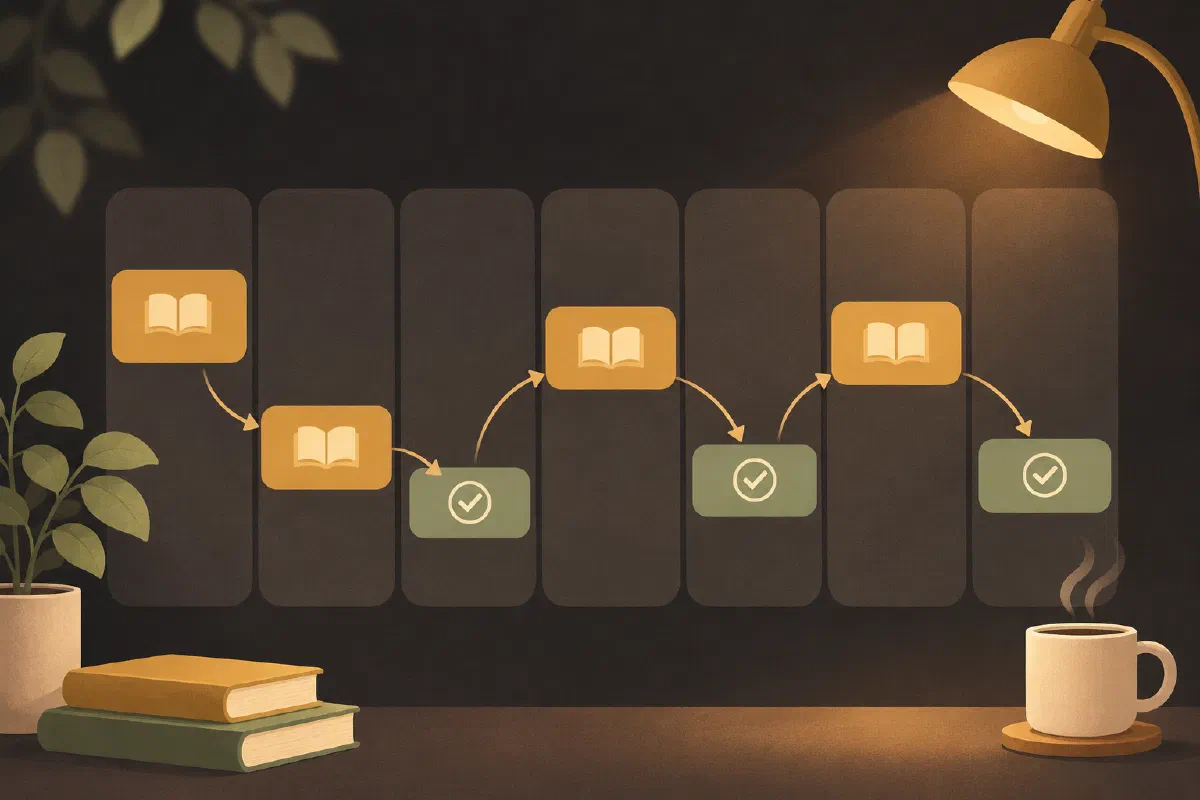
The cycle is a description, not a verdict on you. Its useful feature is that you can step out of it at any point, and the easiest point is usually the moment right after the worry rises. If stress, not worry, is what drives your delays, see how procrastination causes stress. If the worry is mostly about failing or being judged, procrastination out of fear goes deeper into that.
What research shows about procrastination and anxiety
Several kinds of studies point in the same direction, with important limits.
| Study | Who | What it found | Limit |
|---|---|---|---|
| Beutel et al., 2016 | 2,527 people in Germany, aged 14 to 95 | Procrastination was consistently associated with higher stress, depression, anxiety and fatigue | Cross-sectional, so cause cannot be determined |
| Rozental et al., 2022 | 732 Swedish university students | Severe procrastinators had higher anxiety scores than less severe ones, a moderate to large difference | Cross-sectional, self-selected sample, collected during the pandemic |
| Johansson et al., 2023 | 3,525 Swedish university students, outcomes measured 9 months later | Higher procrastination was associated with slightly higher anxiety symptoms later | Observational; the authors call the associations weak |
What this means in plain terms:
- The link is consistent. Across community adults and students, people who procrastinate more tend to report more anxiety.
- The effects are modest. In the Swedish follow-up study, the association with later anxiety was small (β = 0.08) and the authors note that causal conclusions rest on assumptions unlikely to be fully met.
- It probably runs both ways. Rozental and colleagues note that lower mood and increased unrest can cause procrastination, and that procrastination is assumed to create a downward spiral of negative thoughts and feelings. That matches the cycle above.
None of these studies can tell you whether you have an anxiety disorder. They describe groups, not individuals.
A worked example: one email, one afternoon
This is an illustrative example, not a real case.
Daniel is a project coordinator. He needs to email a client to say a delivery will be a week late. The email itself would take 15 minutes.
Without a plan: At 13:00 he opens a blank message, imagines the client’s annoyed reply and feels his chest tighten. He closes it and tidies his inbox instead, and feels lighter. At 15:00 he remembers it, feels worse than at 13:00 and adds “I should have done this hours ago.” At 17:30 he decides it is too late to send today. The worry follows him home.
With small steps: At 13:00 the same tightness arrives. This time Daniel:
- Writes one line on paper: “I’m worried the client will be angry. The task is: tell them the new date.”
- Shrinks the task to “write the subject line and the first sentence only” and sets a 10-minute timer.
- Notices a new worry (“what if they escalate?”) and writes it on a list for his worry time at 16:30.
- When the timer ends, he has a rough draft. He reads it once, fixes one sentence and sends it.
He still felt anxious. The difference is that the anxiety came with a first step small enough to take while feeling it.
Decision table: what the worry says and what to do next
| The worry says | What avoidance gives you | A smaller next step |
|---|---|---|
| “It has to be perfect” | Relief from being judged, for now | Write a deliberately rough first version for 10 minutes |
| “They will be upset” | Relief from imagining their reaction | Write only the key fact in one sentence, then add the rest |
| “I don’t know where to start” | Relief from uncertainty | List three possible first actions and pick the easiest |
| “I’ve left it too long now” | Relief from guilt | Use the reset sentence below, then take one 10-minute step |
| “What if something else goes wrong?” | Relief from a spiral of what-ifs | Park the thought on your worry-time list and return to the task |
Small steps to start when you feel anxious
These are self-help steps for everyday worry, not treatment for an anxiety disorder. Pick one that fits the moment.
Name the worry and the task separately
Write two lines: what you are worried will happen, and what the task actually is. Worry tends to blur the two, so the task feels as big as the fear. Separating them is a common strategy, and it often shows that the first action is much smaller than it seemed.
Shrink the first step and build up gradually
For anxiety in general, NHS advice is to avoid avoidance and instead slowly build up time spent in worrying situations to gradually reduce anxiety. Applied to a task, that can mean starting with five or ten minutes on the smallest piece, then a little longer next time. You can use our free focus timer to set a short, fixed start.
Give worry a fixed time slot
NHS Every Mind Matters suggests that if anxiety is taking over your day, you can set a daily “worry time” to go through your concerns, at the same time each day, so you can focus on other things in between. When a worry interrupts a task, write it down for later instead of solving it now.
Turn “later” into an if-then plan
An implementation intention links a situation to an action: “If it is 9:00 and my coffee is poured, then I open the report and write the first heading.” A meta-analysis of 94 tests found these if-then plans had a medium-to-large effect on reaching goals (d = 0.65). A fixed start point gives the worry less room to negotiate.
Reset kindly after a slip
Self-criticism is part of the cycle, not a way out of it. Sirois and Pychyl report that self-blame predicts stress and anxiety, and that a meta-analysis of four studies found procrastination was associated with low self-compassion. A simple reset sentence: “I delayed this because it made me anxious. That makes sense. The next step can still be small.”
Look after the basics
Anxiety is easier to carry when the basics are in place. The NHS suggests calming breathing exercises, good sleep, regular exercise, balanced meals and cutting back on caffeine, and advises against using alcohol, cigarettes, gambling or drugs to ease anxiety. WHO lists similar self-care, including slow breathing, progressive muscle relaxation and short daily mindfulness practice.
A note for adults with ADHD
Many adults with ADHD recognise this pattern. In an online survey of 490 adults in Japan, people with higher scores on an ADHD screening questionnaire reported more procrastination and more anxiety symptoms. The study was cross-sectional and used a screener, not a diagnosis, and ADHD symptoms did not make the link between procrastination and anxiety stronger. How ADHD and anxiety interact is covered in ADHD and anxiety, and if worry leaves you foggy and unable to think, see brain fog and anxiety.
When to seek professional help
Some anxiety is a normal part of life. NIMH explains that an anxiety disorder involves more than occasional worry: the anxiety does not go away, is felt in many situations and can get worse over time, and it can interfere with job performance, schoolwork and relationships. The NHS describes the main symptom of generalised anxiety disorder as stress or worry that affects your daily life and is difficult to control.
Consider talking to a doctor or another health professional if:
- worry about tasks is hard to control and shows up most days
- you avoid more and more tasks, places or people because of anxiety
- anxiety affects your sleep, your work or your relationships
- self-help steps like the ones above are not helping
The NHS recommends seeing a GP if you’re struggling to cope or the things you’re trying yourself are not helping, and NHS patients aged 18 or over (16 in some areas) can also refer themselves directly to an NHS talking therapies service. WHO notes that effective treatments for anxiety disorders exist, although only about 1 in 4 people who need treatment receive any. Treatment is outside this article; for an overview of professional support for procrastination, see procrastination therapy.
If you feel unable to cope or to keep yourself safe, get help now. Contact your local emergency number or a crisis line in your country. For example, in the UK you can call Samaritans on 116 123 at any time, and in the US you can call or text 988, the Suicide and Crisis Lifeline.
Summary
- Anxiety and worry make a task feel aversive, and putting it off brings quick relief. Researchers call this short-term mood repair.
- The relief does not last: the task stays, avoidance may make anxiety worse, and remembering the delay adds more worry.
- Studies consistently link procrastination and anxiety, with modest effects that probably run in both directions.
- Small steps loosen the cycle: separate the worry from the task, shrink the first step, park worries for a set time, plan with if-then and reset kindly.
- If worry is hard to control or affects daily life, talk to a doctor.
Your next step: pick the task you have been circling, write the worry and the task on two separate lines, and give the smallest piece 10 minutes. If a timer helps, Cyklio, our focus timer app from Mindly 360, lets you start a 10-minute session, rate how it went and see your focus time in daily and weekly reports, with a 7-day free trial and no account needed.