

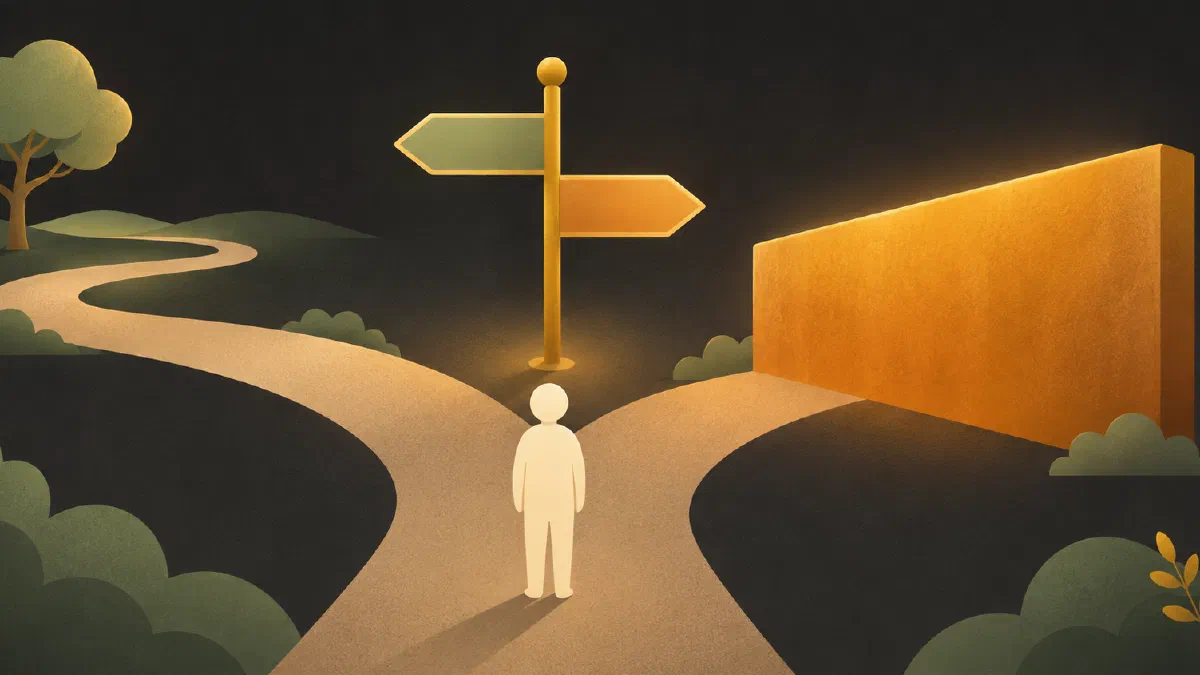
You open the report, read the first line, and somehow end up tidying your inbox instead. This article explains what research says is going on in that moment, in the mind and in the brain, how much of it is solid, and what actually helps.
This article is educational and does not replace advice from a doctor.
The short version: procrastination is mostly about feelings
The best-supported explanation in psychology is that procrastination is less a time-management problem than an emotional one. In a review, psychologists Fuschia Sirois and Timothy Pychyl describe procrastination as putting short-term mood repair ahead of the task: an unpleasant task brings up a bad feeling, delaying it gives quick relief, and the cost lands on your future self.
An older set of experiments supports the idea that delay works as a mood fix. In one experiment, the tendency of upset participants to procrastinate in frivolous ways disappeared when they were led to believe their bad mood could not be changed. If putting the task off no longer promised to feel better, the pull to put it off went away. That was a laboratory experiment, but it fits the everyday experience of reaching for distractions when a task feels heavy.
The broadest summary of the field points the same way. A meta-analysis of 691 correlations found that strong and consistent predictors of procrastination were task aversiveness, task delay, low self-efficacy and impulsiveness, along with facets of conscientiousness such as self-control and distractibility. In plain terms: we delay tasks that feel unpleasant, whose rewards are far away, that we doubt we can do well, and when we are easily pulled toward something more immediate.
If you want to work directly with the feeling side, our guide to emotional procrastination goes deeper.
What brain-imaging studies have found
Neuroscience research on procrastination is young: relatively few studies have looked at its neural correlates. Here is what the main studies report, with their size and limits.
Prefrontal and parahippocampal regions
In a resting-state fMRI study of 132 Chinese university students, higher scores on a procrastination questionnaire went with more spontaneous activity in the ventromedial prefrontal cortex and parahippocampal cortex, and less in the anterior prefrontal cortex. The authors interpreted this as a mix of an overactive default mode network (a set of brain areas that, the authors note, normally quiets down during goal-directed behaviour) and weaker top-down control from the front of the brain. That is their interpretation of correlations measured in one scan, not a demonstrated mechanism.
A later review by the same research group concluded that individual differences in procrastination have been linked to the parahippocampal cortex and the prefrontal cortex. The authors suggest the parahippocampal cortex may matter through imagining the future and memory, and the prefrontal cortex through emotion regulation. The same review names task aversiveness, future rewards and how long they are delayed as key task features, and self-control and impulsivity as the two most predictive traits.
The amygdala and acting on decisions
A German study of 264 adults looked at action control, which the authors describe as differences in the ability to start self-control and emotional-control mechanisms, focusing on how readily people act on decisions. People with lower scores on this decision-related measure tended to have a larger amygdala volume, and stronger resting-state connectivity between the amygdala and the dorsal anterior cingulate cortex went with higher scores. Because the measure is about starting emotional control, it fits loosely with the emotion regulation view, but the study measured a related trait, not procrastination itself, and the authors present it as the first to show this link.
Your future self
Procrastination involves choosing present comfort over a future self’s interests. One small brain-imaging study of 18 Stanford undergraduates found that the difference in brain activity when people thought about their current self versus their future self predicted how much they discounted future money. This was a study of money choices, not procrastination, and the result weakened when one participant was removed. It is an interesting piece of the puzzle, nothing more.
How strong is this evidence?
Brain research gets a lot of attention, so it helps to be clear about what each type of evidence can and cannot tell you.
| Finding | Type of evidence | What it supports | What it does not show |
|---|---|---|---|
| Delay as short-term mood repair | Reviews, lab experiments, many questionnaire studies | Procrastination is often driven by wanting to escape a bad feeling | That every delay is emotional, or why some people are more affected |
| Task aversiveness, delay, low confidence and impulsiveness predict procrastination | Meta-analysis of 691 correlations | These are consistent risk factors across many studies | Which one causes delay in your specific case |
| Prefrontal and parahippocampal activity differences | One resting-state fMRI study (132 students) plus a review | Procrastination tendency has measurable brain correlates | That these brain differences cause procrastination, or that they apply to all adults |
| Amygdala volume and acting on decisions | One MRI study (264 adults) of a related trait | A possible link between emotional brain systems and acting on decisions | Anything about procrastination specifically; it is a single, first study |
| Future-self brain activity | One small fMRI study (18 undergraduates) of money choices | An idea worth testing for procrastination | Anything about procrastination directly |
A few caveats apply to almost all of the brain studies:
- They are correlational. A brain difference that goes with procrastination could be a cause, a result of years of habits, or a side effect of something else.
- Samples are small and narrow, often university students from one place.
- Procrastination is measured by questionnaire, a snapshot of how people describe themselves, not their actual behaviour at work.
- Brain regions do many jobs. A region linked to procrastination is also linked to dozens of other things, so it cannot be read as a “procrastination centre”.
Why “your brain is wired to procrastinate” goes too far
You will often see headlines claiming that procrastination is hard-wired or caused by one brain chemical. The research above does not support that. It shows tendencies with measurable brain correlates, and the strongest evidence is still psychological rather than neurological. The popular story that everything comes down to dopamine is a separate topic; see dopamine and motivation for what that research does and does not say.
Brain findings also do not diagnose anything. Whether procrastination has anything to do with ADHD is a separate question, covered in is procrastination a sign of ADHD?. And if your main problem is mental fog or forgetting things rather than avoiding tasks, our article on brain fog and memory is a better fit.
What helps, according to the research
If procrastination is mainly about a feeling and a hard start, the most useful strategies work on those two points. The evidence for each is real but modest.
- Make the start concrete with an if-then plan. Across 94 independent tests, forming implementation intentions (“If it is 2 pm, then I open the report and write one heading”) had a medium-to-large effect on reaching goals. These studies covered many kinds of goals, not only procrastination.
- Forgive yourself for the last delay. In a study of 134 first-year university students, those who forgave themselves for procrastinating before their first midterm exams procrastinated less before the next set, as summarised by the British Psychological Society’s Research Digest. Self-forgiveness was measured rather than assigned, so it shows a link rather than proof, but it fits the idea that harsh self-blame keeps the bad feeling, and the urge to escape it, going. Our guide to procrastination guilt has more on this.
- Shrink the task until it feels less aversive. Since task aversiveness is one of the strong and consistent predictors, a common strategy is to reduce the first step to something that barely triggers the bad feeling, such as opening the file and writing a rough title.
- Consider structured psychological help if procrastination is persistent. A systematic review of 12 studies (718 participants) found that psychological treatments reduced procrastination with a small overall effect; cognitive behavioural therapy did somewhat better in a subgroup, but the studies were small and the authors called the benefits modest.
For a full step-by-step routine, see how to stop procrastinating. Here the point is simply that the research favours working with your feelings and your first step, not fighting your brain.
Worked example: a Tuesday afternoon report
Here is a hypothetical example of the emotion regulation view in practice.
Marta, a project coordinator, has a quarterly report due Friday. At 2 pm she opens the document, feels a wave of dread because last quarter’s numbers were poor, and finds herself answering low-priority emails for 40 minutes. Afterwards she feels worse, and the report feels heavier.
Seen through the research:
- The trigger was a feeling (dread about the numbers), not a lack of time. That matches the mood repair account.
- The emails gave quick relief, which is exactly what makes delay tempting.
- The guilt afterwards made the task more aversive, setting up the next round of avoidance.
What she tries on Wednesday:
- She notices and names the feeling: “I’m dreading the numbers section.”
- She writes one if-then plan: “If it is 10 am, then I paste last quarter’s table into the report.”
- She sets a 15-minute focus session for that single step.
- She tells herself that Tuesday was a normal human reaction, not proof she is bad at her job.
Nothing here requires knowing what her amygdala is doing. The research is useful mainly because it treats avoidance as an understandable way of managing a feeling, not a character flaw.
When to get support
For most people, procrastination is stressful and frustrating but seldom causes major distress. But if putting things off comes with ongoing low mood, anxiety, exhaustion or trouble sleeping, or it is seriously affecting your work or relationships, talk to your doctor or another qualified health professional. If you are in crisis or thinking about harming yourself, contact your local emergency number or a crisis line in your country straight away.
Summary and next step
- Research most strongly supports an emotional explanation: procrastination is often a way to get quick relief from the bad feelings a task brings up.
- Brain-imaging studies link procrastination to prefrontal and parahippocampal regions, and a related trait to the amygdala, but they are small, correlational and early.
- The practical lessons are modest and consistent: make the first step concrete, forgive yourself for past delays, shrink aversive tasks, and seek structured help if it persists.
Your next step: pick one task you have been avoiding, write one if-then plan for its smallest first step, and start a 10-minute session with the focus timer. If you would like to track those sessions over a week, Cyklio, our own focus-timer app from Mindly 360, offers a 7-day free trial with no account or card needed.