

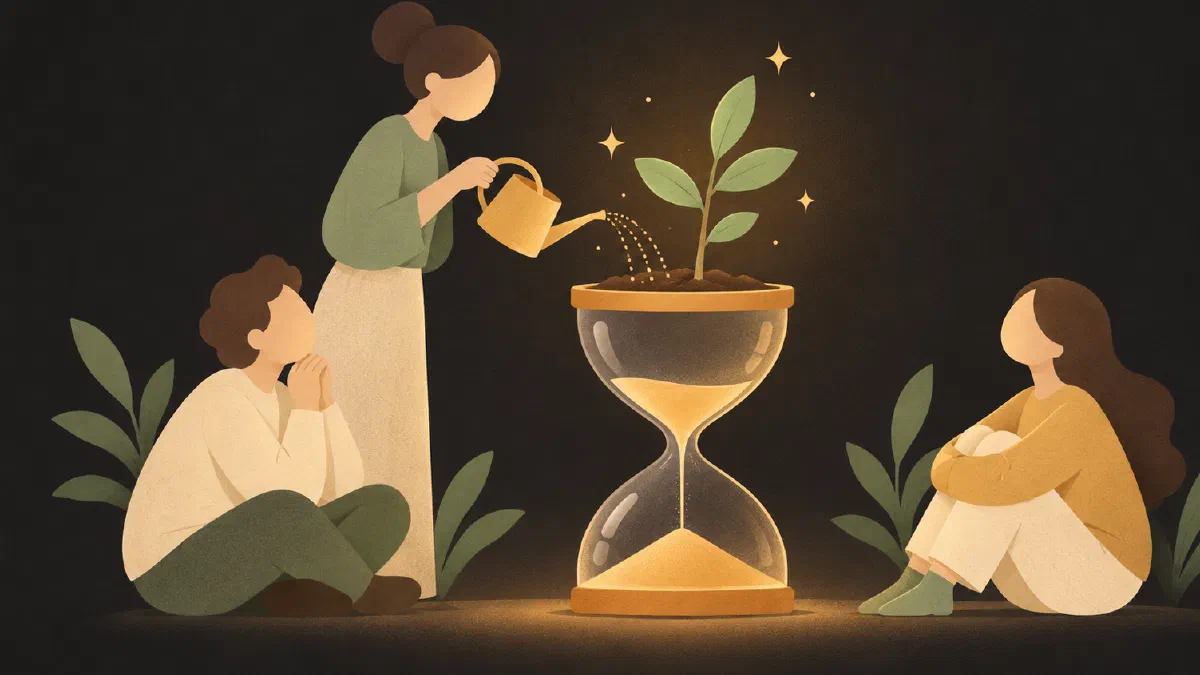
You put off a task, feel better for an afternoon, then worse for a week, and the next time a similar task lands you put it off again. That repeating pattern is what people call the procrastination cycle. This guide walks through its four stages, what usually sets it off and where you can step out of it.
What is the procrastination cycle?
“Procrastination cycle” or “procrastination loop” is an everyday description, not a diagnostic term. It names a pattern that research describes well: putting a task off feels better now and costs more later. A review by Rozental and Carlbring (2014) estimates that procrastination affects roughly one in five adults, so if you recognise yourself here, you are in large company.
Two findings explain why the pattern repeats:
- Relief now, cost later. Psychologists Fuschia Sirois and Timothy Pychyl describe procrastination as short-term mood repair: you avoid a task that feels unpleasant to feel better now, and a later version of you pays for it.
- The cost grows. In two longitudinal studies of students, procrastinators reported less stress and illness early in the term but more later on, and got lower grades. The authors called procrastination self-defeating: short-term benefits, long-term costs.
The cycle is about how avoidance keeps itself going. Why the brain prefers the quick relief is a separate question, covered in what happens in the brain when you procrastinate.
The four stages of the procrastination loop
The stages below are a practical model drawn from the research above, not a fixed scientific sequence. Your own loop may skip or blur a stage.
- Trigger and discomfort. A task arrives that feels boring, unclear, big or risky to get wrong. You feel a flicker of dread, doubt or restlessness when you think about it.
- Avoidance and relief. You switch to something easier: email, tidying, a quick scroll, a “more urgent” small job. The bad feeling eases. A 2023 review by Sirois notes that procrastination gives immediate relief from task-related stress and negative emotions, and that this relief is temporary.
- Pressure and guilt. The task is still there, now with less time. Stress and self-criticism build. The same review describes stress as both a cause and a consequence of procrastination, amplifying each other in a cyclic way.
- Rush, slip and self-doubt. You finish in a last-minute sprint, hand in something you are not proud of, or miss the deadline. Rozental and Carlbring describe how last-minute work can lead to poor results that lower self-efficacy even further, your belief that you can do the task, in a downward spiral. The next similar task now feels even more aversive, and stage 1 starts again with a stronger trigger.
| Stage | What it feels like | What keeps it going | Breaking point |
|---|---|---|---|
| Trigger and discomfort | “Ugh, not this one.” | The task is vague, big or unpleasant | Make the task clearer and smaller |
| Avoidance and relief | “I’ll just do this first.” | Relief rewards the switch | A short, fixed first session with an if-then plan |
| Pressure and guilt | “I should have started days ago.” | Stress makes the task feel worse | Early checkpoints and a rough first version |
| Rush, slip and self-doubt | “I always do this.” | Lower confidence for next time | Self-forgiveness and a quick review |

Common triggers that start the cycle
Some tasks are far more likely to start the loop than others. In a large meta-analysis, Piers Steel (2007) found that strong and consistent predictors of procrastination included task aversiveness, task delay (how far away the task’s rewards or costs are), low self-efficacy and impulsiveness. Newcastle University’s study guidance adds practical triggers that work just as well for adults at work:
- You are not sure what the task actually involves.
- The task is so large that it feels daunting.
- You want the first attempt to be perfect.
- You are waiting to feel motivated before starting.
If one of these keeps showing up, you already know where your loop begins. For a broader look at causes, see why we procrastinate.
How to break the procrastination cycle: one breaking point per stage
You do not have to fix every stage. Interrupting the loop at one point is often enough to change how the next round goes.
Breaking point 1: make the trigger smaller and clearer
Vague tasks are hard to start. Newcastle University suggests seeking clarity, starting with a tiny step and breaking work into specific chunks. Rewrite “Q4 report” as “open last quarter’s report and copy the headings into a new file”. If you do not know what is expected, the first step is a question to whoever set the task.
Breaking point 2: replace avoidance with a short, fixed start
The avoidance stage is where relief does its work, so give yourself a start that feels tolerable. Rozental and Carlbring list a minimal-effort approach: commit to a small amount of work, such as fifteen minutes, and only then decide whether to continue.
Pair it with an if-then plan: “If it is 9:30 after the stand-up, then I open the report file at my desk.” A meta-analysis of 94 tests by Gollwitzer and Sheeran (2006) found a medium-to-large effect of such plans on reaching goals, including help with getting started.
Breaking point 3: defuse the pressure stage early
Pressure peaks when everything is left for one final push. Two habits shrink it:
- Set checkpoints well before the deadline, for example “rough outline by Tuesday, full draft by Friday”. Each checkpoint is a small deadline that arrives while you still have room.
- Allow a rough first version. Newcastle University notes that trying to get things perfect first time piles on pressure and suggests keeping planning, drafting and editing separate.
Breaking point 4: forgive the slip, then review it
The last stage feeds the next round through guilt and lower confidence, so how you treat yourself afterwards matters. In their review, Sirois and Pychyl note that reducing negative feelings about past procrastinating can reduce procrastination, citing a study of self-forgiveness among students. The evidence is limited, but it suggests that being kind to yourself after a slip does not simply let you off the hook.
After forgiving, do a two-minute review: which stage did the loop take hold in, and which breaking point will you try next time? There is more on this in how to handle procrastination guilt.
Worked example: one report, two rounds
This is an illustrative example, not a real case.
Maya, a project coordinator, has two weeks to write a quarterly summary.
Round one (the loop runs). The task feels big and vague (trigger). She answers emails instead and feels lighter (relief). By day ten she is anxious and annoyed with herself (pressure and guilt). She writes it in one late evening, misses two figures and thinks “I always do this” (slip and self-doubt).
Round two (she breaks it at two points). When the next summary arrives, she spends five minutes splitting it into four chunks and writes the first one as “paste last quarter’s headings” (breaking point 1). She sets an if-then plan: “If it is Monday at 9:30, then I do 15 minutes on the headings, timer on” (breaking point 2). She adds a Thursday checkpoint for a rough draft. When she skips one Wednesday session, she notes it without judgement and picks it up on Thursday.
The task is the same, but because she stepped out of the loop at stages 1 and 2, the pressure stage never builds as much.
Map your own cycle: a fill-in template
Pick one task you are putting off right now and fill this in on paper or in a notes app.
- The task: ______
- Trigger: What about it feels unpleasant? (vague / big / boring / risky / perfectionism / far deadline) ______
- Feeling: One word for what you feel when you think about it: ______
- Avoidance: What do you usually do instead? ______
- Relief: How long does the relief last? ______
- Pressure: When does stress usually start to build? ______
- Ending: How does the loop usually end for you? (rush / late / dropped) ______
- My breaking point this week: (1 smaller task / 2 short fixed start / 3 checkpoints / 4 forgive and review) ______
- If-then plan: If ______ (time and place), then I ______ (first step, under 15 minutes).
Doing this for three or four tasks often shows that your loop starts in the same place each time.
When the cycle feels bigger than a habit
For some people the loop is frequent and costly. In a study of 3,525 Swedish university students, higher procrastination was associated with slightly worse later symptoms of depression, anxiety and stress, poorer sleep and loneliness. The effects were small and the study was observational, so it does not prove procrastination caused these problems.
Structured help exists. A systematic review of 12 studies found that psychological treatments had small benefits on procrastination overall, and cognitive behavioural therapy a moderate benefit in a subgroup of three studies. If the cycle affects your work, sleep or mood most days, talking to a GP or a qualified therapist is a reasonable step. If you have ADHD or suspect it, ADHD and procrastination explains how the two can overlap.
Summary and one next step
The procrastination cycle runs in four stages: trigger and discomfort, avoidance and relief, pressure and guilt, then a rush or slip that makes the next round harder. Relief is what keeps it going, and research suggests that relief is temporary. Each stage has a breaking point: a smaller, clearer task, a short fixed start with an if-then plan, early checkpoints, and self-forgiveness followed by a quick review.
Your next step: fill in the template for one task, choose one breaking point, and run a single 15-minute first session today. A simple timer works. You can use the Cyklio Focus Timer in your browser, or Cyklio, our Android app from Mindly 360, which lets you rate each session so you can see which breaking points work for you. For small routines that keep the loop from restarting, see daily habits that reduce procrastination.