


You planned the task on Monday, you genuinely meant to do it, and now it is Thursday and it is still untouched. On top of the task you now carry a heavy, sticky feeling that seems bigger than the task itself. This article explains why procrastination feels so bad when your intentions were good, what research says about guilt and self-compassion, and how to step out of the loop and start anyway.
Why does procrastination feel so bad?
Psychologists define procrastination as voluntarily delaying an intended action despite knowing you will probably be worse off for the delay. Each part of that definition explains part of the bad feeling: you chose the delay, you wanted to do the thing, and you can see the cost coming.
You are far from alone. A review by Rozental and Carlbring estimates that procrastination affects roughly one in five adults, based on self-report studies.
According to the same review by Fuschia Sirois and Timothy Pychyl, the unpleasant feelings come from two places:
- The task itself. Procrastination happens most often with tasks that feel aversive: boring, frustrating, lacking meaning or structure. Avoiding them is a quick way to feel better now, which is why the authors describe procrastination as short-term mood repair at the expense of your future self.
- Noticing that you have not acted. The review summarises research linking procrastination with feelings of shame and guilt. Recalling past procrastination raises anxiety, and admitting you have not followed through is linked to self-blame, which in turn predicts stress and anxiety.
So the heavy feeling is not a sign that something is wrong with you. It is a common result of a real intention meeting a real delay.
The intention-action gap: your good intentions are real
A common fear is that delaying means you do not really care. Research suggests otherwise. In a longitudinal study by Piers Steel and colleagues, students who procrastinated intended to work as hard as, or even harder than, students who did not. The difference was not in their intentions but in the gap between intention and action: procrastinators did substantially less of the work they had planned.
Two details from that study matter for everyday life:
- Distance makes the gap wider. The further away the planned work was, the bigger the shortfall. Plans made two weeks ahead slipped more than plans made one week ahead.
- Nearby temptations win. In the paper’s second, larger online survey, procrastinators were more susceptible to temptations that were close at hand, so a nearby distraction can pull you away from intended work.
The intention findings come from 90 university students followed over 15 weeks, and the research was not experimental, so treat it as a strong hint rather than a law. Still, it reframes the guilt. “I meant to do it and didn’t” is not proof of hypocrisy; it describes a gap that research shows is common, and that grows when plans are far away.
That points to one practical fix: make the plan closer and more concrete. A meta-analysis by Gollwitzer and Sheeran pooled 94 tests of “implementation intentions”, plans in the form “If situation Y happens, then I will do X”, and found a medium-to-large effect on reaching goals in general (d = 0.65). An if-then plan settles in advance when, where and how you will start, which is exactly what a distant good intention leaves open.
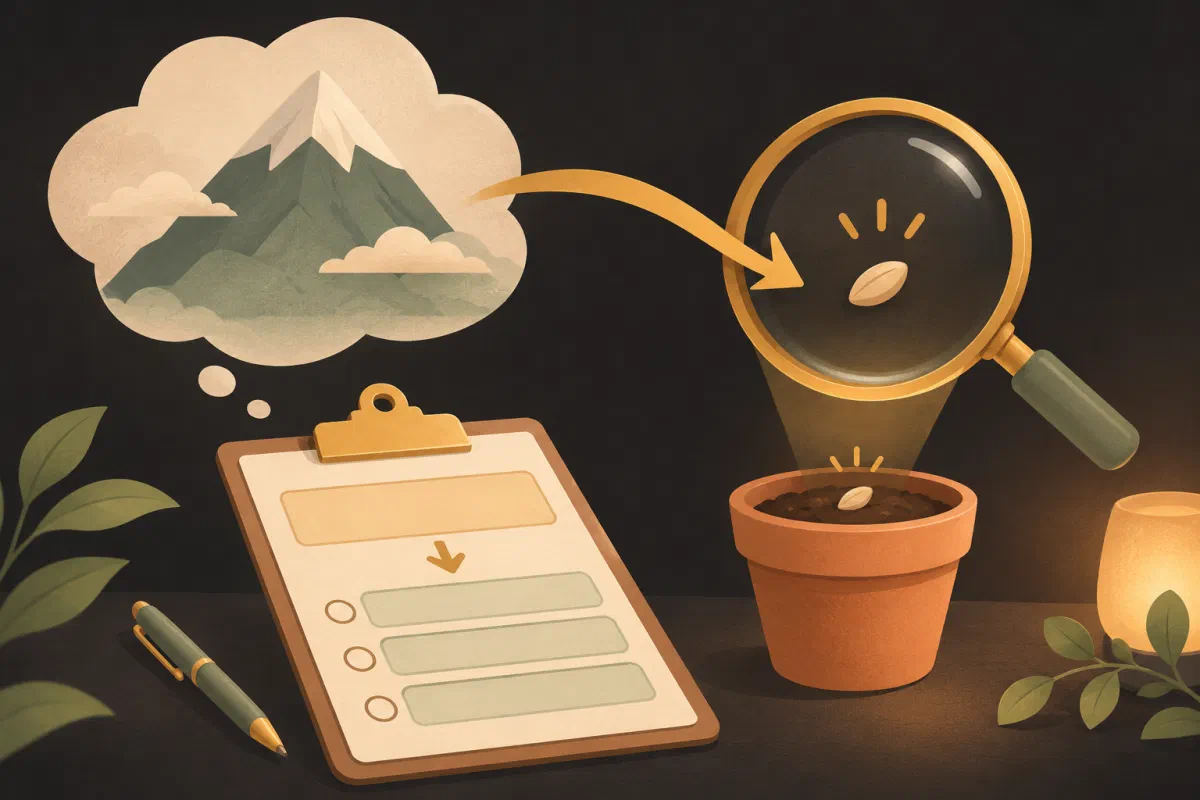
How guilt can keep the procrastination loop going
Guilt feels like it should motivate you. Sometimes it does. Sirois and Pychyl note that being aware of the gap between where you are and where you meant to be could, in principle, fuel a correction. With procrastination, they argue, that bad feeling often becomes disconnected from its useful role and drives avoidance instead. Three patterns from their review are worth recognising:
- Regret avoidance. After missing the ideal moment, returning to the task reminds you of the lost opportunity, so you avoid it to avoid the regret. The review describes how this “inaction inertia” can keep a cycle of doing nothing going.
- “If only” and “at least” thoughts. Thinking “if only I had started sooner” highlights what to change but also brings guilt and self-blame. Thinking “at least it wasn’t a disaster” repairs your mood, but often at a cost to your motivation next time.
- Self-generated stress. Ruminating over past procrastination has been linked to negative mood and distress. The authors conclude that negative feelings about your own procrastination may promote rather than prevent further delay.
Practical guidance points the same way. The University of North Carolina Writing Center notes that people who procrastinate tend to be self-critical, and that punishing yourself every time you notice a delay will not help you change, while rewarding progress will. If this sounds like your week, our guide to the procrastination cycle and where to break it maps the whole loop.
Useful guilt or stuck guilt? A quick decision table
Not every guilty thought is the same. The table below is our practical framing, based on the patterns described in the Sirois and Pychyl review: some thoughts point to a specific change, others only pass a verdict on you.
| What the thought sounds like | What it is doing | What to do next |
|---|---|---|
| “If only I had blocked time on Monday.” | Points to a specific change | Turn it into one if-then plan for tomorrow. |
| “I always do this. I’m hopeless.” | Judges you, not the plan | Write one forgiving sentence, then pick a 10-minute first step. |
| “I can’t open the file, it’ll show how late I am.” | Avoiding regret | Open the file with a 10-minute limit. The goal is to look, not to finish. |
| “At least nobody noticed.” | Repairs mood, lowers motivation | Let the relief land, then add one concrete next step. |
| “I should feel bad so I don’t do it again.” | Uses guilt as a punishment | Swap punishment for a small reward after you start. |
What self-compassion research says
Self-compassion means taking a kind, accepting, connected and mindful approach to your own flaws and setbacks. It is not the same as excusing the delay. Several lines of research link it to less procrastination:
- People who procrastinate tend to be harder on themselves. A meta-analysis of four studies, reported by Sirois and Pychyl, found that procrastination was associated with lower self-compassion (average r = −0.31). In Sirois’s 2023 review, low self-compassion helped explain why procrastination goes with higher stress, and self-compassion is described as something that can be built through short programmes or self-help exercises.
- Forgiving yourself was followed by less procrastination. In a study by Wohl, Pychyl and Bennett, as summarised by the British Psychological Society, 134 first-year students reported how much they had forgiven themselves for procrastinating before their first midterm exams. Those who had forgiven themselves reported less negative mood between exams and procrastinated less before the second round.
- Kindness did not make people lazier. In four experiments by Breines and Chen, people encouraged to treat a failure with self-compassion spent more time studying after failing a difficult test and were more motivated to change a weakness than people in comparison conditions.
How strong is this evidence? It is promising but limited: most samples were university students, and much of the work is correlational or done in the lab. It supports trying a kinder response as a practical strategy, not a promise that self-compassion will end procrastination. Self-compassion exercises are also not a substitute for professional help when you need it.
A 20-minute reset to step out of the guilt loop
Use this when you notice the heavy feeling about a specific task. It combines the ideas above: forgiveness, one concrete if-then plan and a short start.
- Name it (2 minutes). Write: “I delayed [task] because it felt [boring, unclear, scary, too big].” The aim is to turn vague dread into something specific you can work with.
- Forgive the past (2 minutes). Write one sentence, as you would to a colleague: “I put this off, that happened, and I can start now.” You are letting go of the self-blame, not of the task.
- Keep the lesson, not the verdict (2 minutes). Turn any “if only” thought into one if-then plan: “If it is 9:00 tomorrow and I have my coffee, then I will open the report and write the first heading.”
- Shrink the first step (2 minutes). Choose a version you could do in ten minutes: open the file, list three bullet points, reply to one email in the thread.
- Start for ten minutes (10 minutes). Set a timer and do only the small step. Our guide to the 10-minute timer for tasks you are avoiding explains why a short, fixed session lowers the barrier. You can use the free Cyklio Focus Timer.
- Close without grading yourself (2 minutes). Note what you did and what comes next. Record the session, not your worth.
Fill-in template
Copy this into a note and fill it in:
- What I delayed: ______
- The feeling I was avoiding: ______
- One sentence of forgiveness: “I put off ______, and I can start now.”
- If ______ (time and place), then I will ______ (first step).
- The ten-minute version is: ______
- After the session, what I did and what comes next: ______
Worked example: the report that sat for four days
This is an illustrative example, not a real case. Imagine an operations coordinator who planned on Monday to draft a quarterly supplier report due Friday. By Thursday morning the document is still blank. Every time she sees it in her task list she feels a jolt of guilt and switches to email instead, which is the regret-avoidance pattern from the table above.
She runs the reset:
- Name it: “I delayed the report because the data is messy and I don’t know where to begin.”
- Forgive: “I put this off for three days. That’s done, and I can start now.”
- If-then plan: “If it is 10:00 and my meeting has ended, then I will paste last quarter’s headings into the document.”
- Ten-minute version: Paste the headings and write one sentence under each.
- Start: At 10:00 she sets a ten-minute session. She ends with headings and four rough sentences. The guilt is smaller because the task is no longer blank, and the next step is obvious: fill in the first table.
Nothing magical happened. She shortened the distance between intention and action, and she stopped letting the guilt make the task scarier.
When the guilt is more than procrastination
Some delay is a deliberate choice, not a failure, and does not deserve guilt at all. Whether waiting can help is covered in can procrastination be a good thing.
If guilt is not limited to specific tasks, look at the wider picture. The NIMH lists feelings of guilt, worthlessness or helplessness among the possible signs of depression, alongside symptoms such as loss of interest and low energy, and advises talking to a health care provider if signs persist. Our article on procrastination and depression explains how the two connect. If delaying has been a lifelong daily pattern together with trouble focusing and organising, our guide to ADHD and procrastination may help you decide whether to look into it further. For a broader toolkit beyond guilt, see how to stop procrastinating.
Summary
- Procrastination feels bad because you delay something you truly intended to do, and noticing the gap brings guilt, shame and self-blame.
- Research suggests procrastinators do not lack intentions; the plan breaks down between deciding and doing, especially when it is far off.
- Guilt that hardens into self-blame or regret tends to feed more avoidance; guilt turned into one concrete plan can help.
- In mostly student studies, self-forgiveness is linked with less negative mood and less later procrastination, and self-compassion with less procrastination.
Your next step: pick the task that is weighing on you most, write one sentence of forgiveness and one if-then plan, then start a ten-minute session. In Cyklio, our focus timer app from Mindly 360, you can rate it “not today” if it goes badly. That gives you a neutral record instead of another reason for guilt.