

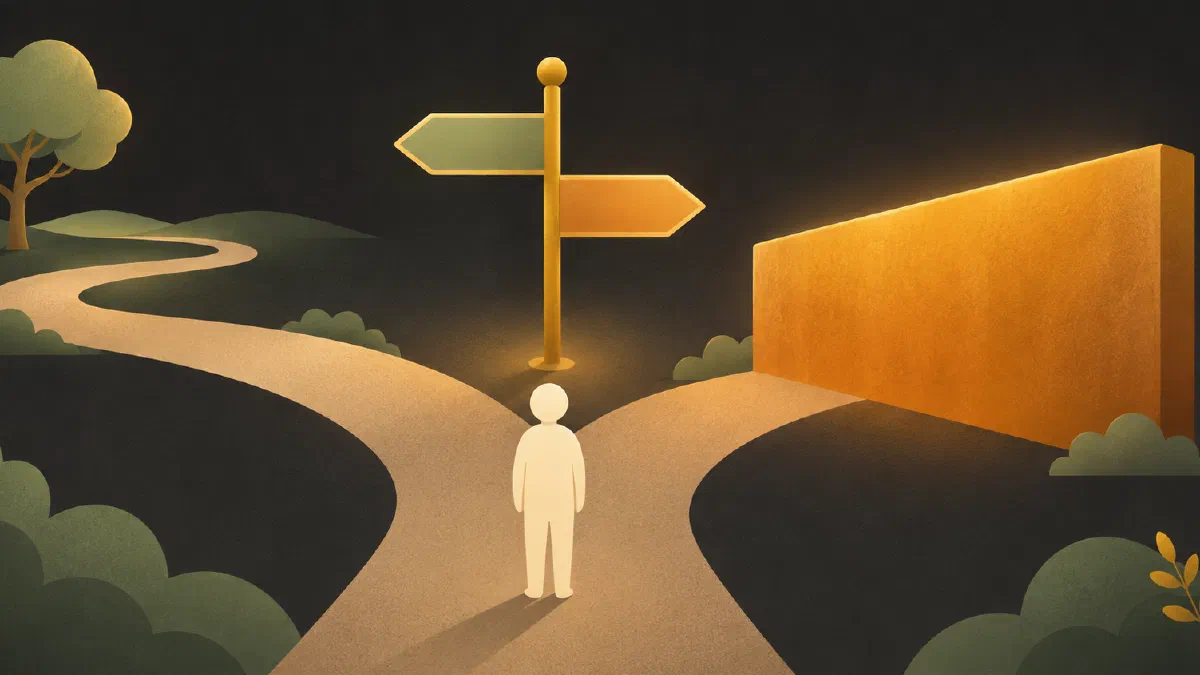
You have two things on your list that have not moved for a week. One is a dull expense report. The other is an email to your manager about a deadline you missed. Both are “not done”, but they probably do not feel the same, and they do not need the same fix. This article explains how procrastination and avoidance differ, where they overlap, and how to pick the right next step for each.
What is procrastination?
The APA Dictionary of Psychology defines procrastination as the unnecessary and voluntary delay of intended tasks, even when you are aware that the delay may cause harm. Psychologist Piers Steel’s meta-analytic review describes it as a common form of self-regulatory failure.
Three parts of that definition matter here:
- You intend to do it. The task is still on your plan. You have not decided to drop it.
- The delay is voluntary. Nothing outside you is stopping you from starting.
- You expect it to cost you. You already know that later will be harder, more rushed or more stressful.
Not every delay is procrastination. Researchers compare procrastination with functional forms of delay, known as strategic delay (Klingsieck, 2013). For example, waiting for a colleague’s numbers before you write a report can be sensible planning rather than procrastination.
Steel’s review found that strong and consistent predictors of procrastination included how unpleasant the task feels (task aversiveness), how far away the deadline or reward is (task delay), low confidence in your ability to do it (self-efficacy), impulsiveness, and conscientiousness with facets such as self-control, distractibility and organisation (Steel, 2007). For a fuller introduction, see what procrastination is.
What is avoidance?
The APA Dictionary of Psychology defines avoidance as keeping away from particular situations, environments, people or things, either because you anticipate a negative consequence of the encounter or because of anxious or painful feelings associated with them. A related entry describes avoidance behavior as any action that lets you avoid or anticipate unpleasant or painful situations.
So avoidance is a wider idea than procrastination:
- It is not limited to tasks. You can avoid a person, a place, a phone call, a topic, a doctor’s appointment or your bank app.
- It does not require an intention. You may have no plan to ever do the thing. Often you would prefer not to think about it at all.
- It is driven by an expected bad outcome or feeling. The point is to not feel the fear, embarrassment or discomfort that contact would bring.
The APA entry also notes that psychology studies avoidance from several angles: as a coping strategy, as a response to fear or shame, as a personality style and as a feature of anxiety disorders. In other words, avoidance is a normal human behaviour, but it can also become part of a mental health problem.
How procrastination and avoidance overlap
They are not opposites. In practice, a lot of procrastination is a form of avoidance.
Psychologists Fuschia Sirois and Timothy Pychyl argue that procrastination often happens when people face tasks they see as aversive, and that it is tied to short-term mood repair and emotion regulation: putting the task off makes you feel better now, while the cost lands on your future self (Sirois & Pychyl, 2013). Seen this way, when you procrastinate you are often avoiding the feeling a task brings up (boredom, confusion, self-doubt) rather than the task itself.
A practical way to hold both ideas:
- Procrastination describes the pattern: an intended task, delayed, at a cost.
- Avoidance describes the function: staying away from something unpleasant or feared.
The two meet when you delay a task because of what it makes you feel. They separate at the edges. You can procrastinate on something you do not fear at all, just because it is dull and the deadline is far away. And you can avoid things that are not tasks and have no deadline, like a conversation you hope will never happen.
Please read the distinctions below as a practical working tool, not as clinical categories. Researchers define the terms, but there is no official checklist for sorting your own to-do list into one box or the other.
How to tell them apart: a decision table
Pick one task you keep not doing and answer each row honestly.
| Question | Leans procrastination | Leans avoidance |
|---|---|---|
| Do you still plan to do it? | Yes, “just not now” | You would rather it disappeared |
| What do you feel when you think about it? | Boredom, heaviness, “ugh” | Dread, anxiety, shame, tightness |
| What exactly are you staying away from? | The effort or the tedium | A feared outcome: judgement, conflict, bad news |
| What happens when the deadline gets close? | You usually start, often in a rush | You may still not start, or keep finding reasons |
| Is it only this task? | Mostly specific tasks | A whole theme: all calls, all money matters, one person |
| What happens when you think about the first step? | It feels tiresome but doable | It feels like the scary part itself |
If most answers fall in the left column, you are probably dealing with ordinary procrastination. If most fall on the right, avoidance is likely doing the work. A mix is common, and it usually means a task that is both tedious and emotionally loaded.

A worked example from a workday
This is an illustrative example, not a real user’s story.
Maya, a project coordinator, has the two tasks from the start of this article.
Task 1: the expense report. She fully plans to do it. Thinking about it brings boredom, not fear: twenty receipts and a clunky form. She knows finance needs it by the end of the month, and she suspects she will do it the day before in a rush. On the table, nearly every answer lands on the left. This is procrastination.
Task 2: the email to her manager. She missed a deadline last week. She tells herself she will write “later”, but every time she opens her inbox she closes it again. What she is staying away from is not typing a few sentences; it is the imagined reply and the feeling of having let someone down. She has also been skipping the team chat. On the table, most answers land on the right. This is avoidance, and it is starting to spread.
The two tasks need different first moves, described below.
One fitting next step for each
If it is mostly procrastination: make the start smaller and timed
When the problem is that the task feels heavy, boring or vague, the aim is to make starting cheaper than delaying.
- Write the first physical action, as specific as possible: “open the expense form and enter the first three receipts”, not “do expenses”.
- Set a short, fixed session, for example 10 minutes, with a clear stop.
- Start the timer and do only that first action. When the time is up, you may stop.
- If you want to continue, set another session. If not, write the next first action down for tomorrow.
A short timed session is a common strategy, not a proven cure. The idea is to make the first step feel less unpleasant and the finish line feel closer. You can use the Cyklio Focus Timer for this. For a complete, step-by-step plan, see how to stop procrastinating, and for everyday situations you might recognise, see these procrastination examples.
If it is mostly avoidance: take one small step toward the feared part
When what you are staying away from is a feared outcome, a smaller task alone often does not help, because the scary part is still waiting. The NHS notes that avoiding situations or relying on habits we think keep us safe may actually make anxiety worse, and that slowly facing up to a situation might help (NHS Every Mind Matters). Doing activities you have been avoiding is also one of the techniques used in cognitive behavioural therapy (NHS).
- Name what you fear will happen, in one sentence: “My manager will think I am unreliable.”
- Choose the smallest step that touches that fear, not the easiest step around it. For Maya: write two sentences of the email and save it as a draft.
- Do that one step, then notice what actually happened compared with what you expected.
- Next time, go one step further: finish the draft, then send it.
If fear is the main reason you delay, our guide to procrastination out of fear goes deeper into why that happens and how to work with it. If you have ADHD and avoidance shows up around many everyday tasks, see ADHD task avoidance.
When to get support
Occasional procrastination and some avoidance are part of ordinary life. It is worth talking to a doctor or another qualified professional if avoidance is spreading across many areas, if you notice strong fear in common situations, or if it starts to stop you from doing things you need to do. The US National Institute of Mental Health notes that in severe cases of anxiety disorders, people may avoid social encounters or refuse to leave their home (NIMH). This article cannot tell you whether that applies to you. If you are wondering whether chronic procrastination itself counts as a condition, see is procrastination a disorder.
Summary
- Procrastination is delaying something you still intend to do, knowing it will cost you.
- Avoidance is staying away from situations, people or things because of an expected bad outcome or feeling. It is broader and does not need an intention or a deadline.
- They overlap whenever you delay a task because of the feelings it brings up.
- Use the decision table to see which one dominates for a specific task.
- For procrastination, shrink the start and time it. For avoidance, take one small step toward the feared part.
Your next step: choose one task you have been putting off, run it through the table, and take the matching first step today. If it is a procrastination task, a 10-minute session is enough. Cyklio, our focus timer app from Mindly 360, lets you set sessions from 10 to 60 minutes and rate each one afterwards, so you can see over a week which starts actually worked.