


You meant to start revising two weeks ago, and now the exam is on Thursday. This guide explains how putting study off differs from cramming, what the research says about last-minute study, and how to make the best of the days you have left.
Procrastination and cramming are not the same thing
The two words often travel together, but they describe different problems.
- Procrastination is about when you start. You intend to study, you know waiting will cost you, and you wait anyway. A large meta-analysis of procrastination research found that people delay most when a task feels unpleasant, when the deadline is far away, when they doubt they can do it well and when they are more impulsive or easily distracted.
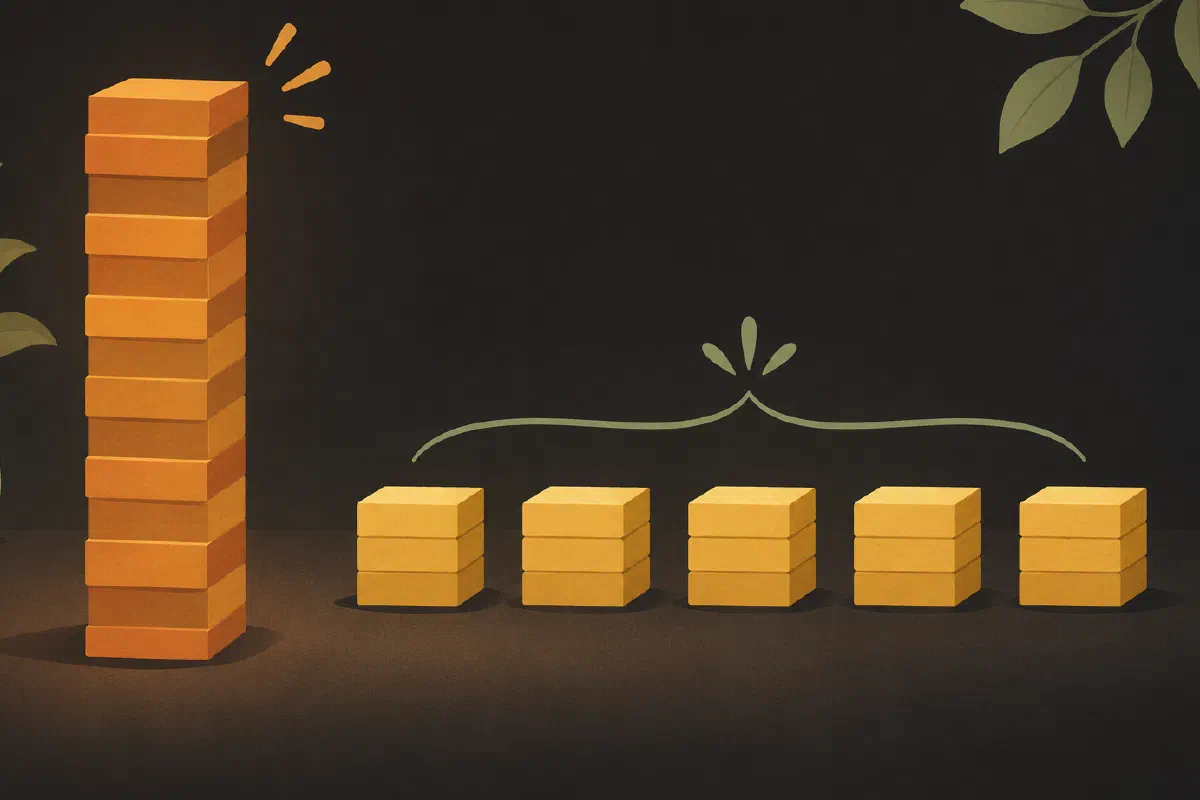
- Cramming is about how you study once time is short. Researchers call it massed practice: all the study for a topic happens in one long block, just before the test, instead of being spread out (distributed or spaced practice).
Procrastination is the most common route into cramming, but not the only one. Some people start on time and still read a whole chapter five times in one evening. Others delay, then study in short, spaced sessions across the last few days. That is why it helps to treat them as two separate levers: start earlier and spread what you do.
If you want to see how delay shows up in everyday life outside study, our guide to procrastination examples covers that.
| Procrastination | Cramming | |
|---|---|---|
| What it is | Delaying the start of a task you intend to do | Studying a topic in one long block close to the test |
| Main cost | Less calendar time left, more stress later | Weaker memory a few days on, especially for long-term use |
| What fixes it | A smaller, scheduled first step | Splitting the same hours across several days |
| Can happen without the other? | Yes, if you then study in spaced sessions | Yes, if you start on time but mass your study |
What the research says about spacing vs massing
The spacing effect is one of the oldest and best-replicated findings in memory research.
- A review and quantitative synthesis by Cepeda and colleagues pooled 839 assessments from 317 experiments. Spaced presentations led to markedly better final-test performance than massed ones, even when the test came less than a minute later. (In these lab studies, “massed” means studying an item in one uninterrupted go, which the authors note is narrower than real-world cramming.) Their analysis also showed that the best gap between study sessions gets longer the longer you need to remember the material.
- A later study of more than 1,350 people by the same group tested this directly. Participants learned facts, reviewed them after a gap of up to 3.5 months and were tested up to a year later. Performance first rose and then slowly fell as the gap grew. The best gap was roughly 20 to 40% of the time until the test when the test was a week away, and roughly 5 to 10% when the test was a year away.
- A major review of ten common study techniques rated distributed practice and practice testing (quizzing yourself) as the only two with high utility. Rereading and highlighting were rated low.
In practical terms: if your exam is a week away, the research suggests that a review roughly two days after you first study a topic is a reasonable target. If you need the knowledge for your job next year, the gaps can be weeks long. The point is not an exact number. It is that some gap, of at least a day, generally beats none.
Why cramming feels like it works
If spacing is better, why does cramming feel so productive? Part of the answer is that massed study creates a strong sense of familiarity. In one experiment on learning to recognise painters’ styles, people learned better when examples were spaced, yet participants rated massed study as more effective, even after their own test results showed the opposite.
A similar gap appears with rereading. In a study comparing rereading with self-testing, repeated studying did better on a test five minutes later, but self-testing produced substantially better memory after two days and after a week. Students also felt more confident after rereading. So the feeling of “I know this” at 1 a.m. is not a reliable guide to what you will remember on Thursday, let alone next month.
What delay itself costs
Procrastination also has costs beyond memory. In a longitudinal study of students, those who procrastinated reported less stress and illness early in the term, but more later on. Overall, they were sicker and got lower grades on all assignments. The short-term relief of putting study off was paid back with interest. For more on how delay feeds stress, see procrastination and stress.
A catch-up plan when you have already put it off
Knowing that spacing works does not help much if the exam is in three days. You cannot go back in time, but you can still spread and test within the time you have. Here is a plan for the last few days.
- List and triage. Write every topic the test covers. Next to each, mark how much it is likely to count and how confident you feel (high, medium, low). Start with the topics that count a lot and that you know least.
- Use every remaining day, not one long block. Even with only two or three days, split the same total hours into shorter sessions on each day. The Cepeda review summarises long-term studies in which squeezing all the study into a single day was worse than leaving a one-day gap between sessions.
- Visit each high-priority topic at least twice. First visit: learn or reread the key points once. Second visit, ideally on a different day: close your notes and test yourself.
- Test, do not reread. Turn headings into questions, cover the answers and write what you remember, then check. This is the practice testing that rated highest alongside spacing. Our guide on how to study with flashcards shows a simple way to set this up.
- Keep sessions short and bounded. Twenty-five to forty-five minutes with a short break is a common way to keep late-stage study from turning into an unfocused all-nighter. Knowing exactly when a session ends can also make it easier to begin.
- Protect the last night’s sleep. A diary study of 535 high school students found that on days when students gave up sleep to study more than usual, they had more trouble understanding material in class and were more likely to struggle with a test or assignment the next day. Stop at a set time the evening before.
- Plan one review after the exam if you will need it again. Research on spaced relearning found that later relearning sessions shrank the gap between material first learned in a massed way and material first learned in a spaced way. If the topic matters for your work or the next module, one or two short review sessions in the following weeks are worth it.
Quick decision table
| Time until the test | What to do |
|---|---|
| 1 day | Short self-test sessions on top-priority topics, a hard stop in the evening and a normal night’s sleep |
| 2–3 days | Two visits per key topic on different days; second visit is always a self-test |
| 4–7 days | Learn a topic, then quiz it again about two days later; add a final mixed self-test the day before |
| 2+ weeks | Plan three short visits per topic spread across the weeks; see how to make a study plan |
An example week: same hours, spaced instead of crammed
Take a hypothetical example. Sam works full time and has a professional certification test next Monday covering four chapters (A, B, C, D). Sam has about five hours of study time in total. The crammed version is easy to picture: nothing until Saturday, then five hours of rereading on Sunday.
Here is the same five hours spread across the week, using the “about two days later” guide from the research above.
| Day | Session (about 40–50 min) | Type |
|---|---|---|
| Monday | Chapter A: read once, write 10 questions | Learn |
| Tuesday | Chapter B: read once, write 10 questions | Learn |
| Wednesday | Chapter A: answer your questions from memory, check; then start Chapter C | Test + learn |
| Thursday | Chapter B: self-test; Chapter D: read once, write questions | Test + learn |
| Friday | Chapter C: self-test | Test |
| Saturday | Chapter D: self-test; mark weak questions from all chapters | Test |
| Sunday | 30-minute mixed quiz on weak questions only; stop by early evening | Test |
Each chapter gets at least two visits, two days apart, and the second visit is always a self-test. The total time is roughly the same as the Sunday cram. What changes is that Sam never has to face five hours in one go, which also makes the first session much easier to start.
If you are juggling study with a job and attention is a constant struggle, our separate guide to study tips for ADHD adapts these ideas further.
Summary and next step
Procrastination decides how much calendar time you have; cramming decides how well you use it. Research on spacing consistently shows that the same hours spread over several days, with self-testing, outlast one massed block. If you are already late, you can still spread what is left across every remaining day, test instead of reread and keep your sleep.
Your next step: write the topics for your next test, pick one, and book a 25-minute self-test session for today and another for two days from now. You can run the sessions with our free focus timer in your browser, or with Cyklio, our app from Mindly 360, which lets you set sessions from 10 to 60 minutes, rate each one and see your study in weekly reports. It has a 7-day free trial with no account or card needed.