


Sometimes the best idea for a stuck project arrives in the shower, on a walk or the morning after you gave up. That is real, and research has a name for it: incubation. This article shows when a pause like that helps, when “I’ll let it simmer” is avoidance, and how to check which one you are doing.
When is procrastination a good thing?
Strictly speaking, procrastination is never the helpful part. Researchers use the word for a delay you choose even though you expect it to cost you. Klingsieck’s widely used definition, quoted in a 2022 review in Psychologica Belgica, describes it as the voluntary delay of an intended and necessary or personally important activity, despite expecting negative consequences that outweigh the positive ones.
What can be good is a deliberate pause that looks like procrastination from the outside. The clearest case is incubation: setting a problem aside after working on it, so that you come back with a fresh angle. People sometimes call this “productive procrastination”. It is a popular phrase, not a research term, and the label only fits when the pause is doing work for you.
The broader question of when waiting pays off, for example while you wait for missing information or deal with a bigger priority first, is covered in can procrastination be a good thing?. Here we stay with creative and open-ended work.
What incubation research actually shows
Incubation has been studied in the lab for decades, usually like this: people work on a problem, take a break of some kind, then return to it. Compared with working straight through, does the break help?
The largest summary is a meta-analysis by Sio and Ormerod. Across 117 studies, they found a positive incubation effect overall, with a few patterns worth knowing:
- Task type matters. The effect was larger for divergent thinking tasks, where you generate many possible ideas, than for linguistic and visual insight puzzles with one right answer.
- Preparation matters. Longer preparation periods before the break went with larger effects.
- The filler matters. Breaks filled with cognitively demanding tasks reduced the effect. For linguistic insight problems, light activity during the break worked better than simply resting.
The size of the benefit is modest. In his review, Gilhooly describes the overall effect from that meta-analysis as low to medium (d = 0.29). Incubation helps; it is not magic.
A well-known experiment by Baird and colleagues looked at what kind of break works. People who did an undemanding task during the break improved on creative problems they had already seen, more than people who did a demanding task, rested or had no break. The gain went with more mind wandering, not with more deliberate thinking about the task.
Two more findings shape the practical advice:
- Expecting to return seems to help. Ritter and Dijksterhuis’s review describes studies in which the break helped when people expected to come back to the task or decision. The same review advises filling the break with something undemanding and very different from the main task.
- The timing evidence is mixed. Some studies find that even a break taken right after reading a problem helps, and results on early versus later breaks differ between idea-generation tasks and decisions.
Researchers still debate why incubation works. Explanations include unconscious processing, rest, and forgetting an approach that was not working, and Ritter and Dijksterhuis note that some related findings held in some experiments but not in others. The practical pattern is more settled than the theory.
Why procrastination can help fuel creativity
Most incubation studies use planned breaks. Shin and Grant asked a bolder question: does ordinary procrastination at work do something similar?
In two experiments in the United States, they tempted participants to procrastinate by making different numbers of funny videos available while they worked on a business problem. In a field study with employees in Korea, supervisors rated creativity. Across these studies, moderate procrastination was linked with more creative ideas than low or high procrastination, an inverted-U pattern. The benefit showed up mainly when people were intrinsically motivated or their job required creativity, and procrastination also predicted lower task efficiency.
So the evidence does not say “put things off and you will be more creative”. It says that a moderate gap, on work you care about, can give ideas time to restructure, while a large gap does not, and you pay for the gap in speed.
Active vs passive delay
A related idea separates people by whether their delay is chosen. Chu and Choi introduced active procrastination, which the Psychologica Belgica review summarises as delay with four features: a preference for time pressure, an intentional decision to delay, meeting deadlines and being satisfied with the outcome. Passive procrastination, in Chu and Choi’s description, is procrastination in the traditional sense: indecision about acting leaves tasks unfinished on time.
The label is disputed. According to the same review, Chowdhury and Pychyl found that active procrastination was not related to a self-report measure of procrastination and concluded it is purposeful delay that cannot be considered procrastination. If you want to know which pattern you tend toward, see the main types of procrastination.
Passive delay usually has a different engine. Sirois and Pychyl argue that procrastination is closely tied to short-term mood repair when a task feels aversive, with the consequences borne by your future self. That is the key difference from incubation: incubation pauses the work, avoidance pauses a feeling. For more on that feeling-driven side, see procrastination vs avoidance.
Incubation or avoidance? The signs side by side
| Sign | Incubation | Avoidance |
|---|---|---|
| Before the pause | You have worked on the problem and can describe where you are stuck | You have not opened it, or only glanced at it |
| Type of task | Open-ended: ideas, writing, design, strategy | Any task, often admin, emails or a hard conversation |
| Reason for the pause | “I want distance from my first approach” | “I don’t feel like it” or no reason at all |
| What fills the gap | Something light: a walk, dishes, routine admin | Something absorbing that keeps the task out of mind |
| Return point | Set: a time, a date or a clear trigger | Vague: “later”, “when I have energy” |
| Feeling during the gap | Neutral or curious; the problem drifts back to mind | Low dread or guilt; relief when you look away |
| When you return | You start quickly and often see something new | Starting is as hard as before, or harder |
One or two avoidance signs do not make you a procrastinator. They tell you which kind of pause this one is.
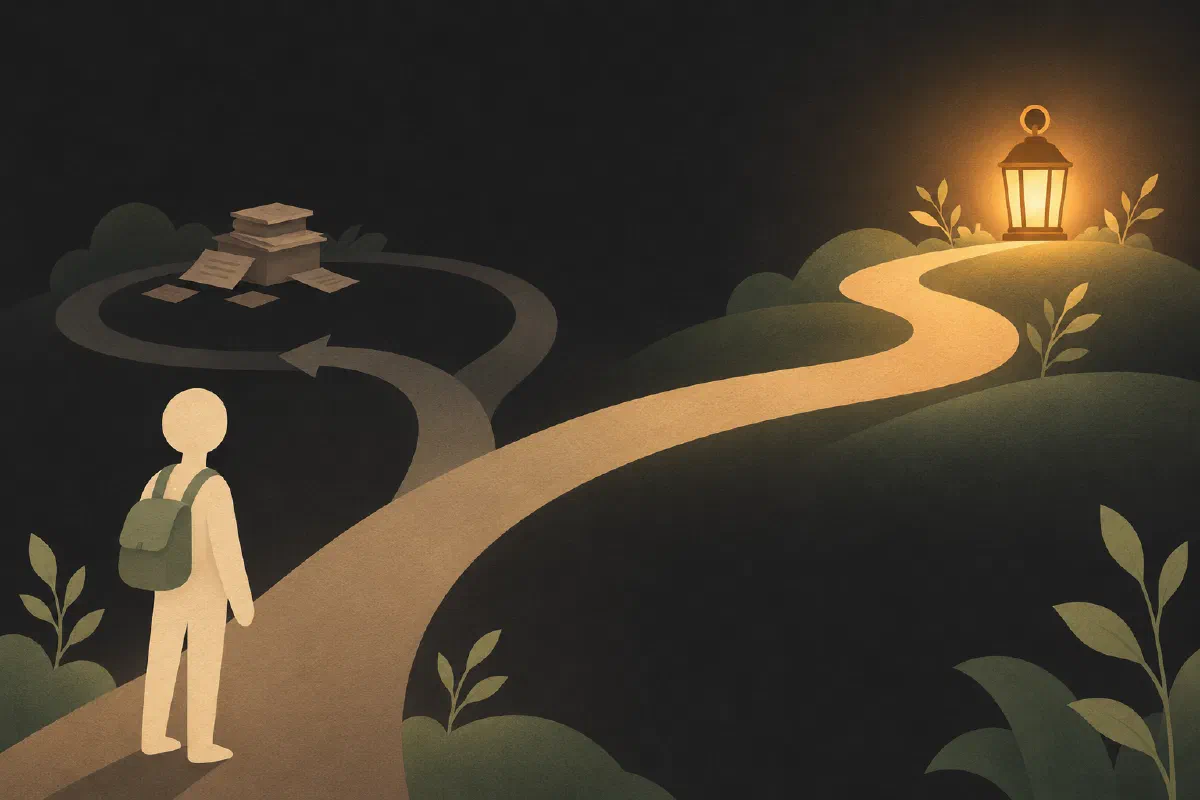
A decision checklist before you step away
Use this for one real task, in your notes or on paper. It takes about two minutes.
- Have I engaged? Write one sentence on what you tried and where you are stuck: ________. If you cannot, work on it for 10 to 25 minutes first.
- Is it open-ended? Does it have many possible good answers (a concept, a draft, a plan) rather than one fixed procedure? Yes / No
- What will the gap contain? Name a light activity that is different from the task: ________. A demanding project does not count.
- When do I return? Date and time, or a trigger such as “after lunch”: ________.
- What does the pause give me? Distance from the problem, or relief from a feeling? ________
- What does waiting cost? Is there a deadline, or someone waiting on you, that makes a long gap expensive? ________
How to read your answers:
- Yes to 1 and 2, a light filler, a set return point and distance as the answer to 5: this is incubation. Put the return point where you will see it.
- No to 1: you are not incubating yet. Do a short first session, then decide again.
- No return point, or relief as the answer to 5: treat it as avoidance. Pick the smallest next step and start it today. Our guide on how to stop procrastinating has strategies for that.
- High cost in 6: keep the pause short, even if it is genuine incubation. The creativity benefit in the research came with lower efficiency.
A worked example: one creative task in a working day
This is an illustrative example, not a real case.
Kasia, a product designer, needs a new layout for a settings screen by Thursday. On Tuesday at 9:30 she spends 30 minutes sketching four versions. None of them works, and she can say why: every version hides the most-used option. That is her one-sentence “where I’m stuck”.
At 10:00 she writes “back at 14:00” on her task, closes the sketches and spends the late morning on expense reports and inbox clean-up, which are light and unrelated. At lunch, walking to the café, the idea of grouping options by frequency instead of by category surfaces. At 14:00 she starts a 25-minute session and has a workable direction within ten minutes.
Compare a Wednesday task on her list: writing a difficult reply to a client. She tells herself she is “letting it simmer”, but she has not drafted anything, there is no return time and she feels relief each time she switches tabs. The checklist flags it as avoidance, so she sets a 10-minute timer and writes a rough first paragraph. If starting itself is the hard part, a 10-minute timer to start a task you are avoiding is one way in.
How to set up a good incubation pause
- Work first. Get far enough into the problem to name what is not working.
- Write where you stopped. One line on your current best idea and the obstacle makes the return faster.
- Choose a light, different filler. A walk, tidying, routine admin. Avoid jumping straight into another demanding problem.
- Set the return point. A calendar slot or a trigger you will actually notice.
- Return with a short session. Do not wait to feel inspired; start and see what the pause produced.
A timer helps at both ends: it marks the end of the first push and makes the return finite. Cyklio, our focus timer from Mindly 360, runs sessions from 10 to 60 minutes and lets you rate each one as full focus, distractions or not today, so over a few weeks you can see which pauses led to a good return. You can also use the free Cyklio Focus Timer in your browser.
Summary
Procrastination is a good thing only when it is really incubation in disguise. Research supports setting a problem aside after you have engaged with it, especially for idea-generating work, and filling the gap with something light. A moderate delay can help creativity, but large delays do not, and delay costs efficiency. If the pause has no return point and mainly brings relief, it is avoidance.
Your next step: pick one task you are currently “letting simmer”, run the six-question checklist and either book the return point or start a 10-minute session on it now.