


“When work calms down.” “After the move.” “Once I’m in better shape.” If the things you care about keep waiting for a better moment, you may be putting your life on hold. This guide explains why someday keeps sliding, helps you see what is actually waiting, and gives you a one-week experiment to take the first small step.
What putting your life on hold looks like
Putting life on hold is not one big decision. It is a long series of small, reasonable-sounding delays that add up. “Someday syndrome” and “living for later” are everyday phrases, not diagnoses, but many people recognise the pattern:
- You have a list of things you will do “when things settle down”, and things never settle down.
- You wait for the perfect time: a new year, a quieter quarter, more money, more energy.
- Plans stay as ideas for years, such as a course, a trip, a creative project or a conversation you keep meaning to have.
- You feel busy every day, yet the things you say matter most get none of that time.
- Thinking about the list brings a dull mix of guilt and “I’ll sort it out later”.
Psychologists describe procrastination as voluntarily delaying something you intended to do even though you expect to be worse off for the delay. Putting life on hold is that same pattern applied to life goals instead of to tasks on a to-do list. Because there is rarely a deadline for “learn to paint” or “change careers”, nothing forces the issue, and the delay can run for years.
Why someday keeps moving
There is usually no single cause. These are the reasons that research and everyday experience point to most often.
Delay feels better now and costs you later
Researchers Fuschia Sirois and Timothy Pychyl describe procrastination as a self-regulation failure driven by short-term mood repair, where the consequences fall on the future self. Starting a big life change brings uncertainty, effort and the risk of failing. Postponing it brings instant relief. The relief is real, which is exactly why the pattern repeats.
Your future self feels like someone else
Work reviewed by Hal Hershfield suggests that people are more willing to make choices that benefit them later when their future self feels similar to who they are now, vivid and realistic. When “future me” is a vague figure who will somehow have more time and discipline, it feels fair to hand them the hard parts.
You are waiting for the right moment
The pull of a perfect start is not imaginary. In three field studies, Dai, Milkman and Riis found that goal-related actions such as gym visits and goal commitments increased after temporal landmarks like the start of a new week, month or year, a birthday or a holiday. The trap is treating only big landmarks as valid. A new week begins every Monday, so you can create a fresh start without waiting for January.
Doing nothing is the easiest default
A review of decision avoidance by Christopher Anderson describes how people avoid decisions by postponing them, failing to act or accepting the status quo, with anticipated regret and difficulty choosing among the key drivers. Staying where you are does not feel like a choice, so it rarely feels like a risk. If you are stuck between several options, our guide to decision paralysis goes deeper.
The goal is too big and too far away
In a large meta-analysis, task aversiveness, a distant payoff, low confidence and impulsiveness were among the strong and consistent predictors of procrastination. “Write a book” scores badly on almost all of these at once: it is unpleasant to start, the payoff is years away and it is hard to feel sure you can do it.
A note for adults with ADHD
If you have ADHD, the distant payoff may weigh even less. A meta-analysis of 25 case-control comparisons found that people with ADHD discounted delayed monetary rewards more steeply than controls, with a medium effect size. That is an average across studies, not a rule for every person, but it fits the experience of long-term goals losing out to whatever is in front of you today.
If fear of failing or being judged is what keeps you stuck, see procrastinating out of fear, which covers that pattern in detail.
What waiting can cost
This is not a reason to panic, but it is worth knowing. A review by Thomas Gilovich and Victoria Medvec found that actions tend to cause more regret in the short term, while inactions cause more regret in the long run. Later work by Shai Davidai and Gilovich found that people’s most enduring regrets more often come from failing to live up to their ideal selves, their hopes and aspirations, than from failing their duties. One reason they give is that people act faster to fix duty-related failures, so the aspiration-related ones are more likely to stay unresolved.
In plain terms: the things you put on hold are often the ones you care about most, and they are also the easiest to keep postponing.
Name what is actually waiting
“I’ve put my life on hold” is too vague to act on. The first step is to write down what, specifically, is waiting. This also has a practical side effect: in a series of experiments, Masicampo and Baumeister found that unfinished goals caused intrusive thoughts, and making a specific plan for them removed those effects. Naming and planning can quiet the background noise even before you act.
Use this template. Give yourself 15 minutes and aim for three to seven items.
| What is on hold | Waiting for… | How long already? | Decision | Smallest next step |
|---|---|---|---|---|
| Keep / Shrink / Release | ||||
| Keep / Shrink / Release | ||||
| Keep / Shrink / Release |
Then give each item one of three decisions:
| Decision | Choose it when… | What it looks like |
|---|---|---|
| Keep | It still matters to you and is realistic now | Schedule a first step this week |
| Shrink | It matters, but the full version is not realistic yet | Pick a smaller version you can start now |
| Release | It no longer fits your life or values | Let it go on purpose, and say so |
Releasing is a valid outcome, not a failure. Research by Carsten Wrosch and colleagues found that being able to disengage from unattainable goals and re-engage in new ones can be associated with higher well-being. A someday item you consciously let go stops costing you guilt every time you remember it.
A worked example (hypothetical). A project manager writes down four items: a career change into UX design, a trip to Japan, restarting the piano and finally calling an old friend. “UX career” has been waiting for three years for “a quieter period at work”. She marks it Shrink: instead of a career change, she will finish one free introductory module. The trip becomes Keep, with a step of 20 minutes to check a realistic date range. The piano becomes Release for now, because the space is used for her child’s desk. The call is Keep, with a step of sending a message on Thursday evening.
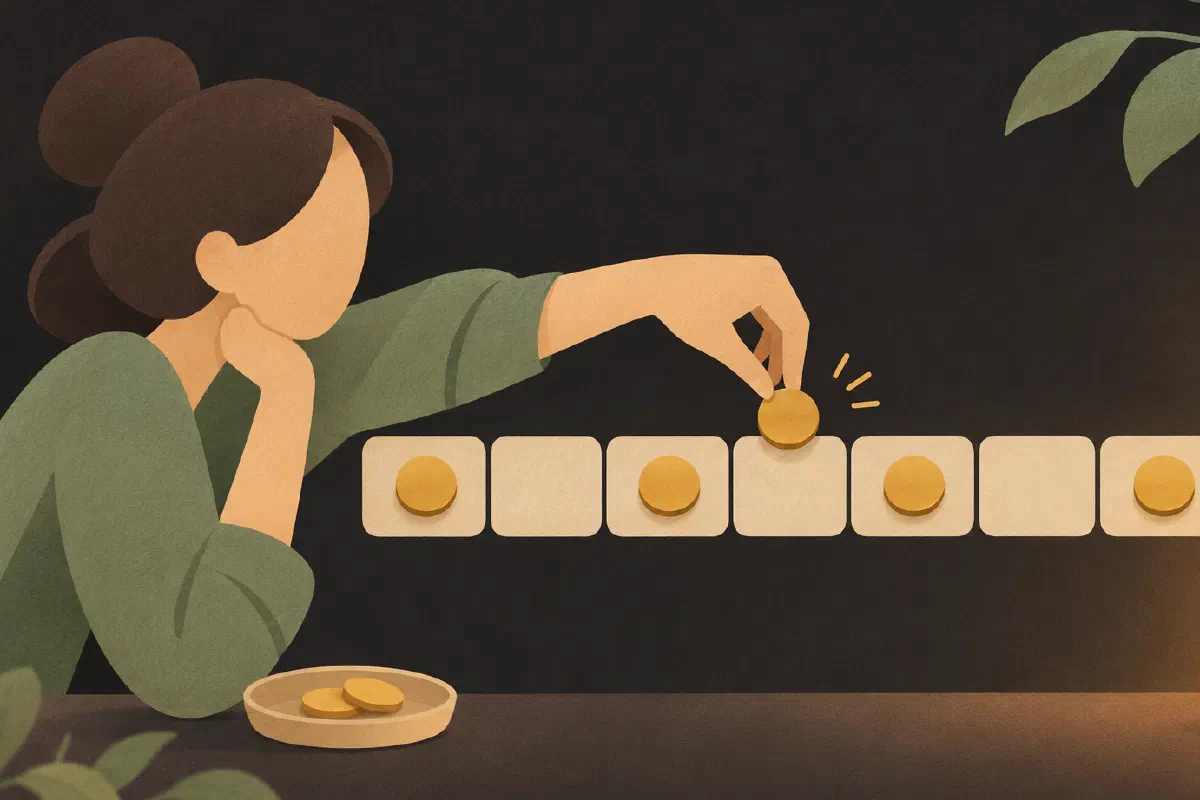
For setting goals that fit your actual week, see how to set realistic goals.
A one-week experiment
Treat this as an experiment, not a promise to change your life. You are testing whether one small, scheduled step makes someday feel less stuck. Pick one Keep or Shrink item and follow this plan:
- Day 1: Choose and shrink. Pick one item. Write the smallest next step that takes 10 to 20 minutes, such as “open the course page and read the syllabus”, not “start the course”.
- Day 1: Make an if-then plan. Write: “If it is Tuesday at 7:30 pm, then I will sit at the kitchen table and do the step.” A meta-analysis by Gollwitzer and Sheeran found that forming such if-then plans had a medium-to-large positive effect on goal attainment, including getting started.
- Day 2 or 3: Do the step with a timer. Set 10 minutes and stop when it ends, even if it went well. Our focus timer works for this, and our guide to the 10-minute timer for starting tasks explains why short sessions help.
- Day 4: Write one line. What did you do, and how did it feel compared with what you expected?
- Day 5 or 6: Take the next step. Plan it the same way: a time, a place and a 10 to 20 minute action.
- If you skip a day, forgive it and continue. A missed day is information, not proof that the plan failed. Note in one line what got in the way, then pick the next time slot.
- Day 7: Review. Look at your template again. Keep going, shrink further, or release. Choose the next item only if the first one is moving.
If you want a broader toolkit for everyday procrastination, our guide on how to stop procrastinating collects strategies for tasks of every size.
When it is more than postponing
Sometimes putting life on hold sits alongside persistent low mood, loss of interest in things you used to enjoy, or feeling that nothing is worth starting. That is a different situation from everyday postponing, and this article is not the right tool for it. Our article on procrastination and depression explains how the two connect, and a doctor or another qualified professional can help you work out what is going on.
Summary
Putting your life on hold usually grows out of small, understandable delays: relief now, a distant future self, waiting for the perfect start and the easy default of doing nothing. You do not need a dramatic reset to change it. Write down what is waiting, decide to keep, shrink or release each item, and test one small step for one week.
Your next step: fill in the template above tonight, pick one item, and schedule a 10-minute first step for this week. If a timer helps you start, Cyklio, our focus timer app from Mindly 360, has a 7-day free trial with no account or card needed, and lets you rate each session so you can see how the week went.