

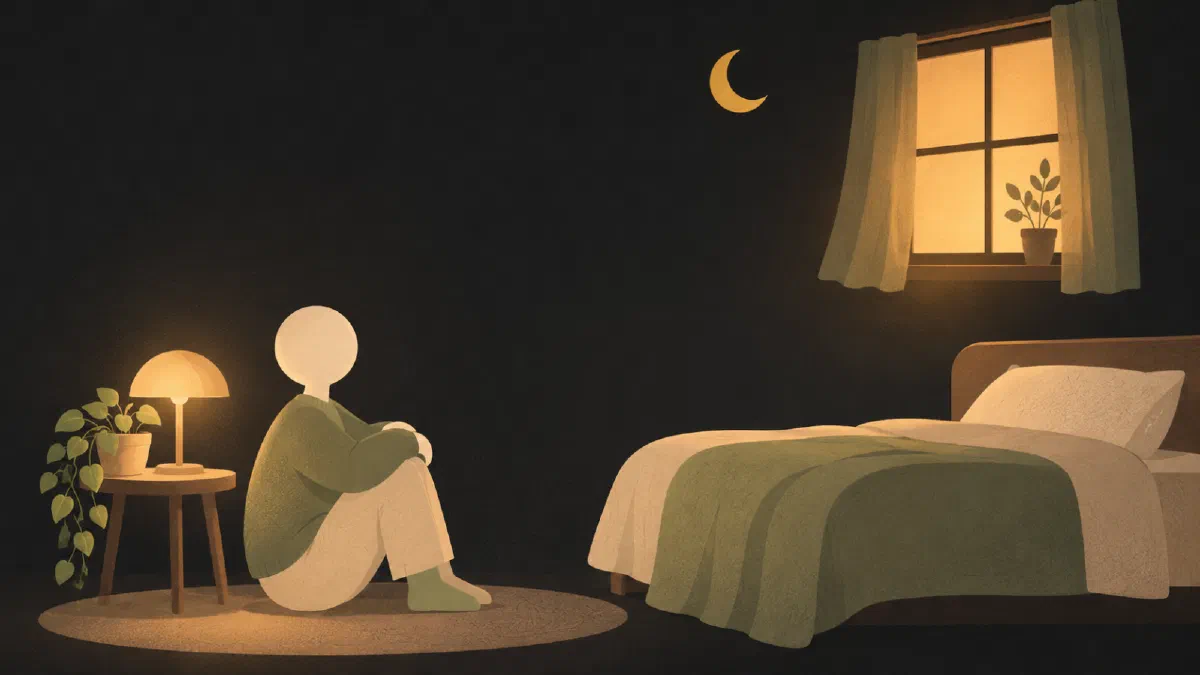
It is 11:40 pm, you are tired, you have an early start, and you are still scrolling, watching or reading. You know you should go to bed. You just do not want the day to end yet. This article explains what is going on, why it shows up after demanding days, and how to take back free time earlier so the night does not have to pay for it.
What is revenge bedtime procrastination?
Revenge bedtime procrastination is the habit of staying up later than you planned, not because something keeps you awake, but because the late evening is the first time all day that feels like your own.
The studies cited here do not use the word “revenge”. They call the behaviour bedtime procrastination, defined in the first study on the topic as failing to go to bed at the intended time while no external circumstances prevent you from doing so. That definition has three parts worth noticing:
- You had an intended bedtime. You meant to sleep earlier.
- Nothing outside you stopped you. No crying baby, no night shift, no emergency.
- You delayed anyway. The gap between intention and action is what makes it procrastination.
The “revenge” part is a popular label rather than a research term. It captures the feeling behind the delay: a sleep medicine psychologist at Cleveland Clinic describes it as using bedtime to do what you want at the expense of a good night’s rest, with feelings such as frustration at keeping up a demanding schedule or feeling powerless over your days among the drivers. It is a useful everyday term, not a diagnosis.
You may also see it called revenge sleep procrastination, sleep procrastination or simply revenge procrastination. They all point to the same pattern.
How it differs from simply not being able to sleep
Bedtime procrastination is about not going to bed, not about lying in bed unable to sleep. If you go to bed on time and then stay awake for a long time, night after night, that is a different problem and is covered in the section on when it might be something else below.
Why it happens after demanding days
Most people who stay up late “for revenge” are not careless about sleep. They usually know they are tired. Research points to a few overlapping reasons why the evening wins anyway.
Your day used up your self-control
In one survey study of 218 adults, people who reported resisting more desires during the day were more likely to report bedtime procrastination and longer delays in going to bed. The effects were small to moderate, and the design cannot prove cause and effect, but the pattern is familiar: a day of saying “not now” to breaks, snacks, messages and your own preferences leaves you with little appetite for one more “not now” at bedtime.
The same authors draw a practical conclusion: simply buckling down and exerting more self-control is unlikely to succeed, so they suggest helping people with pre-decided action plans and avoiding overburdening them at the end of a long, hard day. That is the logic behind the plan later in this article.
A large review backs up the link with self-control. A 2022 systematic review and meta-analysis of 43 studies found that bedtime procrastination was moderately associated with lower self-control and with an evening chronotype (being more of a “night owl”). The authors rated the overall quality of evidence as low and called for better studies, so treat these as consistent associations rather than proven causes.
The evening is the only time you control
Work psychologists who study how people unwind and recuperate from work during leisure time distinguish four recovery experiences: psychological detachment from work, relaxation, mastery and control.
If your workday, commute and household tasks are all decided by other people or by obligations, the hour after everyone else is asleep may be the only time you get to decide for yourself what you do. Staying up becomes a way of getting it back. This is an interpretation that fits the “revenge” feeling, not a finding from a bedtime study, but it explains why “just go to bed earlier” can feel like losing the last scrap of your day.
Not all late nights are the same
In interviews with 17 frequent bedtime procrastinators, researchers found three different patterns:
- Deliberate procrastination: choosing to stay up to get personal time.
- Mindless procrastination: losing track of time during an evening activity.
- Strategic delay: going to bed late on purpose because you expect to fall asleep faster. The authors note that some people in this group may have undiagnosed insomnia.
The authors suggest these distinctions may help in designing better interventions. In practice, each pattern points to a different first step. Deliberate delay needs more free time earlier. Mindless delay needs a stop signal. Strategic delay may need a conversation with a doctor.
Screens make the evening longer
Screens are not the cause of bedtime procrastination, but they make it easy. In a study comparing the two, people who read on a light-emitting e-reader in the hours before bedtime took longer to fall asleep, released less melatonin, had a later body clock and felt less alert the next morning compared with reading a printed book. Endless feeds and autoplay also remove natural stopping points, which feeds the “mindless” pattern above. If your day job is also on a screen, reducing screen time when your job is on a screen covers that side in more depth.
What staying up late costs you
The cost is not just feeling groggy. In the 2022 meta-analysis, bedtime procrastination was moderately associated with shorter sleep, poorer sleep quality and more daytime fatigue. The first bedtime procrastination study also found that it was related to reports of insufficient sleep, above and beyond demographics and general self-regulation.
How much sleep is enough? The American Academy of Sleep Medicine and the Sleep Research Society recommend that adults aged 18 to 60 get seven or more hours of sleep per night. The CDC uses the same figure for that age group, and notes that getting enough sleep can improve attention and memory, lessen the risk of motor vehicle crashes and lower the risk of chronic conditions such as type 2 diabetes, heart disease, high blood pressure and stroke.
There is also a quieter cost: the next day starts tired, so it feels harder, so you resist more urges, so the evening feels even more precious. Many people recognise this as a loop. The loop is not a character flaw. It is a predictable result of a day that leaves no room for you.
Revenge bedtime procrastination and ADHD
If you have ADHD, this pattern may sound familiar. Research specifically on bedtime procrastination in ADHD is still limited, so it is worth being careful about what is and is not known.
What reviews do report:
- A systematic review of 62 studies found that ADHD is consistently linked with a later chronotype, with later timing of evening melatonin onset and sleep onset.
- The National Institute of Mental Health lists sleep problems among conditions that often occur alongside ADHD, and describes ADHD as involving difficulty paying attention, staying on task and staying organised.
- Separately, bedtime procrastination is associated with evening chronotype and lower self-control in the general population.
Putting those together, it is plausible that ADHD makes the pattern more likely, through a later body clock and through difficulty stopping an absorbing activity. But that is an inference, not a tested finding, and staying up late is not a sign that you have ADHD. If you already have a diagnosis and want a routine built around it, the ADHD bedtime routine guide goes into ADHD-specific wind-down steps, and ADHD and sleep summarises what research says about the link. Questions about medication and sleep belong with your prescriber, not a blog.
Find your pattern: a quick decision table
Before changing anything, notice which kind of late night you are having. Think about the last three nights you stayed up later than planned, and pick the row that fits best.
| What it feels like | Likely pattern | First thing to try |
|---|---|---|
| “This is the only time that is mine.” You know it is late and choose to stay up. | Deliberate delay | Move some chosen free time earlier in the day (next section). |
| “Where did the last hour go?” You meant to stop after one episode or a few minutes. | Mindless delay | Add an external stop signal and pick leisure with a natural end. |
| “I was too wired or drained to start getting ready.” Brushing teeth feels like a big task. | End-of-day depletion | Do the bedtime prep earlier, while you still have energy. |
| “If I go to bed now, I will just lie awake.” | Strategic delay | Keep a short sleep diary and, if it lasts, talk to a doctor. |
| “My mind is racing about tomorrow.” | Unfinished work spillover | End work with a clear stop and a written list for tomorrow. |
Most people have a main pattern and a secondary one. Start with the main one.
Protect your leisure earlier in the day
If the core of the problem is that the late evening is your only free time, the most direct fix is to make sure it is not. This does not mean filling your day with self-improvement. It means giving yourself small pieces of time that are genuinely yours, before the night.
1. Find one protected pocket before evening
Look for 15 to 30 minutes that could belong to you: part of a lunch break, the first half hour after work, the time right after dinner. Put it in your calendar like a meeting. The important word is chosen: you decide what happens in it.
2. Give work a visible finish line
Free time leaks away when work has no clear end. Decide a stop time, and in the last 10 minutes do a short shutdown: note where you left off, write the first task for tomorrow, close the tabs. Writing down tomorrow’s tasks is also an NHS tip if worries keep you awake. A planned end makes it easier to switch into evening mode with something left in the tank.
3. Make evening leisure real leisure
If your evening is mostly household jobs and half-attention to messages, it does not feel like rest, so you go looking for rest at midnight. Try to keep at least one block of the evening for something you actually enjoy and that lets you mentally switch off from work (psychological detachment is one of the four recovery experiences above). If you find it hard to rest without feeling guilty or restless, how to rest when your brain will not switch off has ideas for low-effort, restoring activities.
4. Lighten the load where you can
If you are regularly too drained to go to bed, that is information about your days, not just your nights. Researchers suggest avoiding overburdening people at the end of a long, hard day. Look for one recurring evening task you could move, share or drop. If exhaustion has been building for weeks, the pattern may be part of something bigger; procrastination and burnout covers the warning signs.
A wind-down plan for the last hour
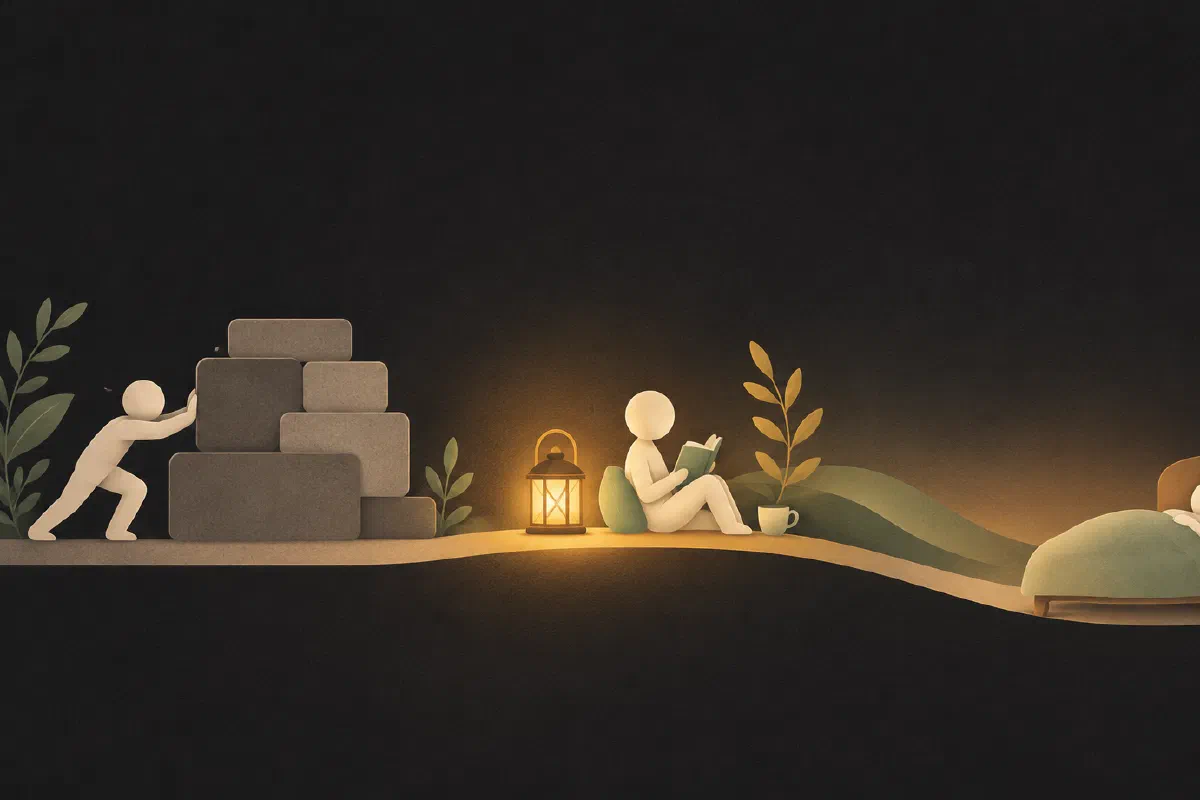
Protecting time earlier reduces the pull of the late evening. The second half of the fix is a small, pre-decided plan for the hour before bed, so you are not relying on willpower when you have the least of it.
One approach that has been tested in trials is implementation intentions: if-then plans that link a specific cue to a specific action. In two randomised trials with university students, an online exercise combining mental contrasting with implementation intentions increased commitment to reduce bedtime procrastination compared with control exercises, and this corresponded to fewer minutes of bedtime procrastination per night. The participants were students, so results in working adults may differ, but the method is simple and costs nothing.
Step-by-step plan
- Set a target bedtime you can actually reach. Start with 15 to 30 minutes earlier than your current average, not two hours. Keeping similar bed and wake times every day, including days off, is recommended by both the CDC and the NHS.
- Set a wind-down alarm, not just a wake-up alarm. Put an alarm 60 minutes before your target bedtime. That is your cue to start the plan, not to go to sleep immediately.
- Do the boring prep first. Teeth, face, clothes for tomorrow, phone on the charger. Doing it at the start of the hour means depletion cannot block it later.
- Switch to leisure with an end. One episode instead of autoplay, a chapter of a printed book, a podcast episode, a short call. Activities with a natural stopping point help with the mindless pattern.
- Move screens out of the last part of the evening. The CDC suggests turning off electronic devices at least 30 minutes before bedtime; the NHS suggests avoiding phones, tablets and computers for about an hour before bed. Pick whichever you can keep.
- Make the bedroom easy to sleep in. Quiet, dark and cool, as the NHS recommends.
- Go to bed when the plan ends, tired or not. If you are not sleepy yet, a calm activity in dim light is fine. The goal of this plan is to end the delay, not to force sleep.
For a fuller routine that also covers tidying up and preparing for the next day, see how to build a night routine.
Fill-in template: my if-then bedtime plan
Copy this into your notes and fill it in once. Short, specific answers work best.
- My target bedtime this week: ________
- If my wind-down alarm goes off at ________, then I will ________ (first prep step).
- If I notice I am reaching for another episode or another scroll after ________, then I will ________ (for example, put the phone in the kitchen).
- If I feel I have not had any time for myself today, then tomorrow I will protect ________ minutes at ________ (time of day) for ________ (activity).
- The one obstacle most likely to keep me up is: ________. If it happens, then I will ________.
The “obstacle” line is the mental contrasting part: you picture what usually gets in the way, then decide in advance what you will do about it.
Worked example: one working adult’s week
The following is an illustrative example, not a real person or a study result.
Maya works in a busy support team. Her days are back-to-back tickets and meetings, she picks up her child at 5:30 pm, and after dinner, homework and bath time, it is 9:30 pm before she sits down. She usually stays up until about 12:30 am watching shows, and her alarm goes off at 6:45 am.
Using the decision table, she sees her main pattern is deliberate delay (“this is my only time”) with some mindless delay (autoplay).
What she changes:
| Change | When | Why |
|---|---|---|
| A 20-minute walk alone with a podcast | Lunch break, three days a week | A chosen pocket of free time before evening |
| A 10-minute work shutdown with tomorrow’s first task written down | 4:50 pm | Work has a visible end, fewer thoughts about tickets at night |
| Wind-down alarm | 11:00 pm, target bedtime 12:00 am for week one | A 30-minute step earlier, not a big jump |
| Teeth and clothes for tomorrow first | 11:00 pm | Prep happens before she is too drained |
| Autoplay off, one episode only | After 11:15 pm | A natural end to the evening |
Week two: she moves the target bedtime to 11:30 pm. Some nights she still stays up, especially after hard days. Instead of judging herself, she writes “hard day” in her notes and protects a slightly longer lunch walk the next day. The goal is fewer late nights, not perfect nights.
When it might be something else
Bedtime procrastination describes a choice to delay going to bed, and this article does not cover sleep disorders. Some signs suggest it may be worth getting checked rather than only working on habits.
The NHS advises seeing a GP if changing your sleeping habits has not helped, you have had trouble sleeping for months, or poor sleep is making it hard to cope with daily life. Also consider talking to a doctor if:
- You go to bed on time but regularly lie awake for a long time.
- You delay bedtime mainly because you expect to lie awake, the “strategic delay” pattern that researchers say may reflect undiagnosed insomnia.
- You feel very tired during the day even when you do get enough hours in bed.
- Low mood, anxiety or exhaustion are building alongside the late nights.
If you have ADHD and take medication, talk to your prescriber about sleep rather than changing anything yourself.
Summary and your next step
Revenge bedtime procrastination is staying up later than you meant to because the late evening feels like your only free time. Researchers call it bedtime procrastination, and a 2022 review links it with lower self-control, an evening body clock, shorter and poorer sleep and more daytime fatigue. It tends to show up after demanding days, which is why more willpower at midnight rarely works.
What does help:
- Work out your main pattern: deliberate, mindless, depleted, strategic or spillover.
- Protect a small, chosen pocket of free time earlier in the day.
- Give work a visible finish line so the evening starts on time.
- Use a one-hour wind-down plan with an alarm, prep first and leisure that ends.
- Fill in the if-then template once and adjust it weekly.
Your next step: today, set a wind-down alarm for 60 minutes before the bedtime you want, and choose one 15-minute pocket of free time for tomorrow. If long work blocks are what squeeze out your day, you can try running tomorrow’s work in clear sessions with the free Cyklio Focus Timer, or in Cyklio, our own app, which has a 7-day free trial with no account or card needed, so work has a defined end and the evening is yours earlier.