


High school asks you to keep five or six subjects moving at once, usually on top of sport, a job or family duties. The fix is rarely more hours. It is a simple weekly routine that does three things: puts study at a fixed time, turns your notes into something you can test yourself on, and brings each topic back a few times before the test.
What actually works: test yourself and spread it out
If you only change two habits, change these.
A large review of ten common study techniques by Dunlosky and colleagues (2013) rated only two as highly useful: practice testing (quizzing yourself, flashcards, practice questions) and distributed practice (spreading study over several sessions). Elaborative interrogation (asking yourself “why is this true?”), self-explanation and interleaved practice (mixing different problem types) received moderate ratings. Summarization, highlighting and rereading were among the five techniques rated low. As the Association for Psychological Science summary puts it, these are some of the most common strategies students use, yet they seem to provide minimal benefits to learning.
Testing yourself feels harder than rereading, and that is part of the point. In a classic experiment by Roediger and Karpicke (2006), students who took recall tests on a text remembered more after two days and after a week than students who simply restudied it, even though the restudying group felt more confident. Restudying came out ahead only on the test given five minutes later.
The authors of the review also add an honest caveat, reported by the Association for Psychological Science: these techniques are not a cure-all and help most when students are motivated and able to use them. That is why the rest of this article is about the routine that makes them easy to use. If getting started is your real problem, read how to get motivated to study first.
Step 1: Give studying a fixed daily slot
A routine removes the nightly decision about whether, when and what to study. Pick one slot on school days and keep it.
- Choose the time. Right after a snack when you get home, or after dinner, whichever you can protect most days.
- Choose the length. 30 to 60 minutes on most school days is a realistic start. If an hour feels long, split it into two 25-minute blocks with a short break between them.
- Choose the place. The same desk or table every day, with what you need already there.
- Decide the first task the night before. Write one line, such as “Biology: cue questions for Tuesday’s notes”. That way the slot starts with doing, not deciding.
- Keep homework and study apart in your head. Homework is due tomorrow; study is what you do so you will still know it in three weeks. Your slot should include a little of both.
A timer helps you keep the slot honest: start it, work until it ends, stop. You can use the free Cyklio focus timer in your browser.
Step 2: Take notes you can quiz yourself on
Most class notes are written once and reread later, which is exactly the low-value habit described above. The Cornell method fixes this by building a quiz into every page. The University of Cincinnati Learning Commons describes the layout like this:
- Notes column (right, the widest part). In class, write short sentences and abbreviations. Leave gaps so you can add details later.
- Cue column (left, about 2.5 inches wide). After class, write questions or keywords that match each chunk of notes.
- Summary. After class, write the main points of each page in a few lines so you can find them quickly later.
To review, cover the notes column and answer the cue questions out loud, then check. The same source says quizzing yourself like this helps you see how much you really know and limits the studying you need to do at the end of term.
A worked example from one biology lesson:
| Cue column (after class) | Notes column (in class) |
|---|---|
| What does the mitochondrion do? | Makes most of the cell’s usable energy (ATP) |
| Plant cell vs animal cell: 3 differences? | Plant: cell wall, chloroplasts, large vacuole |
| Why can’t animal cells photosynthesise? | No chloroplasts |
Summary: “Cells share basic parts; plants add a wall, chloroplasts and a big vacuole.”
The cue questions also work well as flashcards: question on the front, answer from the notes column on the back.
Step 3: Build review cycles into the week
Distributed practice simply means you meet the same material several times with gaps in between. How long should the gaps be? In a study of more than 1,350 people learning facts, Cepeda and colleagues (2008) found that the best gap between first learning and review depended on how far away the test was. For a test about a week away, the best gap was roughly 20 to 40 percent of that time, so a review one to three days after learning. For tests months away, longer gaps worked better.
For a high school week, that translates into three simple review cycles:
- Same day (5 to 10 minutes per subject). Write the cue questions and summary for today’s notes. This is light and quick.
- End of week (20 to 30 minutes in total). Cover the notes for everything from this week and answer the cue questions. Mark the ones you missed.
- Before each test (spread over several days). Start about a week before. Test yourself on the missed questions first, then mix in older material and practice problems of different types.
A sample high school week
Here is one way the routine fits into an ordinary week with five subjects and one test on the following Monday. Adjust times to your timetable; the pattern matters more than the exact minutes.
| Day | Homework | Same-day review | Extra study block |
|---|---|---|---|
| Monday | 30 min | Cue questions for today’s classes (10 min) | None |
| Tuesday | 30 min | Cue questions (10 min) | Self-test on Monday’s notes (10 min) |
| Wednesday | 30 min | Cue questions (10 min) | Practice problems for next Monday’s test (20 min) |
| Thursday | 30 min | Cue questions (10 min) | Flashcards from Tuesday and Wednesday (10 min) |
| Friday | Light or none | Cue questions (10 min) | Weekly review: cover all notes from this week (25 min) |
| Saturday | Off or catch-up | None | Optional: one block on the hardest subject (25 min) |
| Sunday | Plan the week (10 min) | None | Test prep: missed questions plus mixed practice (30 min) |
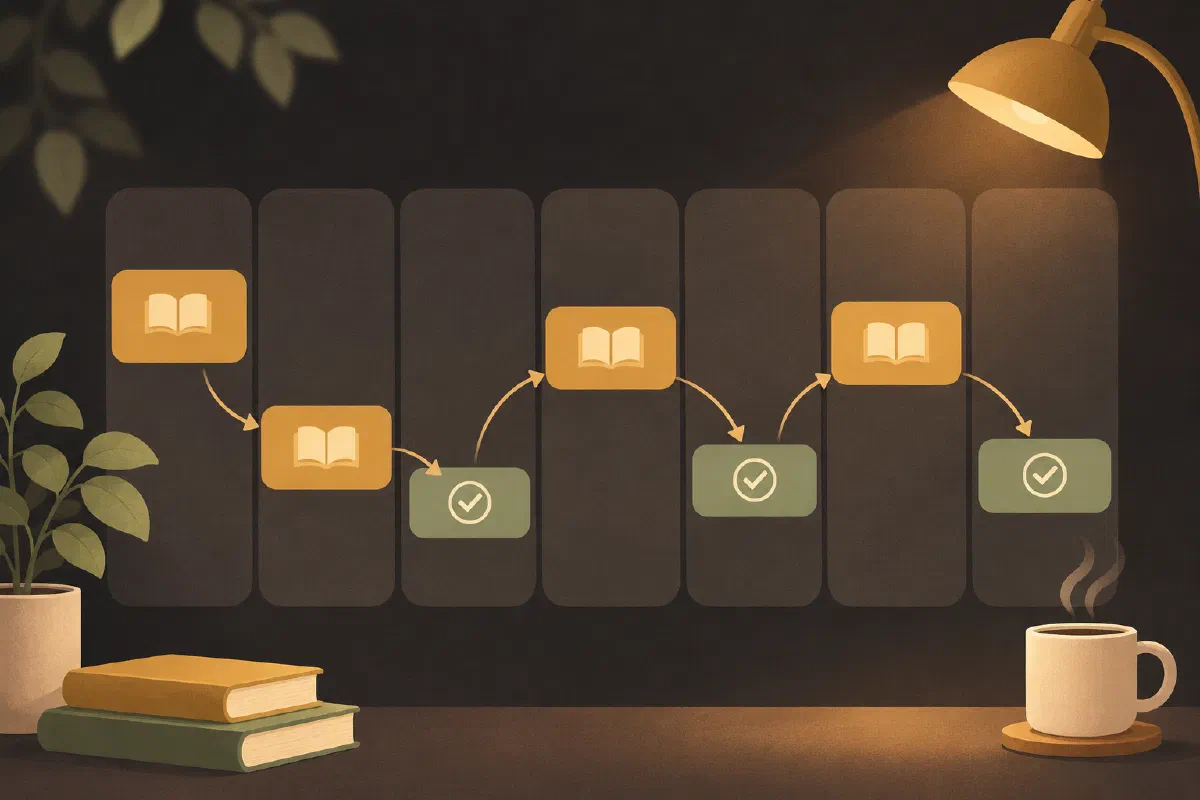
Notice what is missing: there is no three-hour session the night before the test. The Monday test material comes up on Wednesday, Friday and Sunday, each time with a gap of a day or two. If you want to turn this into a fuller plan with your own subjects and test dates, see how to make a study plan.
How to run one 45-minute study session
Use this plan for a typical weekday evening.
- Minute 0 to 2: set up. Phone in another room or face down out of reach, water on the desk, today’s notes open.
- Minute 2 to 12: same-day review. Fill the cue column and summary for the classes you had today.
- Minute 12 to 32: homework or practice. One task only. If it is a test subject, do practice questions without looking at the answers first.
- Minute 32 to 37: break. Stand up, stretch, get a drink. Avoid starting a video you cannot stop.
- Minute 37 to 44: self-test. Cover the notes from two days ago and answer the cue questions. Mark anything you missed.
- Minute 44 to 45: close. Write tomorrow’s first task on a sticky note.
Sleep is part of the study plan
A routine that runs until midnight defeats itself. The CDC recommends 8 to 10 hours of sleep per day for teens aged 13 to 17. Most do not get it: in the CDC’s 2025 youth survey, only 24 percent of high school students slept at least 8 hours on an average school night. The same page says sufficient sleep supports students’ ability to focus at school, and that too little sleep can make concentrating harder.
Practical consequences for your routine:
- Set a study cut-off time, for example an hour before bed, and treat it like the end of a class.
- Keep a similar sleep schedule on school nights and weekends, as the CDC’s guidance on student sleep suggests.
- Limit screens in the evening. The same CDC page recommends limiting light exposure and technology use at night, for example by keeping devices out of the bedroom.
If you regularly cannot sleep, feel exhausted despite enough hours, or feel low for weeks, talk to a parent, school nurse or doctor.
Common mistakes and quick fixes
| Mistake | Why it hurts | Quick fix |
|---|---|---|
| Rereading notes until they “feel familiar” | Feeling confident is not the same as remembering, as the experiment above showed | Cover the notes and answer the cue questions |
| Highlighting whole pages | Rated low-utility in research reviews | Turn each key point into a question instead |
| One long session the night before | No spacing, and it eats into sleep | Start test prep about a week ahead in short blocks |
| Studying only the subject you like | Weak subjects stay weak | Put the hardest subject first in the slot |
| No plan for the session | Time goes on deciding what to do | Write the first task the night before |
| Doing only one type of problem in maths | Real tests mix problem types | Mix older and newer problem types in practice |
When this routine is not quite the right fit
This article covers a general high school routine. Some situations need a different approach:
- ADHD or attention difficulties: see study tips for ADHD for strategies built around attention and starting tasks.
- College or university: lectures, reading loads and self-directed study change the picture; see study tips for college students.
- Online or remote classes: see online study tips.
- Nursing school: see study tips for nursing school.
Summary and one next step
A simple weekly routine beats occasional marathon sessions. Study at the same time most days, take Cornell-style notes with questions in the left column, review the same day and at the end of the week, and start test prep about a week before. Test yourself instead of rereading, and protect your sleep.
Your next step: tonight, pick your study slot and run one 25-minute session that ends with five minutes of self-testing on today’s notes. If you want to track whether the routine holds, Cyklio, our focus-timer app from Mindly 360, lets you set a daily goal in hours, run sessions from 10 to 60 minutes and rate each one, with a 7-day free trial and no account needed.