


You sit down to answer “one quick email” and look up to find the meeting started ten minutes ago. Or you know the drive takes twenty minutes, yet you leave with five to spare, every single time. Many people, especially adults with ADHD, call this time blindness. This guide explains what the term means, what research does and does not show, and how to build a few simple outside supports so time stops sneaking up on you.
What is time blindness?
Time blindness is an everyday name for having a weak sense of time: not noticing how much time has passed, underestimating how long things take, and finding future deadlines hard to feel until they are suddenly close.
It is important to be clear about what the term is and is not:
- It is a popular term, not a diagnosis. You will not find “time blindness” as a named symptom in official health information. The NHS page on ADHD in adults lists “finding it hard to organise your time” among inattentive symptoms, and the NIMH guide to ADHD in adults lists “poor time management, planning, or organization”. Time blindness is the community’s shorthand for that experience.
- It is not unique to ADHD. Many people lose track of time when absorbed or underestimate their tasks, as the research below shows. In ADHD, though, trouble managing time is common enough that the official sources above list it among adult symptoms.
- It is not a character flaw. Being late or missing a deadline because time felt shorter than it was is not the same as not caring. The fix is usually a better system, not more guilt.
Common signs people describe
These are the patterns people most often mean when they say “time blindness”. They are descriptions, not a checklist for diagnosing yourself:
- Regularly running late, even for things you care about and planned for.
- Being surprised by how much time has passed (“it’s 4 pm already?”).
- Underestimating how long tasks take, from a shower to a report.
- Feeling that deadlines are either “not now” or “right now”, with little in between.
- Losing hours in an absorbing activity and missing meals, breaks or appointments.
- Struggling to switch from one activity to the next at a planned time.
Is time blindness real? What research says
Researchers do not study “time blindness” under that name. They study time perception: how accurately people judge, produce and compare durations. Here the evidence for ADHD is real but narrower than social media suggests.
The largest summary so far is a 2022 meta-analysis in the Journal of the American Academy of Child and Adolescent Psychiatry. The authors screened 2,266 records and pooled 55 studies comparing people with and without ADHD on timing tasks. They report evidence of a broad range of timing differences in people with ADHD, including more difficulty telling apart very short durations and more variable estimates of intervals lasting a few seconds. They also suggest that attention and motivation play a part in some of these results.
Two limits matter for everyday life:
- The tasks measured milliseconds to seconds. The same meta-analysis focused on short intervals in the lab. How those results translate into missing a train or underestimating a project is less clear.
- Research on adults is still thin. A 2023 review of a decade of research on time perception in adult ADHD found only nine studies that met its criteria. Results were mixed, methods varied a lot between studies, and the author notes there are no validated, standardised tests of time perception. The same review points out that adult ADHD treatment manuals do not specifically address time perception.
So the honest summary is: lab studies, pooled together, find timing differences in ADHD, official sources list trouble managing time among adult ADHD symptoms, and science has not yet fully connected the two. You do not need that connection to be settled to take your own experience seriously and work with it.
If you want to go deeper into explanations and theories, see our guide on what causes time blindness.
Why time slips away, for everyone
Two well-studied effects apply to most people and help explain why time management is hard even without ADHD. They also point straight to useful strategies.
Busy minds judge time as shorter
When you know you are keeping track of time, how much attention you can spare for the clock changes your sense of duration. A meta-analysis of 117 experiments in Acta Psychologica found that when people are timing a period while the task in front of them is more demanding, they judge that less time has passed relative to the real duration, and their judgments become more variable. In plain words: the more a task absorbs you, the less reliable your inner clock becomes.
That is exactly the situation of a focused workday. If your attention is fully on a spreadsheet, it is not on the time. An outside signal does the watching for you.
We underestimate our own tasks
Psychologists call the second effect the planning fallacy. A classic set of studies in the Journal of Personality and Social Psychology explored why people underestimate how long their own tasks will take to complete. In one of those studies, the optimistic bias disappeared when participants were asked to connect their prediction to relevant past experiences.
Writing about this research for the Society for Personality and Social Psychology, psychologist Roger Buehler notes that the bias shows up across small chores and big projects, and that conscientious people and procrastinators both underestimate. He describes three kinds of remedies: comparing with similar past tasks, breaking the plan into smaller parts or planning backwards from the deadline, and committing to specific parts of the task at set times.
Absorbing activities can swallow hours
Many adults with ADHD describe long stretches of intense focus, often called hyperfocus. A 2019 study of over 600 adults found that people with higher levels of ADHD symptoms reported hyperfocus more often, including during hobbies, school work and screen time. When focus is that deep, missing the passage of time is a predictable side effect. We cover this in more detail in what hyperfocus is and how to work with it.
The core idea: make time visible outside your head
If your inner clock is unreliable when you are busy, and your estimates tend to be optimistic, the practical answer is not to try harder to “feel” time. It is to move time out of your head and into your environment, where you can see it.
That idea runs through what adults with ADHD already do. In a qualitative study of 32 adults with ADHD, participants described using checklists, smartphones, electronic calendars and reminder apps to plan and remember tasks and appointments, and the authors describe these coping skills as varying in effectiveness. One participant described being “overly punctual” as a deliberate compensation strategy.
Structured therapy uses the same building blocks. In a randomized trial published in JAMA, 86 adults whose ADHD symptoms continued despite medication received 12 sessions of either cognitive behavioural therapy (CBT) or relaxation with educational support. The CBT group improved more on ADHD symptom ratings, and responders kept their gains at follow-up. A CHADD article describing the published manual for this CBT programme (its 2017 second edition) explains that it teaches people to use a calendar and task list, which it calls cornerstones of staying organised, and to break long, uninteresting tasks into smaller chunks. That trial tested a full therapy programme, not individual tools, but it shows these tools are part of evidence-based care rather than internet tips.
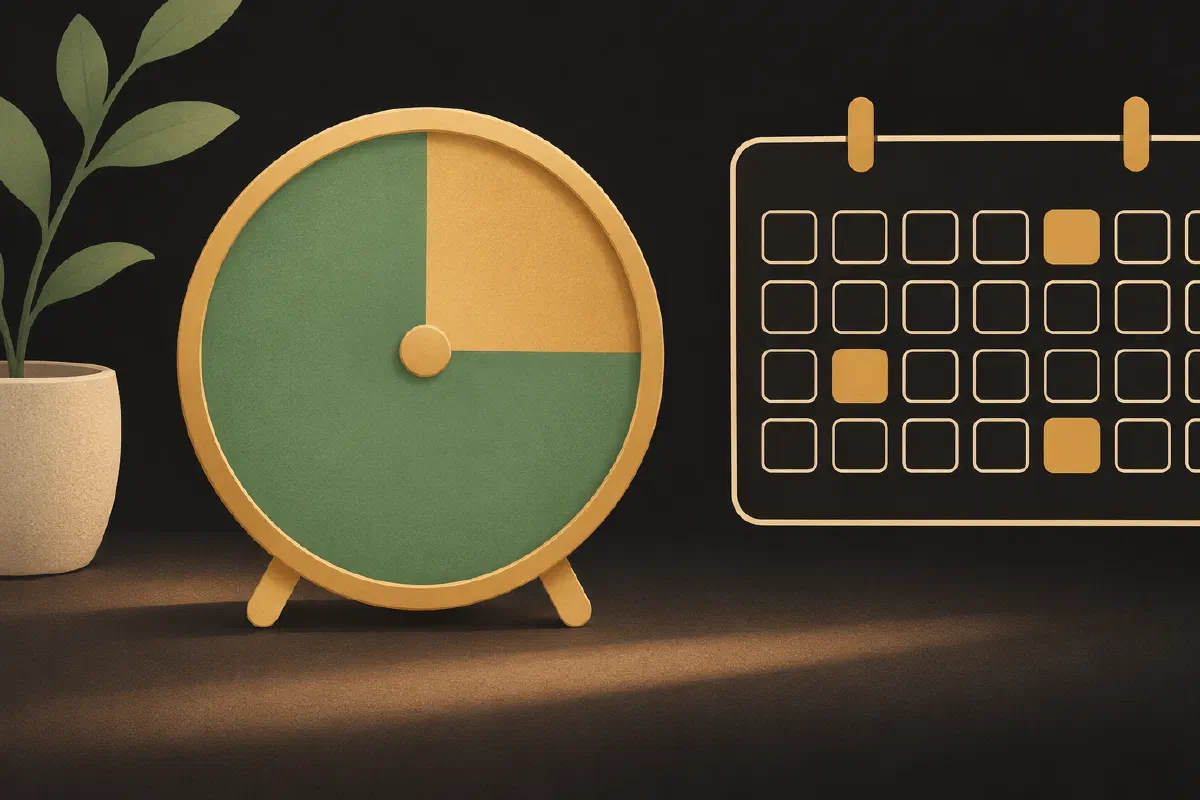
Making time visible usually means three layers:
- Now: how much time is left for the thing you are doing (a countdown).
- Today: what is fixed and when (a calendar with alerts).
- Between: the gaps that always get forgotten (travel, transitions, buffers).
9 practical strategies for time blindness
Some of these draw directly on the research above, as noted where they do. The rest are common practical strategies that follow from it; they are low-risk, but most have not been tested one by one in studies. Pick one or two, not all nine.
1. Put a visible countdown on the current task
A countdown you can see turns “some time” into a shape that shrinks. Set it for the block you intend to work, for example 25 or 40 minutes, and keep it in view. When it ends, decide on purpose: continue, take a break or switch. A free option is the Cyklio Focus Timer in your browser.
2. Keep one calendar for everything fixed, with two alerts
Every appointment, meeting and pick-up goes into one calendar, not three. Give each important event two alerts: one when you need to start getting ready, one when you need to leave or join. The second alert is the one people forget, and it is the one that prevents running late. If you want help designing this, see our guide to an ADHD calendar system.
3. Plan backwards from the moment that matters
Instead of asking “when should I start?”, start from the end and work back. For a 10:00 appointment:
- Arrive and settle: 9:55.
- Travel (your real time, not your best time): 25 minutes, so leave at 9:30.
- Shoes, keys, bag, the forgotten item: 10 minutes, so start getting ready at 9:20.
- Stop what you are doing: 9:15. That is your alarm.
Planning backwards from the deadline is one of the remedies Buehler describes for the planning fallacy, and it makes the hidden steps visible.
4. Estimate first, then measure
Before a routine task, write down how long you think it will take. Afterwards, write down how long it actually took. After a week you will have your own correction factor: maybe “my 15-minute tasks take 25”. This uses the finding that tying predictions to past experience reduces optimism. The template further down makes this easy.
5. Add buffers between things
Back-to-back plans assume nothing runs over. Something always does. Add 10 to 15 minutes between appointments and a larger buffer before anything you cannot be late for. If a buffer goes unused, it becomes a small gift of free time rather than a crisis.
6. Break big tasks into chunks with a time tag
“Write the report” has no visible size. “Outline: 20 minutes”, “Section one: 30 minutes”, “Check figures: 15 minutes” does. Breaking the plan into parts is both part of the CBT programme above and one of Buehler’s suggested remedies. When you start, the chunk sets the length of your countdown. If starting itself is the hard part, our guide to task initiation can help.
7. Turn intentions into “when, then” commitments
Vague plans (“I’ll do it this afternoon”) are easy to lose. A specific commitment (“When my 14:00 call ends, I will open the budget file and work on it for 30 minutes”) gives your future self a clear trigger. Committing to specific parts of a task at set times is the third remedy Buehler describes.
8. Give deep focus an exit alarm
Hyperfocus can be useful, so the aim is not to stop it but to give it an exit. Before you start something absorbing, set an alarm for the time you must stop, and put it somewhere you have to stand up to switch it off. Decide in advance what you will do next, so the alarm leads somewhere.
9. Use transition checkpoints
Many people lose time at the edges: between finishing one thing and starting the next. Pick a few fixed checkpoints in your day, such as after each meeting, after lunch and before leaving work, and at each one look at your calendar and ask “what is next, and when?”. It takes 30 seconds and catches drift early.
Which tool for which time problem?
Use this table to match the strategy to the problem you actually have, rather than adopting a whole new system.
| Situation | What usually goes wrong | First thing to try |
|---|---|---|
| Starting work in the morning | “Just checking” email turns into an hour | Countdown for one named task before opening email |
| Leaving for appointments | Travel time judged from your best day | Backwards plan plus a “stop now” alarm |
| Back-to-back meetings | No time to prepare, everything runs late | 10–15 minute buffers in the calendar |
| Big projects with a deadline | Deadline feels far away until it isn’t | Chunks with time tags, placed on calendar days |
| Absorbing tasks or hobbies | Hours disappear, meals and plans missed | Exit alarm you must stand up to stop |
| Routine chores | “Five minutes” is really twenty | Estimate, measure, apply your correction factor |
| Switching between tasks | Drift between one thing and the next | Fixed transition checkpoints |
A worked example: one Tuesday with time blindness
Here is an illustrative example, not a real case. Maya is a project coordinator. Her Tuesday used to go like this: she opened email at 8:45 “for a minute”, noticed the time at 9:40, rushed into a 10:00 meeting unprepared, then spent the afternoon on a report she expected to take an hour and finished at 18:30, missing the gym class she had booked.
She changed three things, one week at a time.
Week 1: one calendar, two alerts. She moved her personal and work events into one calendar and added a “get ready” alert to every meeting. The 10:00 meeting now has an alert at 9:45: “stop and prepare”.
Week 2: countdown for the first task. At 8:45 she starts a 40-minute countdown for one named task, “draft the supplier summary”, before opening email. When it ends at 9:25 she takes a short break and checks email until 9:45.
Week 3: estimate and measure. She starts writing down estimates for routine tasks. By Friday she sees that her “one-hour” reports take about an hour and forty minutes. She now books two hours for them and splits them into three chunks.
Her Tuesday now looks like this:
| Time | Plan | Support |
|---|---|---|
| 8:45–9:25 | Supplier summary | 40-minute countdown |
| 9:25–9:45 | Break, then email | Calendar alert at 9:45 |
| 9:45–10:00 | Prepare for meeting | Buffer |
| 10:00–11:00 | Team meeting | Checkpoint afterwards |
| 14:00–16:00 | Report in three chunks | Countdown per chunk |
| 17:15 | Stop work | Exit alarm across the room |
| 18:00 | Gym class | Leave-by alert at 17:35 |
Nothing about Maya’s sense of time changed. What changed is that time became something she could see.
Template: estimate vs actual log
Copy this into a notebook or notes app and fill in one line per task for a week. Do not judge the numbers; they are information.
| Date | Task | My estimate (min) | Actual (min) | Difference | What got in the way? |
|---|---|---|---|---|---|
At the end of the week, answer three questions:
- Which kinds of tasks do I underestimate most (writing, chores, travel, admin)?
- Roughly how much longer do they take than I expect? That is your correction factor.
- What interrupted me most often, and can a buffer or a checkpoint catch it?
Then use your correction factor the next time you plan. A 20-minute estimate with a 1.5 factor becomes a 30-minute block in your calendar.
Common mistakes when managing time blindness
- Setting up a perfect system on day one. A complex planner you abandon in a week helps less than one alarm you keep. Add one support at a time.
- Ignoring the alarm “just this once”. If you snooze every alert, your brain learns that alerts do not matter. When an alert fires, take one small action, even if it is only to reset it deliberately.
- Using your best-ever time as your estimate. Plan with your typical time. Your log will tell you what that is.
- Treating lateness as a moral failure. Shame makes it harder to look honestly at the numbers. Curiosity works better: what happened, and what would have caught it?
- Hiding the clock. Time you cannot see is time you cannot track. Keep a countdown or clock in your line of sight while you work.
When to talk to a professional
Practical strategies help many people, but they are not a substitute for an assessment if time problems are part of a bigger pattern. The NHS advises seeing a GP if symptoms affect your studies, work or relationships; the GP can discuss support and may refer you for an assessment with a specialist. Online quizzes and articles, including this one, cannot tell you whether you have ADHD.
If you already have a diagnosis and time management is still hard, it is worth raising with your clinician. NIMH notes that adults may work with a coach to learn executive function skills, and that psychotherapy such as CBT is among the most common treatments. The JAMA trial described above found that a structured CBT programme helped adults whose symptoms continued on medication. Never change a treatment plan on your own; talk to the person who prescribed it.
Summary
- Time blindness is a popular name for a weak sense of time passing and for underestimating tasks; it is not a diagnosis.
- Lab research does find timing differences in ADHD, but it mostly measures seconds, and adult research is still limited.
- Most people judge time less reliably when a task takes up their attention, and most underestimate their own tasks, so outside supports help.
- Make time visible in three layers: a countdown for now, a calendar with alerts for today, and buffers for the gaps between.
- Measure your estimates for a week to learn your own correction factor.
Your next step: choose one task you will do today, estimate how long it will take, and run it with a visible countdown, either in the free Cyklio Focus Timer or in Cyklio, our own app, where you can set a session from 10 to 60 minutes and rate it afterwards. Write down the actual time. That single line is the start of your log.