

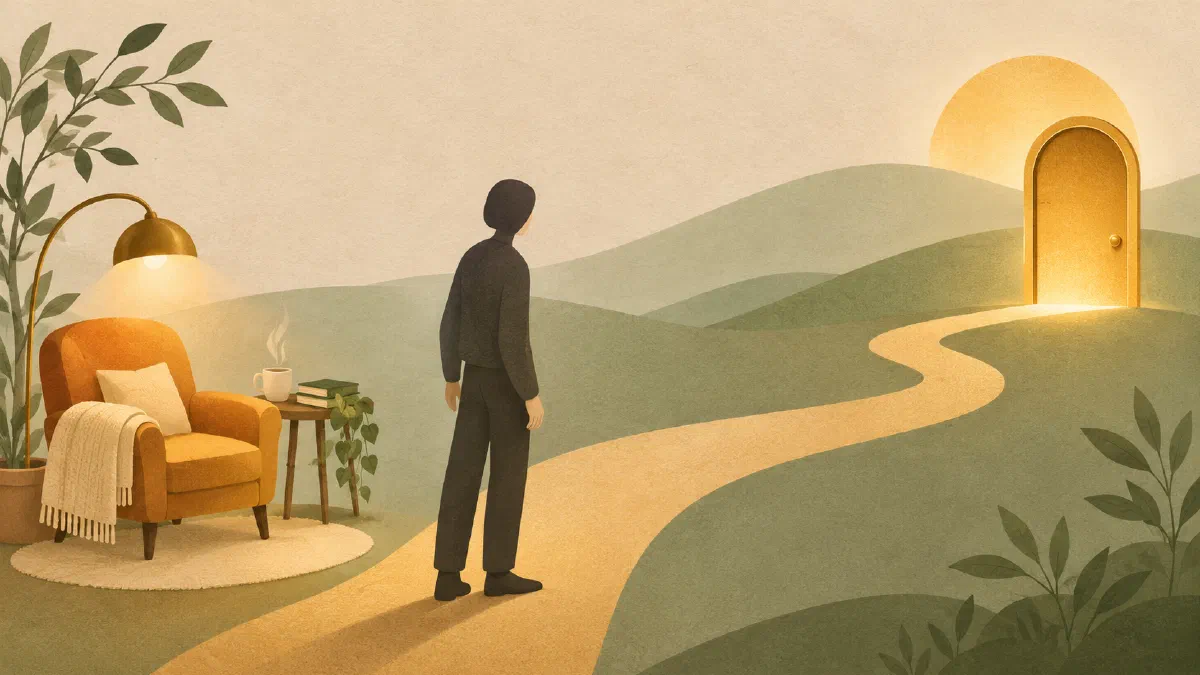
Almost everyone puts things off sometimes, but “procrastination” means something more specific than “doing it later”. This guide gives you a clear definition, the difference between active and passive procrastination, everyday examples from work and study, and the reason it is not the same as being lazy.
Procrastination meaning: a clear definition
A widely cited research definition comes from psychologist Piers Steel’s review in Psychological Bulletin: to procrastinate is to “voluntarily delay an intended course of action despite expecting to be worse off for the delay” (Steel, 2007). A more recent review by Fuschia Sirois describes it in similar terms, as the voluntary and unnecessary delay of important, intended tasks, even when you recognise the delay will cause harm to yourself or others (Sirois, 2023).
The word itself is old. Steel notes that it comes from the Latin pro, meaning “forward”, and crastinus, meaning “of tomorrow” (Steel, 2007). Literally, it means pushing something forward to tomorrow.
Put simply, a delay counts as procrastination when all four of these are true:
- You delay starting or finishing something. It can be a task or a decision.
- You intended to do it. It is on your own list, not just one of the thousands of things you could be doing.
- The delay is your choice. Nobody and nothing is stopping you right now.
- You expect the delay to cost you. More stress later, a rushed result, a missed chance or an annoyed colleague.
That last point is what makes procrastination feel so uncomfortable: you can see the cost coming and still not start.
What procrastination is not
Because the definition is specific, plenty of delays do not count. Steel points out that tying procrastination to an intended action keeps it separate from simple decision avoidance, where you meant to wait all along (Steel, 2007). He also notes that the word is sometimes used positively, for useful delay such as waiting for more information, but that this sense is secondary (Steel, 2007).
Use this table to check a delay you have in mind:
| Situation | Intended? | Your choice? | Expect to be worse off? | Procrastination? |
|---|---|---|---|---|
| You planned to draft the report this morning, then spent two hours on email and feel worse for it | Yes | Yes | Yes | Yes |
| You postpone a decision until next week’s sales figures arrive | Yes | Yes | No, waiting helps | No, planned waiting |
| You stop work at 6 pm, tired, and do the task tomorrow as planned | Yes | Yes | No | No, rest |
| A system outage stops you from submitting the form | Yes | No | Yes | No, an external block |
| You drop a task that no longer matters after a priority change | No longer | Yes | No | No, reprioritising |
| You keep “researching” a presentation you dread instead of opening the slides | Yes | Yes | Yes | Yes, it just looks productive |
The quick test: if you meant to do it, could do it now, expect the delay to hurt, and still are not doing it, that is procrastination.
Active vs passive procrastination
A well-known split into two types comes from a 2005 study by Angela Hsin Chun Chu and Jin Nam Choi (Chu and Choi, 2005). They described two kinds of procrastinators:
- Passive procrastinators are procrastinators in the traditional sense. The authors describe them as paralysed by indecision and failing to finish tasks on time.
- Active procrastinators prefer to work under pressure and make a deliberate decision to delay.
| Passive procrastination | Active procrastination | |
|---|---|---|
| How the delay happens | Paralysed by indecision about acting | A deliberate decision to delay |
| Timing and pressure | Often fail to finish tasks on time | Prefer to work under pressure |
| Most similar to | The traditional picture of procrastination | People who do not procrastinate, in that study |
In their results, active procrastinators procrastinated to the same degree as passive ones, but were more similar to non-procrastinators in how purposefully they used time, their control of time, their belief in their own ability, their coping styles and outcomes including academic performance (Chu and Choi, 2005).
Two cautions are worth keeping in mind. First, this was one study, and the outcomes it measured included academic performance, not results at work. Second, it is not clear that “active procrastination” is procrastination at all. Under Steel’s definition, a delay you choose because you expect it to work out fine is not procrastination, and he groups this kind of delay with the positive, secondary sense of the word (Steel, 2007). A practical way to read it: if your delay is a real plan and the results are good, it is strategy. If you call it a plan but feel stressed and keep rushing, it is probably the passive kind.
Researchers also distinguish chronic procrastinators, who have ongoing problems finishing tasks, from situational ones, who delay depending on the task itself (APS Observer, 2013).
Procrastination examples at work and study
Procrastination rarely looks like lying on the sofa. More often it looks busy. These are typical patterns, offered as illustrations rather than research findings.
At work:
- Answering every small email before opening the one hard document.
- Rewriting a to-do list instead of starting the first item on it.
- Saying yes to a colleague’s quick request so the difficult call can wait.
- Waiting for “a clear afternoon” to start a big proposal that never gets one.
- Polishing the formatting of a slide deck while the main argument is still missing.
In study or training:
- Making a beautiful revision timetable and not following it.
- Re-reading notes because it feels easier than practice questions.
- Starting an assignment the night before, then rushing the parts that needed thought.
- Watching “just one” related video instead of writing the first paragraph.
An illustrative workday
Imagine a project coordinator who plans to write a budget summary first thing on Tuesday. At 9:00 they open their inbox “for five minutes”. At 10:30 they tidy the shared drive. At 11:30 they help a colleague with a spreadsheet. By lunch the summary is untouched, and there is a heavy, guilty feeling in the background. Every single action was useful. The day still fits the definition: the summary was intended, nothing prevented it, and they expected the afternoon to be more stressful because of the delay.
Spotting this pattern is the first step. For many more cases, see our collection of procrastination examples from daily life and work.
Why procrastination is not the same as laziness
From the outside, procrastination and laziness can look identical: the task is not getting done. The difference is inside. In everyday use, calling someone lazy suggests they do not want to make the effort. A procrastinator does want the task done; it is, by definition, something they intended to do.
Research points to feelings rather than lack of effort. Sirois and Pychyl argue that procrastination “has a great deal to do with short-term mood repair and emotion regulation”, with the consequences “typically borne by the future self” (Sirois and Pychyl, 2013). In other words, avoiding the task makes you feel better now and leaves the cost for later. Sirois’s 2023 review describes procrastination as poor mood regulation in the form of avoidant coping: a way of avoiding difficult emotions tied to a task (Sirois, 2023).
The same picture appears in Steel’s meta-analysis of 691 correlations. Among the strongest and most consistent predictors of procrastination were how unpleasant the task feels, how far away the deadline or reward is, low confidence in your ability, and impulsiveness (Steel, 2007).
Researcher Joseph Ferrari has said that procrastination has “nothing to do with time-management”, and Timothy Pychyl calls emotional regulation “the real story around procrastination” (APS Observer, 2013). Time management skills still matter, but they solve a different problem; our guide to time management skills covers them. The University of North Carolina’s Writing Center puts the laziness question plainly: procrastinating does not mean you are inherently lazy or inefficient; it is a habit with a specific origin that can be overcome (UNC Writing Center).
This matters because the label shapes the response. If you believe you are lazy, the obvious fix is to push harder or criticise yourself. If procrastination is mostly about escaping an uncomfortable feeling, a better response is to make the first step smaller and less threatening. We look at this question in more depth in is procrastination laziness?, and at the main causes in why we procrastinate.

How common is procrastination?
Very common, and for some people it is a long-term pattern. Estimates cited in Steel’s review suggest that 80% to 95% of college students procrastinate, and that procrastination chronically affects about 15% to 20% of adults (Steel, 2007). Ferrari’s work similarly suggests that up to 20% of people may be chronic procrastinators; as he puts it, everybody may procrastinate, but not everyone is a procrastinator (APS Observer, 2013).
It also tends to cost more than it seems at first. In a study of students by Dianne Tice and Roy Baumeister, procrastinators reported less stress early in the term but ended up with lower grades and more stress and illness overall (APS Observer, 2013). So the relief of putting something off is real, but short-lived.
Summary and one next step
- What it is: voluntarily delaying something you intended to do, while expecting to be worse off for it.
- What it is not: rest, planned waiting, reprioritising, or delays you cannot control.
- Types: passive procrastination is the classic, stressful kind; “active procrastination” is deliberate delay that works, and under Steel’s definition it is closer to strategy than to procrastination.
- Examples: often busy-looking, such as email, tidying and easy tasks in place of the important one.
- Not laziness: it is mostly about avoiding an unpleasant feeling now, at the expense of your future self.
One next step: pick one task you are putting off right now and check it against the four points in the definition. If it passes, do not try to finish it. Commit to just ten minutes on its very first step. You can use any timer, or Cyklio, our focus timer app from Mindly 360, which lets you start a 10-minute session and rate afterwards how it went. When you are ready for more, our guide on how to stop procrastinating has practical strategies to try next.